
Now Reading: Observations Of Atmospheric Helium And Oxygen With SPHEREx
-
01
Observations Of Atmospheric Helium And Oxygen With SPHEREx


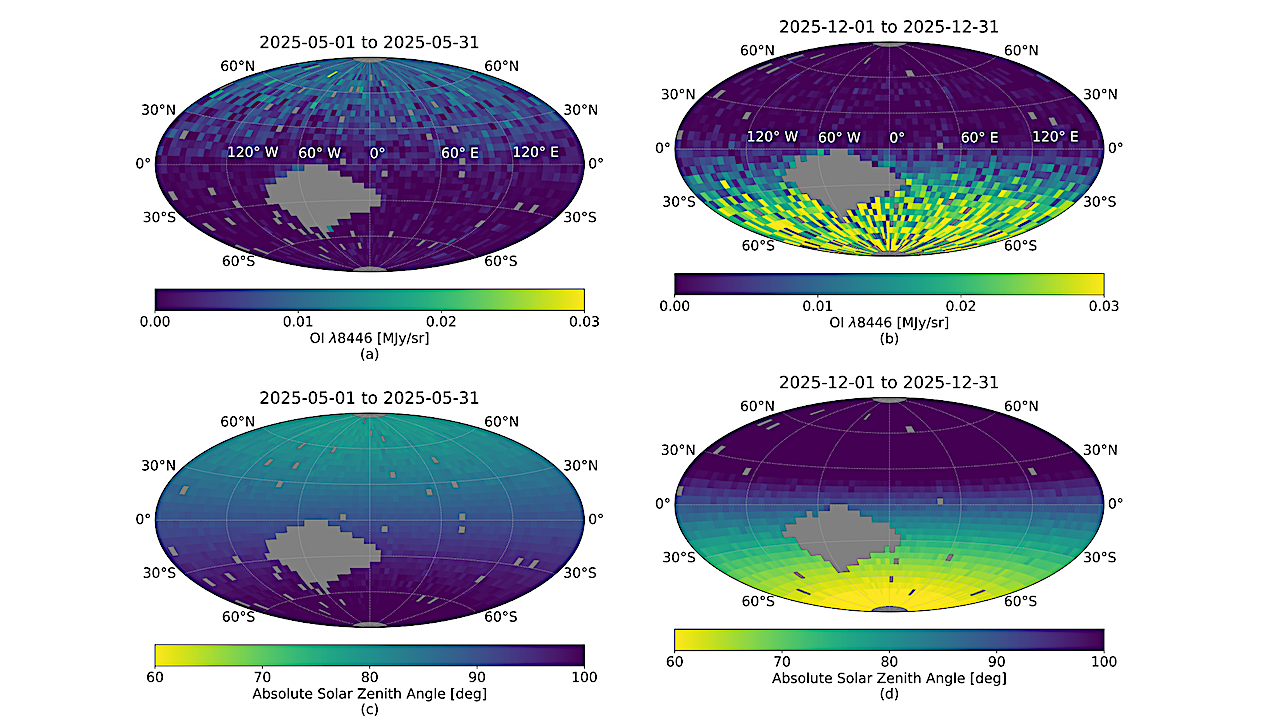
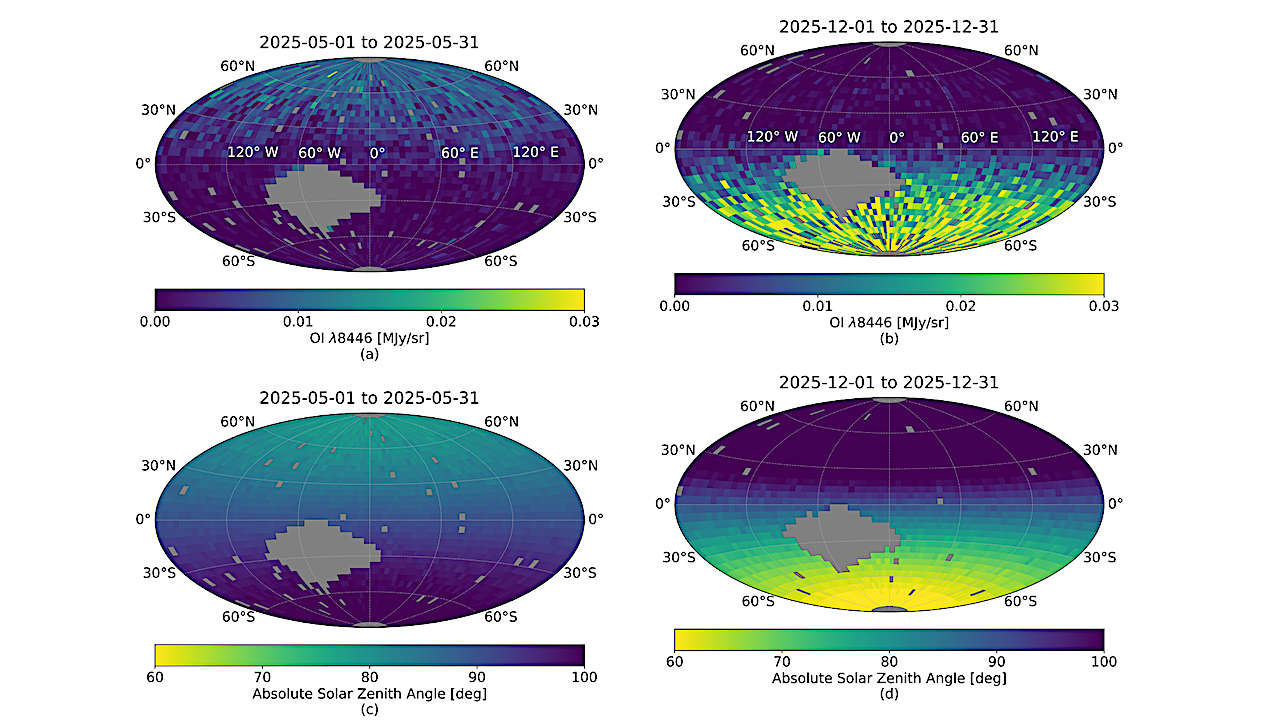
One-month snapshots of the 2-D distribution in terrestrial coordinate of the oxygen emission in (a) May and (b) December 2025. The measured emission is averaged over 31 days in latitude and longitude bins of 5-degree bin width. The corresponding absolute SZA is plotted in (c) and (d), with the color limit reversed to denote lighter color means closer pointing to the Sun. A movie showing the month-by-month evolution of the oxygen emission and solar zenith angle is available online. — physics.ao-ph
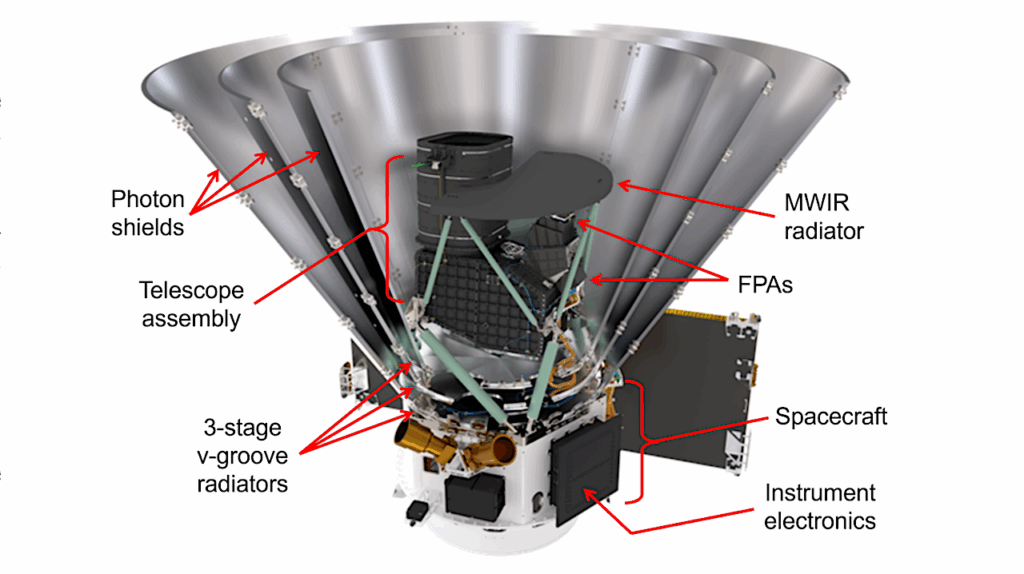
We present measurements of near-infrared (NIR) terrestrial airglow produced by helium and oxygen in the exosphere as observed by SPHEREx. Using eight months of survey data obtained from a 680 km low-Earth orbit, emission from HeI λ10830, OI λ8446, and OI λ11287 is mapped with both global spatial and multi-season temporal coverage.
These measurements are obtained along upward looking lines of sight as part of the astrophysical survey, in contrast to conventional nadir-viewing Earth remote sensing, which probes the behavior of low-density material in the thermo- and exosphere. We describe an analytical framework to extract atmospheric emission lines in the presence of astrophysical backgrounds including stars, resolved galaxies, and the diffuse Zodiacal light.
The resulting global measurements reveal temporal variability over the survey period and systematic dependencies on geographic location. We interpret these variations in the context of the variable Solar illumination and seasonal effects. SPHEREx, an astrophysical space observatory, is demonstrated to be a promising new platform for monitoring NIR airglow and investigating its coupling to Solar activity and global geophysical processes.
Howard Hui, Chi Nguyen, Ryan Wills, Katrina Bossert, Sean Bryan, Yoonsoo Bach, Jamie Bock, Tzu-Ching Chang, Shuang-Shuang Chen, Asantha Cooray, Brendan Crill, Olivier Doré, C. Darren Dowell, Andreas Faisst, Jae Hwan Kang, Phil Korngut, Carey Lisse, Dan Masters, Roberta Paladini, Volker Tolls, Michael Werner, Yujin Yang, Mike Zemcov
Comments: Submitted for publication in JGR: Atmospheres. 25 pages, 19 figures, and 3 supplemental movies
Subjects: Atmospheric and Oceanic Physics (physics.ao-ph); Earth and Planetary Astrophysics (astro-ph.EP); Instrumentation and Methods for Astrophysics (astro-ph.IM); Space Physics (physics.space-ph)
Cite as: arXiv:2605.00851 [physics.ao-ph] (or arXiv:2605.00851v1 [physics.ao-ph] for this version)
https://doi.org/10.48550/arXiv.2605.00851
Focus to learn more
Submission history
From: Ryan Wills
[v1] Mon, 20 Apr 2026 15:48:22 UTC (40,207 KB)
https://arxiv.org/abs/2605.00851
Astrobiology,










Related Posts
Stay Informed With the Latest & Most Important News
Previous Post
Next Post


Advertisement
-
 01Two Black Holes Observed Circling Each Other for the First Time
 -
 02From Polymerization-Enabled Folding and Assembly to Chemical Evolution: Key Processes for Emergence of Functional Polymers in the Origin of Life
 -
 03Astronomy 101: From the Sun and Moon to Wormholes and Warp Drive, Key Theories, Discoveries, and Facts about the Universe (The Adams 101 Series)
 -
 04True Anomaly hires former York Space executive as chief operating officer
 -
 05Φsat-2 begins science phase for AI Earth images
 -
 06Hurricane forecasters are losing 3 key satellites ahead of peak storm season − a meteorologist explains why it matters
 -
 07Binary star systems are complex astronomical objects − a new AI approach could pin down their properties quickly