
Now Reading: On The Nature Of The Earliest Known Lifeforms
-
01
On The Nature Of The Earliest Known Lifeforms


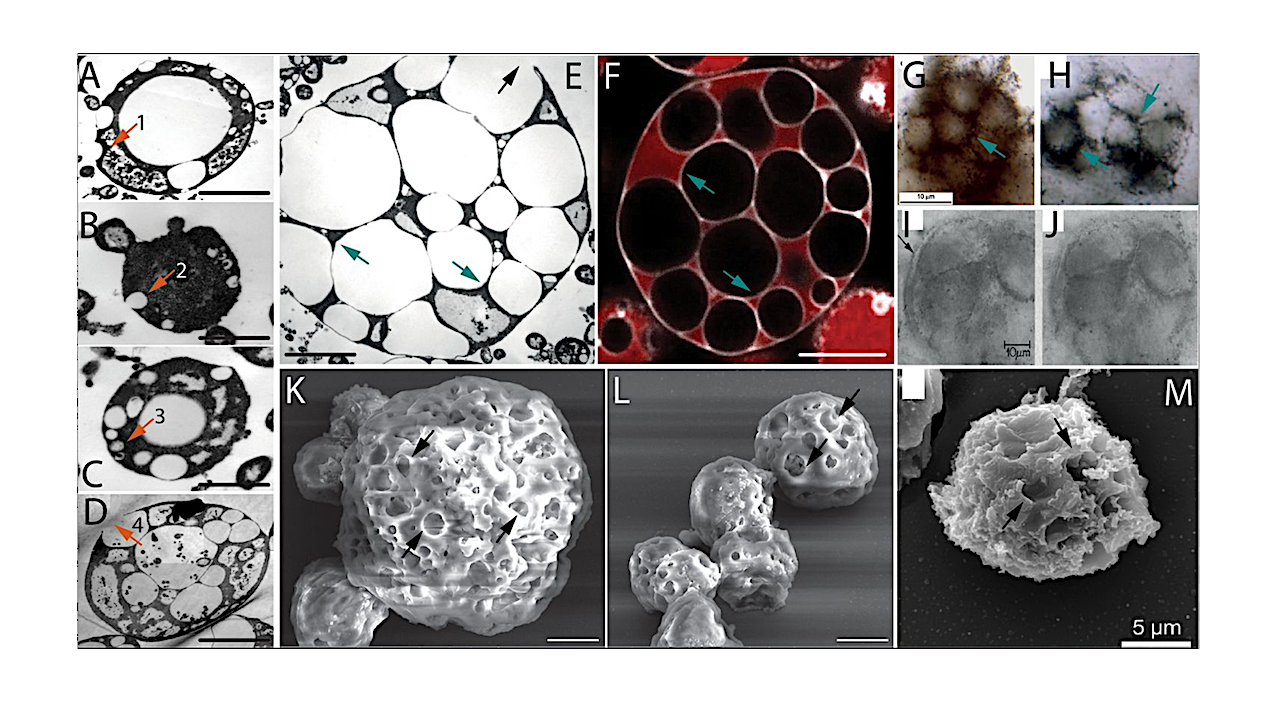
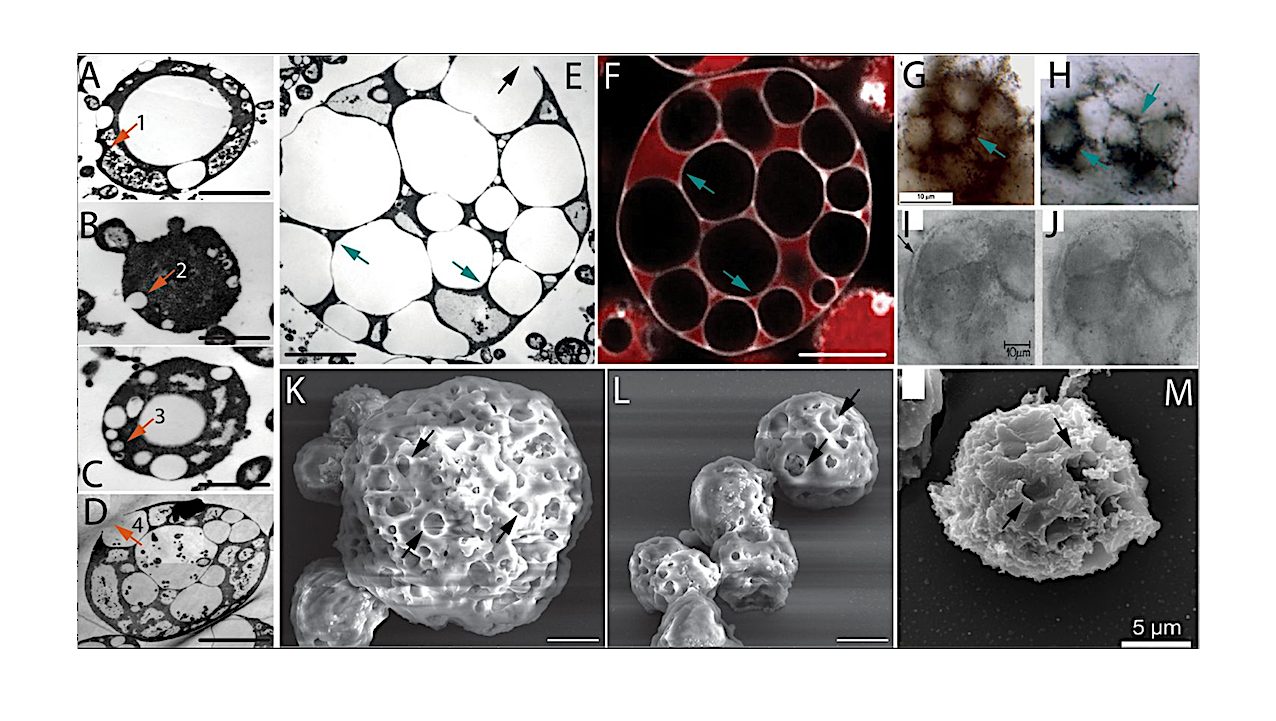
Morphological comparison of the Apex Chert and the Strelley Pool Formation microfossils with EM-P. Images (A-D) are TEM images of EM-P cells forming intracellular vesicles (ICVs) and intracellular daughter cells. The numbered arrows in these images point to different stages of ICV formation (see Figure 1—figure supplement 1 and 2). Images (E, F, K & L) show TEM, SEM, and STED microscope images of EM-P cells with ICVs and surface depressions (black arrows). Cells in image F were stained with universal membrane stain, FM5-95 (red), and DNA stain, PicoGreen (green). Images (G-J & M) are spherical microfossils reported from the Apex Chert and the Strelley Pool Formation, respectively (originally published by Schopf and Packer, 1987; Delarue et al., 2020 ; Schopf and Packer, 1987; Delarue et al., 2020). Cyan arrows in images (E-H) point to cytoplasm sandwiched between large hollow vesicles. The arrow in the image I points to the dual membrane enclosing the microfossil. Morphologically similar images of EM-P cells are shown in Figure 1—figure supplement 3. Black arrows in images (K-M) point to surface depressions in both EM-P and the Strelley Pool Formation microfossils, possibly formed by the rupture of ICVs as shown in (D & E) (arrows) (also see Figure 1—figure supplements 4–6). Scale bars: (A-D) (0.5 µm) (E, K, & L) (2 µm), and 5 µm (F). — eLife
Microfossils from the Paleoarchean Eon are the oldest known evidence of life. Despite their significance in understanding the history of life on Earth, any interpretation of the nature of these microfossils has been a point of contention among researchers.
Decades of back-and-forth arguments led to the consensus that reconstructing the lifecycles of Archaean Eon organisms is the most promising way of understanding the nature of these microfossils.
Here, we transformed a Gram-positive bacterium into a primitive lipid vesicle-like state and studied it under environmental conditions prevalent on early Earth. Using this approach, we successfully reconstructed morphologies and life cycles of Archaean microfossils.
In addition to reproducing microfossil morphologies, we conducted experiments that spanned years to understand the process of cell degradation and how Archaean cells could have undergone encrustation of minerals (in this case, salt), leading to their preservation as fossilized organic carbon in the rock record.
These degradation products strongly resemble fossiliferous features from Archaean rock formations. Our observations suggest that microfossils aged between 3.8–2.5 Ga most likely were liposome-like protocells that have evolved physiological pathways of energy conservation but not the mechanisms to regulate their morphology. Based on these observations, we propose that morphology is not a reliable indicator of taxonomy in these microfossils.
On the nature of the earliest known lifeforms, eLife
Astrobiology,











Related Posts
Stay Informed With the Latest & Most Important News
Previous Post
Next Post

Advertisement
-
 01Two Black Holes Observed Circling Each Other for the First Time
 -
 02From Polymerization-Enabled Folding and Assembly to Chemical Evolution: Key Processes for Emergence of Functional Polymers in the Origin of Life
 -
 03Astronomy 101: From the Sun and Moon to Wormholes and Warp Drive, Key Theories, Discoveries, and Facts about the Universe (The Adams 101 Series)
 -
 04True Anomaly hires former York Space executive as chief operating officer
 -
 05Φsat-2 begins science phase for AI Earth images
 -
 06Hurricane forecasters are losing 3 key satellites ahead of peak storm season − a meteorologist explains why it matters
 -
 07Binary star systems are complex astronomical objects − a new AI approach could pin down their properties quickly