
Now Reading: Oxygen And Nitrogen Isotopologues On Cold COCONUTS-2b Observed With MIRI/MRS
-
01
Oxygen And Nitrogen Isotopologues On Cold COCONUTS-2b Observed With MIRI/MRS


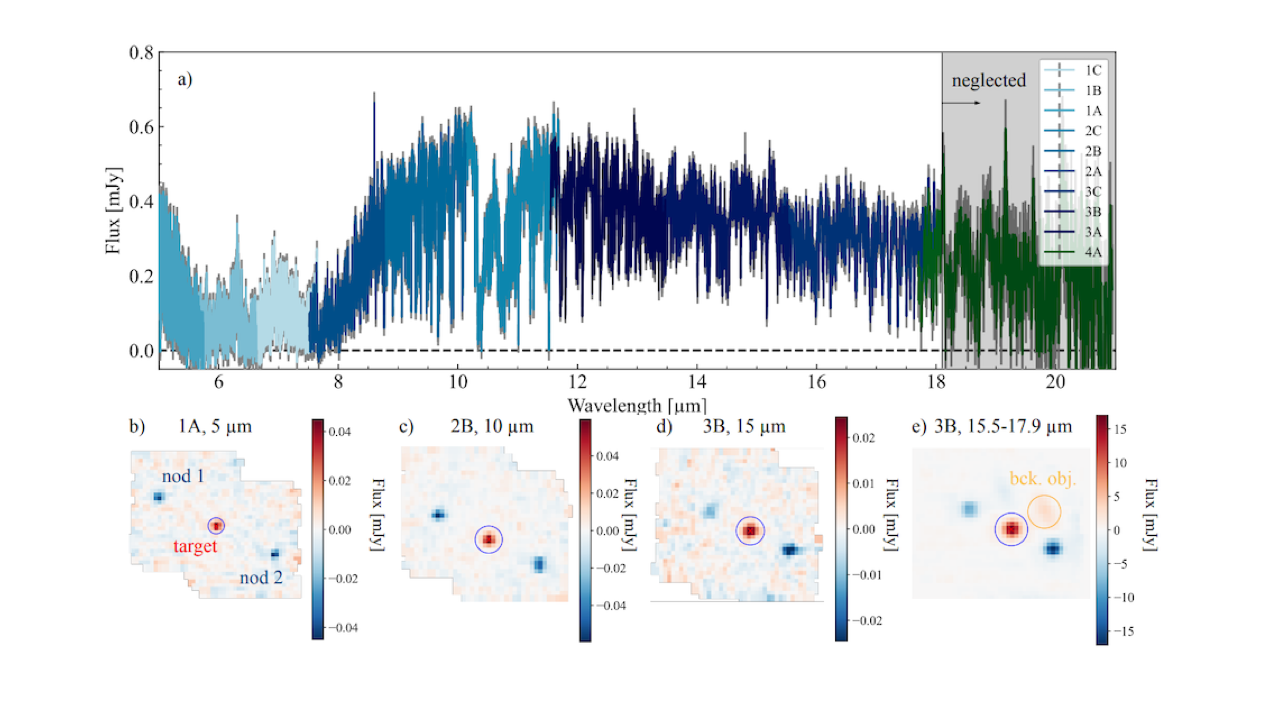

Observation and cube detector images of channel 1A to 4A, where channel 4A gets neglected from further analysis (see text). The red cross corresponds to the position of the target and the blue circle to the aperture from which the flux has been extracted from. The two negative spots on the detector correspond to two nods originating from the background subtraction. The yellow circle shows the position of a background object. — astro-ph.EP
Linking the composition of gas giant planets to their formation paths has long been a goal in exoplanet science. Especially, cold gas giants with temperatures below ∼500K have been out of reach for detailed atmospheric characterization.
With JWST, however, we can reach high signal-to-noise (S/N) spectra for such cool worlds and can can measure not only their main trace gas abundances, but even their isotopic content unlocking new possibilities in linking them to their formation paths.
In this study, we present the spectrum of one of the coldest planetary-mass companions COCONUTS-2b (Teff≈480K, separation of ∼6400 au from its M dwarf host star) obtained with the Mid-InfraRed Instrument Medium Resolution Spectrometer (MIRI/MRS).
Combining the MIRI and archival Gemini/FLAMINGOS-2 data sets, we aim to characterize the chemical composition and physical structure of its frigid atmosphere, setting the stage to uncover insights on the formation of COCONUTS-2b.
For the first time on a MIRI/MRS data set, we use the full spectral resolution of MIRI/MRS and perform atmospheric retrievals to unlock the search for faint absorption features by rare molecules and isotopologues. The latter are identified using a leave-one-out analysis and Bayes factor comparison.
We robustly detect three isotopologues, namely 15NH3, H218O and H217O in the atmosphere of COCONUTS-2b. We find the first clear evidence of oxygen isotopes in water in a cold companion. This data set demonstrates the capability of MIRI/MRS to characterize such cold planetary-mass companion’s atmospheres with respect to their compositional and isotopic content.
In the future, the constrained elemental and isotope ratios provide a unique avenue in comparing with the host star’s abundances and eventually in tracing formation scenarios.
H. Kühnle, E. C. Matthews, P. Mollière, P. Patapis, Z. Zhang, E. Nasedkin, D. Gasman, N. Whiteford, H. S. Wang, M. Ravet, G. Chauvin, M. Bonnefoy, D. Barrado, A. M. Glauser, S. P. Quanz
Comments: Accepted for publication in A&A
Subjects: Earth and Planetary Astrophysics (astro-ph.EP)
Cite as: arXiv:2604.26850 [astro-ph.EP] (or arXiv:2604.26850v1 [astro-ph.EP] for this version)
https://doi.org/10.48550/arXiv.2604.26850
Focus to learn more
Submission history
From: Helena Kuehnle
[v1] Wed, 29 Apr 2026 16:14:14 UTC (3,099 KB)
https://arxiv.org/abs/2604.26850
Astrobiology, Astronomy, exoplanet,










Related Posts

Stay Informed With the Latest & Most Important News

Advertisement
-
 01Two Black Holes Observed Circling Each Other for the First Time
 -
 02From Polymerization-Enabled Folding and Assembly to Chemical Evolution: Key Processes for Emergence of Functional Polymers in the Origin of Life
 -
 03Astronomy 101: From the Sun and Moon to Wormholes and Warp Drive, Key Theories, Discoveries, and Facts about the Universe (The Adams 101 Series)
 -
 04True Anomaly hires former York Space executive as chief operating officer
 -
 05Φsat-2 begins science phase for AI Earth images
 -
 06Hurricane forecasters are losing 3 key satellites ahead of peak storm season − a meteorologist explains why it matters
 -
 07Binary star systems are complex astronomical objects − a new AI approach could pin down their properties quickly