
Now Reading: The Tale Of The 3 Planets: 3D Cloud Feedback Enhances The Spectral Diversity Of Warm Jupiters
-
01
The Tale Of The 3 Planets: 3D Cloud Feedback Enhances The Spectral Diversity Of Warm Jupiters

The Tale Of The 3 Planets: 3D Cloud Feedback Enhances The Spectral Diversity Of Warm Jupiters

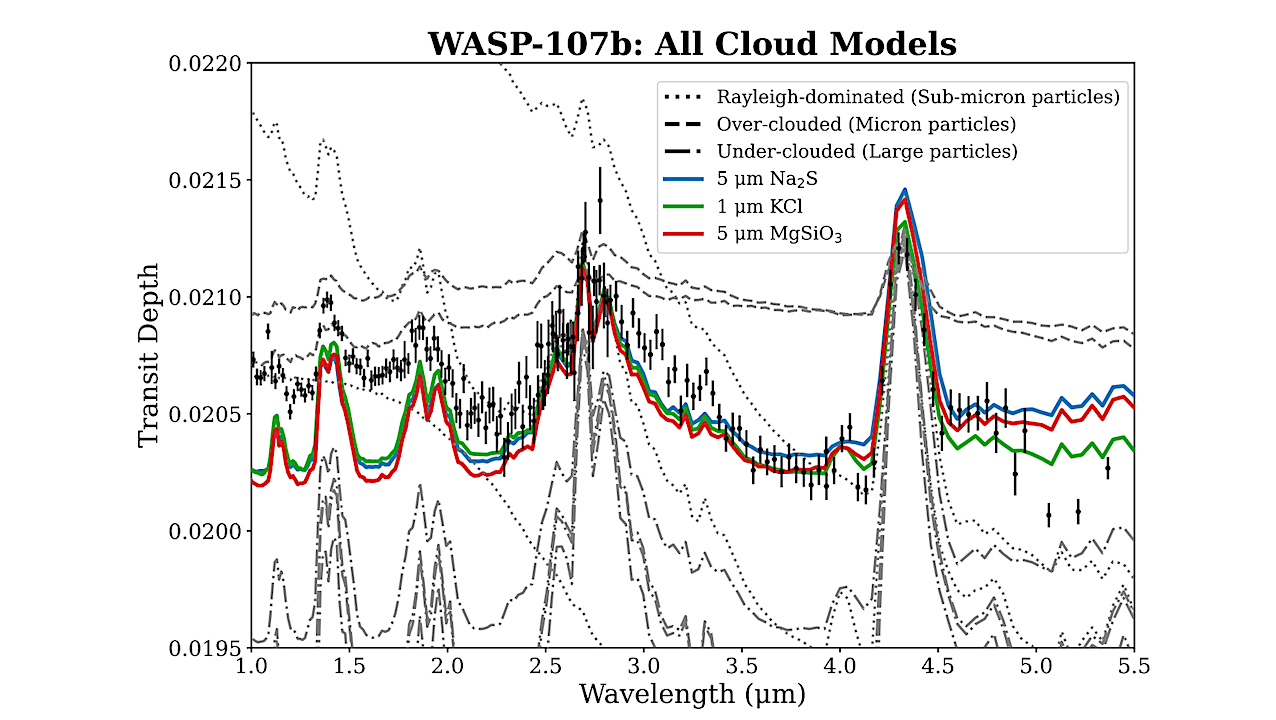
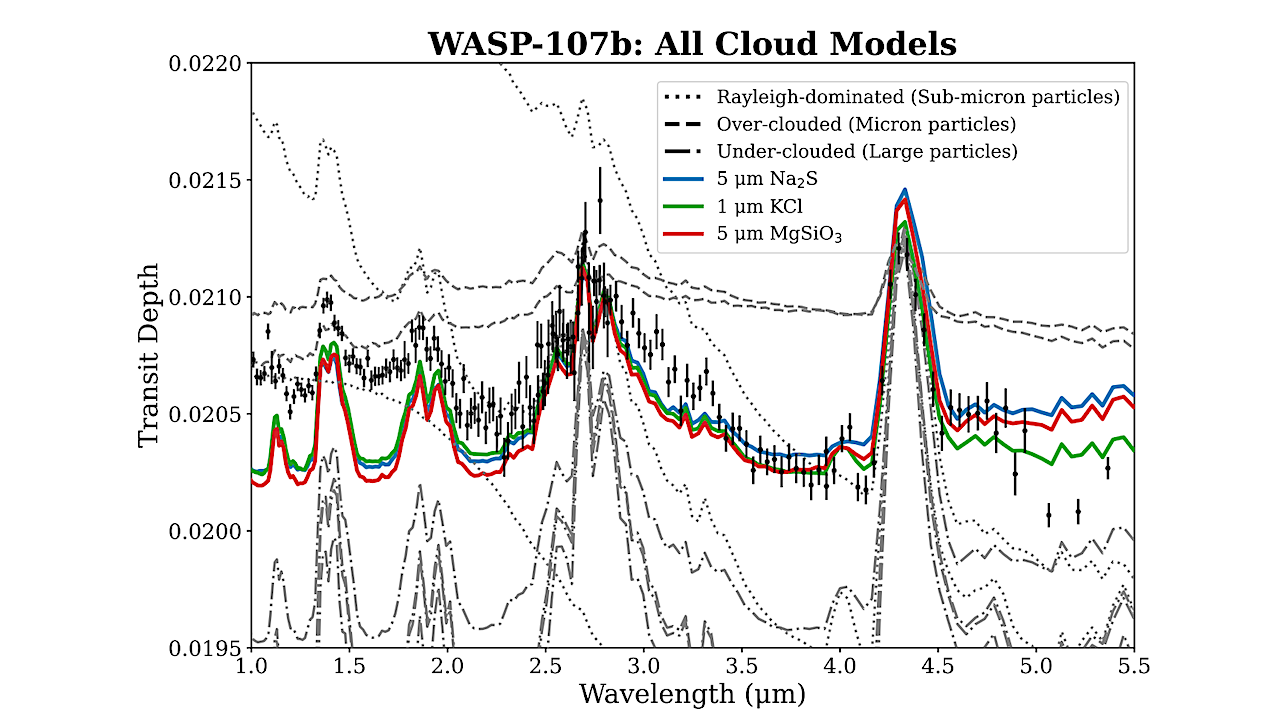
Transmission spectra of all cloud models for WASP-107b compared with the JWST NIRCam observations (black points). Dotted lines show small-particle models dominated by Rayleigh scattering (0.1 µm Na2S, KCl, MgSiO3); dashed lines are over-clouded models with suppressed molecular features (1 µm Na2S and MgSiO3); dot-dashed lines are under-clouded models with large features (10 µm Na2S; 5, 10 µm KCl; 10 µm MgSiO3). Solid lines indicate the three best-fit models: 5 µm Na2S (blue), 1 µm KCl (green), and 5 µm MgSiO3 (red). — astro-ph.EP
JWST has shown a large diversity in warm Jupiter spectra, despite only small variations in the planetary parameters. However, the main driver of this diversity remains unclear. We aim to identify the mechanisms responsible for the spectral difference of three warm Jupiter-size exoplanets observed by JWST: whereas WASP-80b appears mostly cloud-free, both WASP-107b and WASP-69b have spectra dominated by clouds.
We model each planet using the same framework, ADAM (formerly SPARC/MITgcm), which solves for the interactions among cloud transport, radiative transfer, and atmospheric circulation in 3D. We investigate the role of three condensate species, Na2S, KCl, and MgSiO3, and four particle sizes (0.1, 1, 5, and 10 μm).
Clouds settle deeper in the atmosphere of the higher-gravity planet WASP-80b than in WASP-107b, reproducing their spectral difference naturally. For WASP-107b, three clouds can reproduce the NIRCam observations: 5 μm Na2S, 1 μm KCl, and 5 μm MgSiO3 models. However, these cannot match the scattering slope observed at shorter wavelengths in NIRISS and the possible silicate feature in the MIRI bandpass, suggesting a multi-modal distribution of clouds.
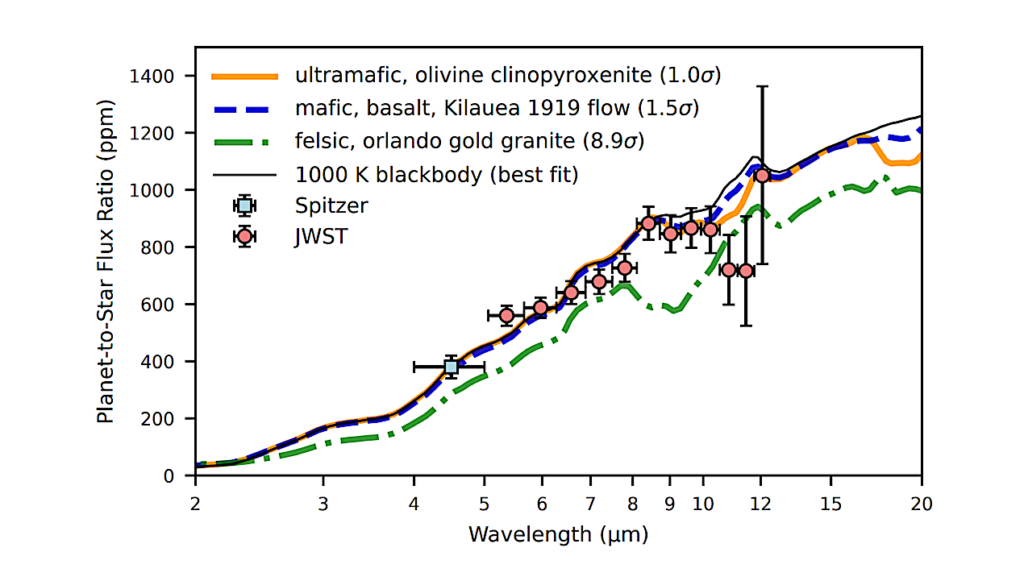
Our model predicts that small silicate particles should be homogeneously distributed and thus cannot account for the difference between the two limb spectra in the MIRI bandpass. Finally, applying the same model to WASP-69b does not yield a partially cloudy dayside solution that fits the emission spectra, as proposed in a previous study.
Coupling among 3D circulation, clouds, and radiative transfer can enhance the spectral diversity of warm Jupiter exoplanets, particularly through changes in cloudiness with gravity. The combination of multi-phase, wide-wavelength coverage and models that couple clouds, circulation, and radiative transfer is key to advancing our understanding of these new objects.
Nishil Mehta, Vivien Parmentier, Xianyu Tan, Elspeth K. H. Lee, Tristan Guillot, Matthew M. Murphy, Thomas P. Greene, Thomas G. Beatty, Taylor J. Bell, Jonathan J. Fortney, Michael R. Line, Sagnick Mukherjee, Kazumasa Ohno, Everett Schlawin, Anastasia Triantafillides, Luis Welbanks, Lindsey S. Wiser
Comments: Submitted to Astronomy & Astrophysics
Subjects: Earth and Planetary Astrophysics (astro-ph.EP)
Cite as: arXiv:2604.26911 [astro-ph.EP] (or arXiv:2604.26911v1 [astro-ph.EP] for this version)
https://doi.org/10.48550/arXiv.2604.26911
Focus to learn more
Submission history
From: Nishil Mehta
[v1] Wed, 29 Apr 2026 17:21:49 UTC (12,491 KB)
https://arxiv.org/abs/2604.26911
Astrobiology, exoplanet,










Related Posts

Stay Informed With the Latest & Most Important News
Previous Post
Next Post



Advertisement
-
 01Two Black Holes Observed Circling Each Other for the First Time
 -
 02From Polymerization-Enabled Folding and Assembly to Chemical Evolution: Key Processes for Emergence of Functional Polymers in the Origin of Life
 -
 03Astronomy 101: From the Sun and Moon to Wormholes and Warp Drive, Key Theories, Discoveries, and Facts about the Universe (The Adams 101 Series)
 -
 04True Anomaly hires former York Space executive as chief operating officer
 -
 05Φsat-2 begins science phase for AI Earth images
 -
 06Hurricane forecasters are losing 3 key satellites ahead of peak storm season − a meteorologist explains why it matters
 -
 07Binary star systems are complex astronomical objects − a new AI approach could pin down their properties quickly