
Now Reading: Phantom Space eyes edge in orbital data race with thermal deal
-
01
Phantom Space eyes edge in orbital data race with thermal deal


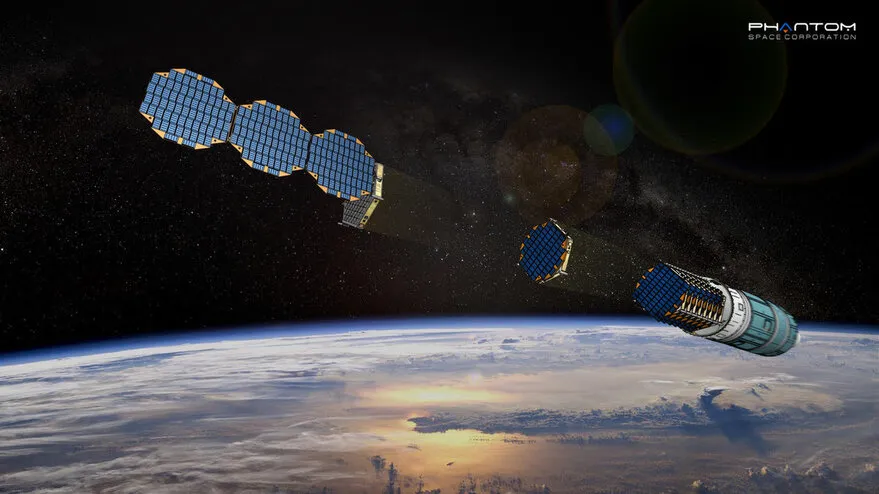

Phantom Space believes it now has the key pieces of a vertically integrated model to compete on the edges of the emerging orbital data center market, where industry giants are already staking claims to meet soaring AI-driven demand.
The Tucson, Arizona-based satellite and rocket developer recently acquired what it sees as a critical missing piece: Thermal Management Technologies (TMT), a specialist in spacecraft heat control systems that addresses a key challenge for high-performance computing platforms in orbit.
The deal came just months after Phantom snapped up assets from small launch vehicle developer Vector Launch, which filed for bankruptcy in 2019, to support its Daytona rocket ahead of a targeted 2027 maiden flight.
While Phantom plans to sell satellites and launch services independently, the company sees a growing opportunity to bring them together for a Phantom Cloud constellation designed to move, process and distribute data in orbit.
“Bringing TMT fully in-house is already shaving months off our development timeline while reducing costs for the complete 66-satellite constellation,” said Jim Cantrell, Phantom’s cofounder and CEO. Cantrell also cofounded Vector and served as its CEO before leaving in 2019 after it ran into financial difficulties.
“Instead of negotiating at arm’s length or waiting on external lead times, our teams can iterate designs together in real time, optimizing the thermal-structural architecture alongside the bus, payload and power systems,” he told SpaceNews. “That tight integration means fewer interfaces to manage, less mass overhead and a faster path to qualification and flight.”
Cantrell said closer coordination should help Phantom stay on track for a Block I demonstration mission in the second half of 2027, comprising two spacecraft to be launched by a third party. Once Daytona is operational, the company expects to improve the economics and speed of deploying its orbital data infrastructure over the following years.
While Phantom is not disclosing detailed specifications, Cantrell said the Block I satellites are designed as a scalable precursor to a full 66-satellite constellation that has yet to be filed with the Federal Communications Commission.
He said the company is focusing on executing its 2027 demonstration mission under experimental, limited authorizations.
Solving the heat problem
According to Cantrell, TMT has already worked with Phantom on an earlier spacecraft delivered to a customer in 2023, though the company didn’t disclose details.
Unlike terrestrial data centers, which rely on air or liquid cooling, satellites must dissipate heat by radiating it into space.
“High-density AI or data-processing payloads can produce tens or even hundreds of kilowatts,” he said, “which must be collected, transported and dissipated efficiently without adding too much mass or compromising the spacecraft’s structural integrity.”
TMT integrates thermal and structural functions into shared hardware, promising more compact and efficient designs.
Cantrell said Phantom is already seeing strong interest in the upcoming demonstration mission, with early partnerships including Ubotica for edge AI processing, Assured Space Access for radio-frequency communications payloads and Secured2 for quantum-secure data protection, alongside additional data center and industrial partners that have not been publicly disclosed.
“We’re in active discussions with several parties for larger commitments that will leverage the full 66-satellite constellation,” he added.
Carving out a niche
As interest in orbital data centers grows, Phantom Cloud is being positioned differently from efforts by SpaceX, Starcloud and others focused on large-scale space-based computing for AI.
Instead, Cantrell said Phantom is targeting data backhaul and edge processing with an aim to address bottlenecks in how information is transmitted and analyzed between satellites and end users.
“Phantom Cloud is being built as an open orbital data platform that acts as a shared mesh network for data backhaul, edge processing and cloud-like storage and computing directly in low Earth orbit,” he said.
“It is accessible to a wide range of customers, including government agencies, commercial Earth observation operators, scientific missions and satellite owners seeking faster, lower-latency data relay and on-orbit intelligence.”
Cantrell said Phantom is also developing 10-kilowatt-class Galactic Sky “micro data centers,” which would be deployed alongside the core 66-satellite constellation to improve the network’s edge-processing capability.
“This setup has developed over nearly 10 years, originating from the innovative work many of us at Phantom did while at Vector,” he said, without providing details.
By owning more of its systems, including satellites, thermal hardware and eventually launch, Phantom aims to carve out a sustainable place in the budding orbital data infrastructure market, even as deeper-pocketed players seek to dominate it.
“The result should be a more affordable, resilient mesh network that lowers barriers for satellite operators and drives the next wave of space-based digital services,” Cantrell said, “bringing us closer to a true orbital economy where data moves and gets processed in space as seamlessly as it does on the ground.”










Related Posts

Stay Informed With the Latest & Most Important News
Previous Post
Next Post




Advertisement
-
 01Two Black Holes Observed Circling Each Other for the First Time
 -
 02From Polymerization-Enabled Folding and Assembly to Chemical Evolution: Key Processes for Emergence of Functional Polymers in the Origin of Life
 -
 03Astronomy 101: From the Sun and Moon to Wormholes and Warp Drive, Key Theories, Discoveries, and Facts about the Universe (The Adams 101 Series)
 -
 04True Anomaly hires former York Space executive as chief operating officer
 -
 05Φsat-2 begins science phase for AI Earth images
 -
 06Hurricane forecasters are losing 3 key satellites ahead of peak storm season − a meteorologist explains why it matters
 -
 07Binary star systems are complex astronomical objects − a new AI approach could pin down their properties quickly