
Now Reading: Plato aces space-like tests
-
01
Plato aces space-like tests



23/04/2026
223 views
0 likes
The European Space Agency Plato mission has successfully completed a series of tough tests under space‑like conditions. With this accomplishment, the spacecraft is on track to lift off in early 2027 and begin its search for terrestrial planets.
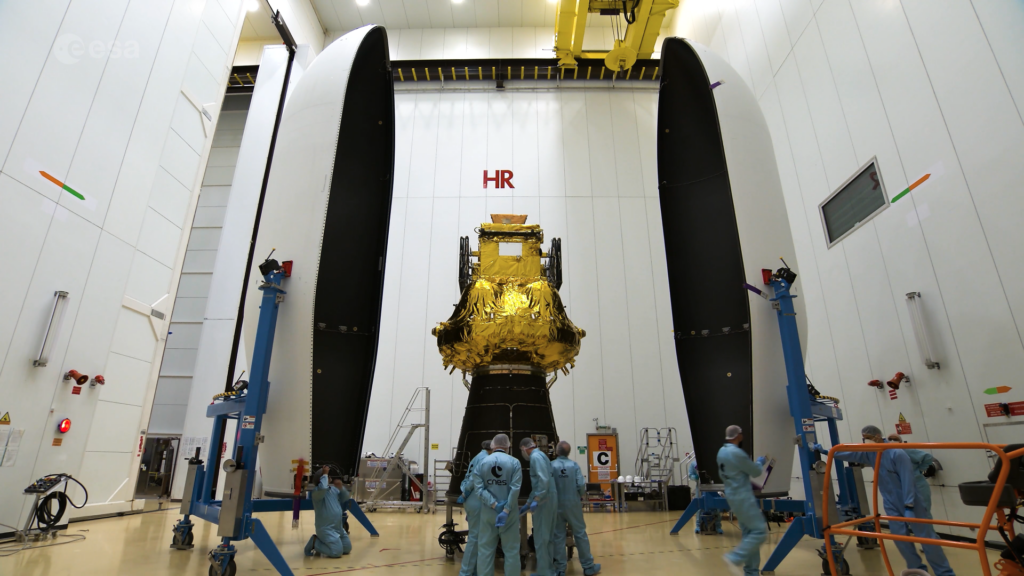
Plato recently emerged from the Large Space Simulator (LSS) chamber at ESA’s Test Centre, where the spacecraft made its first acquaintance with the rigours of space.
Within space projects, ‘test as you fly’ is every engineer’s mantra. So before launching a spacecraft, it is crucial to check all its functionalities in the same conditions it will meet in orbit. To this end, Plato was placed inside the LSS.
Once the LSS chamber’s top and side hatches were sealed, in early March, powerful pumps sucked air out of the enclosure, creating a vacuum a billion times sparser than standard atmospheric pressure. Meanwhile, liquid nitrogen pumped through the walls to reproduce the cold of space. A grid of powerful heating elements, specially placed inside the LSS, were switched on to mimic the heat of the Sun hitting Plato’s solar panels and sunshield.
Then, testing began.
Plato’s eye tests
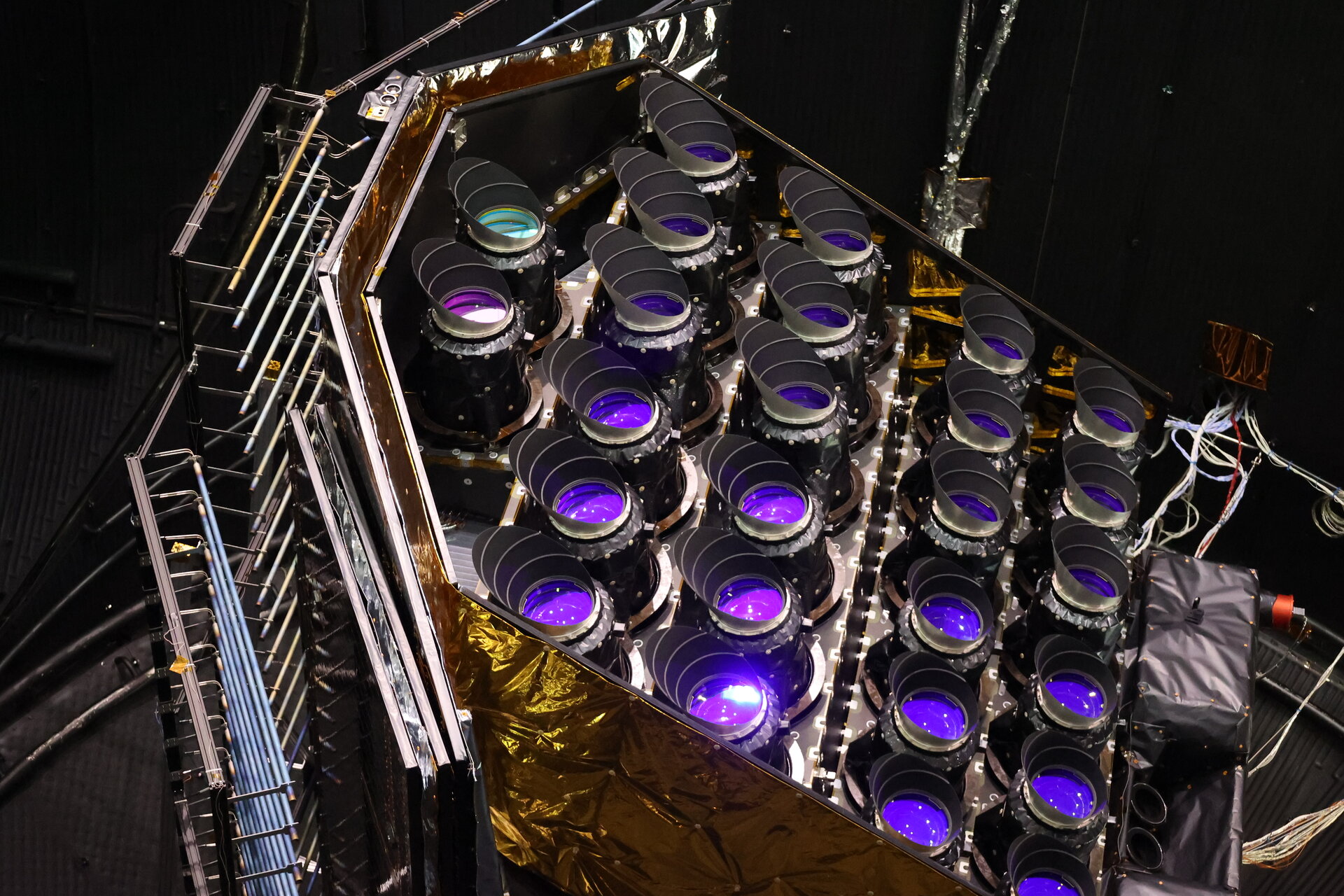
The mission’s overarching goal is to discover potentially habitable, Earth-like planets around bright stars similar to the Sun. For this, the performance of Plato’s 26 ultrasensitive cameras is crucial. To spot when a planet passes in front of its host star, they must capture the tiniest dips in the intensity of the star’s light.
“To find and characterise Earth-like planets in orbit around Sun-like stars, we need to tease out variations in a star’s luminosity smaller than 80 parts per million,” explains Ana Heras, ESA’s Plato Project Scientist.
“Such a high precision is very demanding, and these tests in space-like conditions are crucial. They allow us to verify that we can control the response of the cameras and the rest of the spacecraft systems to the level that we need for detecting small planets.”
“We carried out dedicated tests to assess the correct functioning of Plato’s cameras and the complete spacecraft in the thermal conditions that it will experience in its final orbit,” adds Thomas Walloschek, ESA’s Plato Project Manager.
“The sharpness of the cameras – their focus – is fine-tuned by adjusting the temperature of their optical tubes. So, we ran a series of tests to establish that we can maintain the cameras’ optimal focus by controlling their temperatures with very high accuracy.”
Testing hot and cold
Engineers tested the entire spacecraft in typical space environment, as well as in so-called hot and cold phases.
“In the LSS, we stress-tested Plato by going to more extremes than the spacecraft will normally see in orbit,” continues Thomas. “We want to verify that the spacecraft can do what we expect it to do in harsh as well as nominal space conditions.”
During the hot phase, engineers ran all the spacecraft’s elements on full power, while the solar-panel side warmed up to 150 °C. At the same time, they made sure that the cameras, protected by the sunshield and facing the cold part of the chamber, stayed between –70 and –90 °C.
For the cold phase, temperatures were lowered across the spacecraft, and its heaters had to be powered up to prevent the cameras becoming too cold.
The tests in a space-like environment have been completed, but the analysis of the data collected while Plato was inside the LSS will continue in the coming months.
Engineers and scientists will study the information gathered to learn more about the spacecraft’s behaviour and the detailed performance of its instruments. They will use the data to improve thermal models that will be essential for predicting the cameras’ responses in detail, once Plato is flying.
And this moment is getting closer. Plato is expected to be ready for launch by the end of this year. Lift-off on an Ariane 6 is planned by Arianespace for January 2027.
Notes for editors
ESA’s Plato (PLAnetary Transits and Oscillations of stars) will use 26 cameras to study terrestrial exoplanets in orbits up to the habitable zone of Sun-like stars.
Plato’s scientific instrumentation, consisting of the cameras and electronic units, is provided through a collaboration between ESA and the Plato Mission Consortium composed of various European research centres, institutes and industries. The spacecraft is being built and assembled by the industrial Plato Core Team led by OHB together with Thales Alenia Space and Beyond Gravity.
Plato is a medium-class mission of ESA’s Cosmic Vision programme.
Find out more about ESA Space Science and ESA’s Science Programme.










Related Posts

Stay Informed With the Latest & Most Important News
Previous Post
Next Post


Advertisement
-
 01Two Black Holes Observed Circling Each Other for the First Time
 -
 02From Polymerization-Enabled Folding and Assembly to Chemical Evolution: Key Processes for Emergence of Functional Polymers in the Origin of Life
 -
 03Astronomy 101: From the Sun and Moon to Wormholes and Warp Drive, Key Theories, Discoveries, and Facts about the Universe (The Adams 101 Series)
 -
 04True Anomaly hires former York Space executive as chief operating officer
 -
 05Φsat-2 begins science phase for AI Earth images
 -
 06Hurricane forecasters are losing 3 key satellites ahead of peak storm season − a meteorologist explains why it matters
 -
 07Binary star systems are complex astronomical objects − a new AI approach could pin down their properties quickly