
Now Reading: Univity funds VLEO 5G demonstrators with $32 million Series A
-
01
Univity funds VLEO 5G demonstrators with $32 million Series A


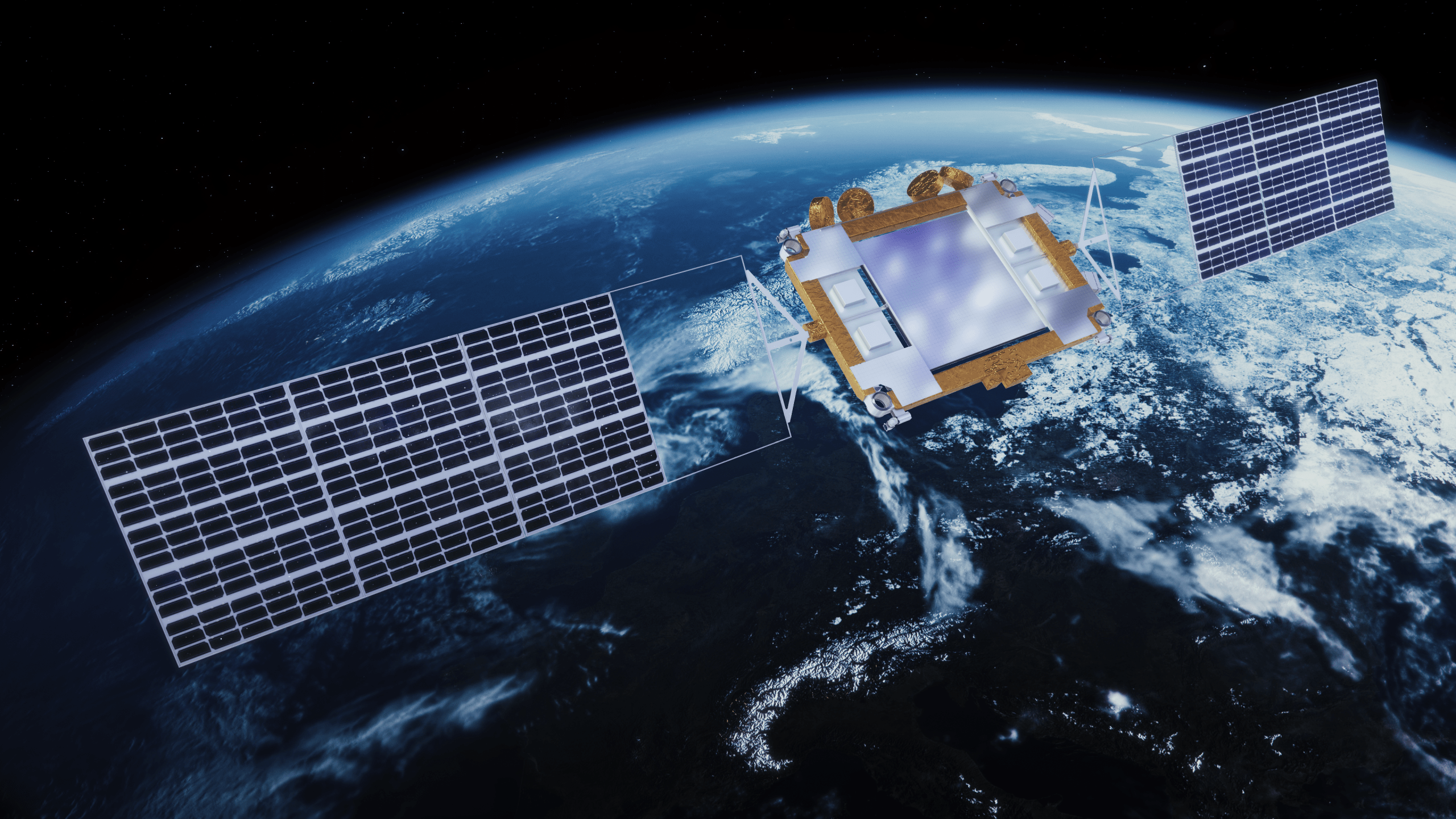

TAMPA, Fla. — French startup Univity has raised around $32 million to deploy a pair of 5G demonstrators into very low Earth orbit next year, ahead of plans for at least 1,600 VLEO satellites to help telecom operators extend 5G coverage from space.
The four-year-old venture announced the Series A round April 23, which included further backing from a fund that French investment firm Bpifrance manages on behalf of France’s government.
Stéphane Lefevre-Sauli, a senior investment director at Bpifrance, said Univity’s VLEO and space-based 5G technologies are critical to helping telcos remain competitive as space and terrestrial networks become more integrated.
“This investment fully addresses national and European sovereignty challenges in connectivity, which are at the core of our investment thesis,” he said in a statement.
Univity deployed its first payload last year in low Earth orbit to begin testing a service that would use spectrum from cellular partners to connect user terminals and support future direct-to-device (D2D) services.
The Series A funding will support the deployment of two 350-kilogram UniShape prototypes, designed to demonstrate interoperability between terrestrial and space networks, before ramping up industrial production from 2028.
Univity founder and CEO Charles Delfieux said the two identical demonstrators would carry a hybrid regenerative payload for broadband and D2D services. Two spacecraft are needed to test optical inter-satellite links and routing algorithms.
The VLEO prototypes “are largely representative of the satellites that will [be] mass-produced starting 2028,” Delfieux said via email.
“They are however a bit smaller and lighter as the company needs to cope with the size constraints of a ride-share launch opportunity. Also, whilst the architecture of the satellites is comparable, we expect that the mass-produced satellites will benefit from several technological development and optimization of equipment/sub-systems to leverage the R&D activities that will continue to be carried over the next two years.”
Using an aerodynamic design that minimizes drag, he said Univity’s satellites would be able to operate for seven years in orbit before running out of fuel.
The venture is targeting an initial constellation of at least 1,600 satellites, up from a previous plan for 1,500 spacecraft, under a strategy that could scale to as many as 3,400.
According to Delfieux, Univity has raised 68 million euros ($80 million) in total financing to date, including equity, debt, subsidies and contract revenues from France’s CNES space agency.
Investment firms Blast and Expansion led the Series A funding round alongside France’s Deeptech 2030 fund.










Related Posts

Stay Informed With the Latest & Most Important News
Previous Post
Next Post



Advertisement
-
 01Two Black Holes Observed Circling Each Other for the First Time
 -
 02From Polymerization-Enabled Folding and Assembly to Chemical Evolution: Key Processes for Emergence of Functional Polymers in the Origin of Life
 -
 03Astronomy 101: From the Sun and Moon to Wormholes and Warp Drive, Key Theories, Discoveries, and Facts about the Universe (The Adams 101 Series)
 -
 04True Anomaly hires former York Space executive as chief operating officer
 -
 05Φsat-2 begins science phase for AI Earth images
 -
 06Hurricane forecasters are losing 3 key satellites ahead of peak storm season − a meteorologist explains why it matters
 -
 07Binary star systems are complex astronomical objects − a new AI approach could pin down their properties quickly