
Now Reading: Priority Effects Inhibit The Repeated Evolution Of Phototrophy
-
01
Priority Effects Inhibit The Repeated Evolution Of Phototrophy


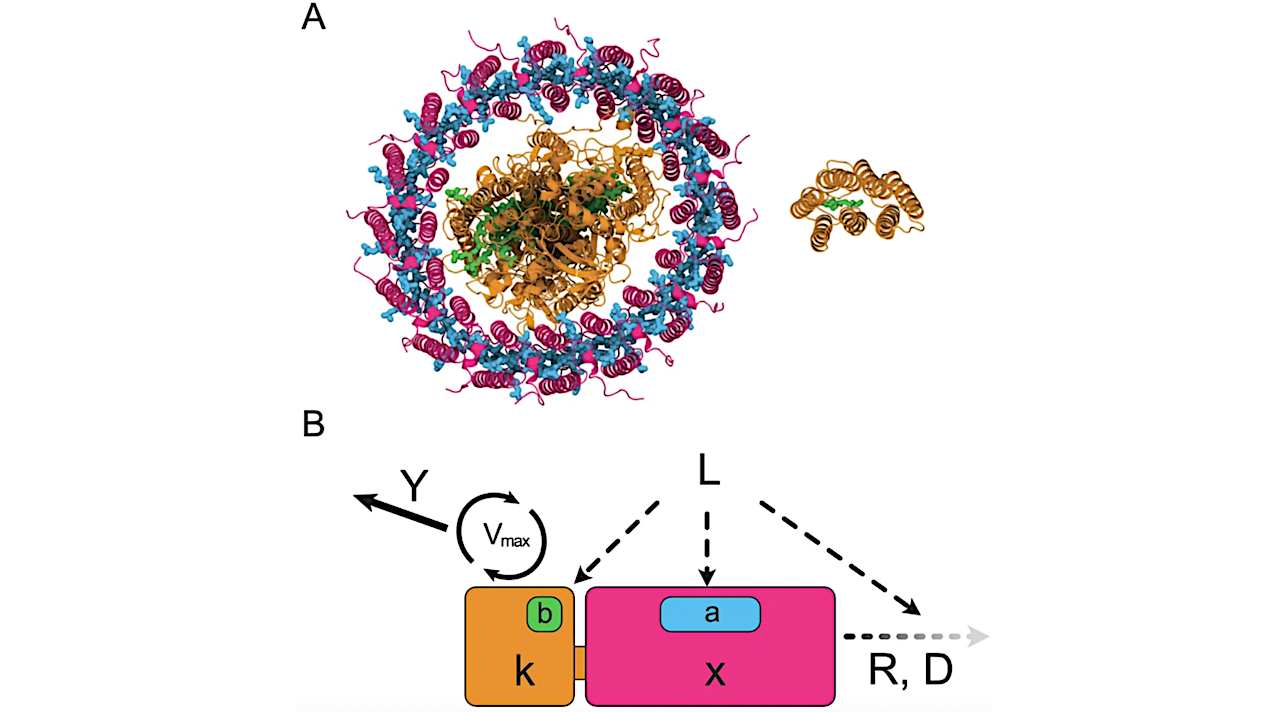
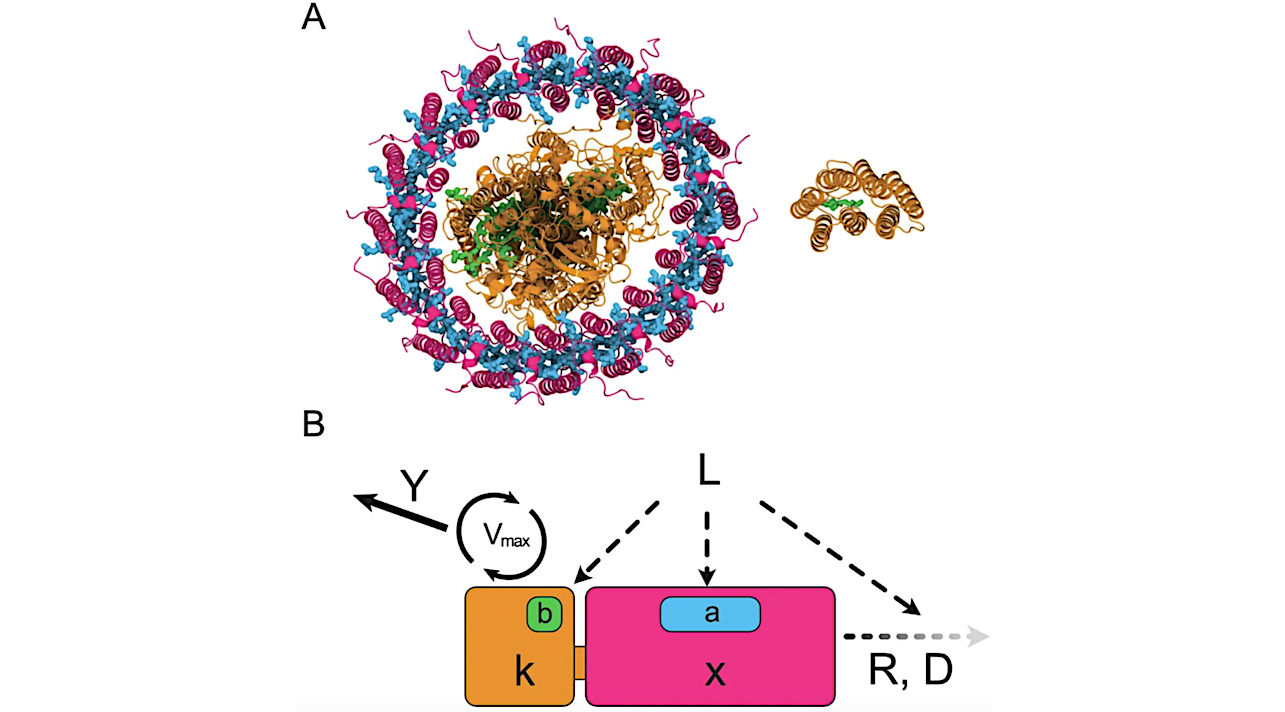
A Structural comparison of chlorophyll-based and retinal-based photosystems. Left: Type II reaction center with antenna complex from Thermochromatium tepidum88. The catalytic core (orange) contains bacteriochlorophyll pigments (green) that drive electron transport and carbon fixation, while antenna complexes (magenta) with additional pigments (blue) expand light capture. Right: Bacteriorhodopsin, a single transmembrane protein (orange) that pumps one proton per photon using a retinal chromophore (green)94. B Biophysical model parameters corresponding to structural components described above. Each system has an invariant catalytic core (orange, mass k) with maximum reaction rate Vmax and proton yield Y per cycle. Core light absorption is b, while antenna mass x (magenta) provides additional absorption capacity a per unit mass. Environmental parameters include incident light intensity L, protein recycling rate R, and photodegradation constant D. Protein structures in (A) were visualized using Protein Imager95. — NPJ via Pubmed
The emergence of phototrophy is one of the most significant innovations in the history of life, vastly increasing available metabolic energy. Phototrophy is, however, known to have arisen only twice.
This raises a curious question: if phototrophy was accessible enough to evolve twice, why has it never arisen again despite billions of years of subsequent evolution? Through physiological modeling, we demonstrate that chlorophototrophy and retinalophototrophy together saturate the bioenergetic landscape available to light-harvesting systems.
They represent opposite solutions to key biophysical trade-offs: maximizing efficiency per photon versus maximizing metabolic flux, specialization versus versatility, and sophistication versus simplicity. Together they create an evolutionary priority effect, blocking any newly-arising phototrophic system from succeeding.
By revealing the basis of this competitive exclusion, our work sheds light on a general principle – that early innovations can saturate ecological space such that they constrain future evolutionary possibilities, making apparently ‘easy’ innovations appear as rare events.
Astrobiology,











Related Posts
Stay Informed With the Latest & Most Important News
Previous Post
Next Post



Advertisement
-
 01Two Black Holes Observed Circling Each Other for the First Time
 -
 02From Polymerization-Enabled Folding and Assembly to Chemical Evolution: Key Processes for Emergence of Functional Polymers in the Origin of Life
 -
 03Astronomy 101: From the Sun and Moon to Wormholes and Warp Drive, Key Theories, Discoveries, and Facts about the Universe (The Adams 101 Series)
 -
 04True Anomaly hires former York Space executive as chief operating officer
 -
 05Φsat-2 begins science phase for AI Earth images
 -
 06Hurricane forecasters are losing 3 key satellites ahead of peak storm season − a meteorologist explains why it matters
 -
 07Binary star systems are complex astronomical objects − a new AI approach could pin down their properties quickly