
Now Reading: Simulating The Interplay Between The Snowline Pebble Flux And Ongoing Planet Formation And Migration
-
01
Simulating The Interplay Between The Snowline Pebble Flux And Ongoing Planet Formation And Migration

Simulating The Interplay Between The Snowline Pebble Flux And Ongoing Planet Formation And Migration

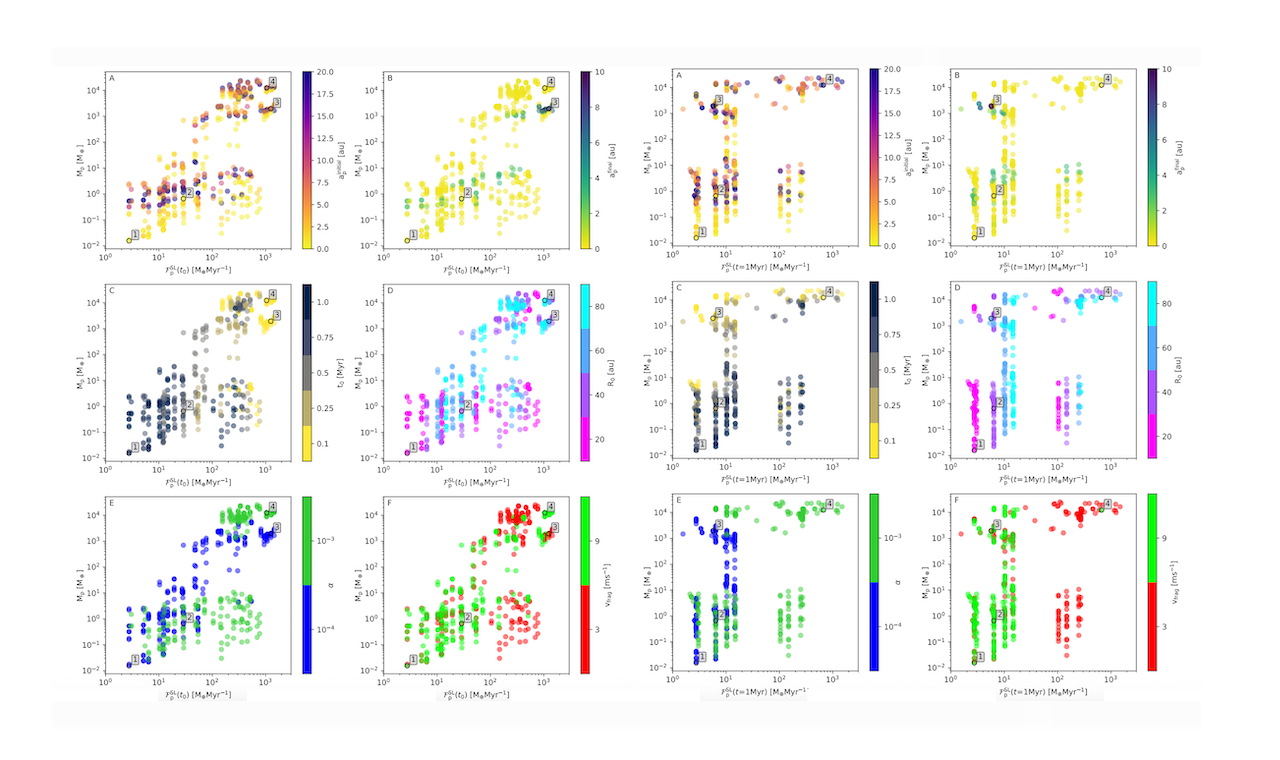
[LEFT] Final planet mass vs pebble flux across the snowline at time of insertion. Plots A and B are coloured by the planet’s initial and final semi-major axes
respectively. Plot C is coloured by the planet’s insertion time 𝑡0, and plot D is coloured by the characteristic disk radius 𝑅0. Plot E is coloured by the disk’s 𝛼
parameter, and plot F is coloured by the fragmentation velocity 𝑣frag. All plots contain outlined numbered points, which correspond to the points numbered in
Fig. 2. [RIGHT Final planet mass vs pebble flux across the snowline at 1 Myr. Plots A and B are coloured by the planet’s final and initial semi-major axes respectively.
Plot C is coloured by the planet’s insertion time 𝑡0, and plot D is coloured by the characteristic disk radius 𝑅0. Plot E is coloured by the disk’s 𝛼 parameter, and
plot F is coloured by the fragmentation velocity 𝑣frag. All plots contain outlined numbered points, which correspond to the points numbered in Fig. 2. — astro-ph.EP
Pebble drift plays a central role in modern planet formation models. In this work we carry out planet formation simulations (including pebble accretion and migration) for a range of disc parameters to investigate (a) the impact of the snowline pebble mass flux on final planet orbits and masses, and (b) the back-reaction of growing and migrating planets on the snowline pebble fluxes in their natal discs. We find a strong correlation between the snowline pebble flux (at the time of protoplanet insertion) and the final planet mass.
The correlation is continuous in disks with high turbulence levels (α=10−3), but exhibits a step function at lower turbulence (α=10−4), with giant planet formation requiring (initial) snowline pebble mass fluxes exceeding 100 M⊕Myr−1.
We find qualitative agreement between pebble mass fluxes inferred for discs aged ∼1 Myr and our planet-containing models, especially for larger disks (≥40 au), high α (10−3), and low vfrag (3 m s−1). Additionally, giant planets in high turbulence disks are found to perturb the snowline pebble flux only temporarily (for ≈105−6 yr) due to them quickly growing and migrating across the snowline.
Our simulations show that currently observed pebble fluxes can indeed be used to constrain planet formation simulations, emphasizing that planet formation via pebble accretion is broadly in agreement with the currently available constraints from disc evolution as provided by JWST.
Danila Astrakhantsev, Sebastiaan Krijt, Sofia Savvidou, Bertram Bitsch
Comments: Accepted for publication in MNRAS
Subjects: Earth and Planetary Astrophysics (astro-ph.EP)
Cite as: arXiv:2604.14358 [astro-ph.EP] (or arXiv:2604.14358v1 [astro-ph.EP] for this version)
https://doi.org/10.48550/arXiv.2604.14358
Focus to learn more
Related DOI:
https://doi.org/10.1093/mnras/stag721
Focus to learn more
Submission history
From: Danila Astrakhantsev
[v1] Wed, 15 Apr 2026 19:19:39 UTC (1,879 KB)
https://arxiv.org/abs/2604.14358
Astrobiology, Astrochemistry, Astrogeology,











Related Posts

Stay Informed With the Latest & Most Important News
Previous Post
Next Post

Advertisement
-
 01Two Black Holes Observed Circling Each Other for the First Time
 -
 02From Polymerization-Enabled Folding and Assembly to Chemical Evolution: Key Processes for Emergence of Functional Polymers in the Origin of Life
 -
 03Astronomy 101: From the Sun and Moon to Wormholes and Warp Drive, Key Theories, Discoveries, and Facts about the Universe (The Adams 101 Series)
 -
 04True Anomaly hires former York Space executive as chief operating officer
 -
 05Φsat-2 begins science phase for AI Earth images
 -
 06Hurricane forecasters are losing 3 key satellites ahead of peak storm season − a meteorologist explains why it matters
 -
 07Binary star systems are complex astronomical objects − a new AI approach could pin down their properties quickly