
Now Reading: SpaceX accelerates renovations at Pad 1 while preparing for future launches
-
01
SpaceX accelerates renovations at Pad 1 while preparing for future launches

SpaceX accelerates renovations at Pad 1 while preparing for future launches

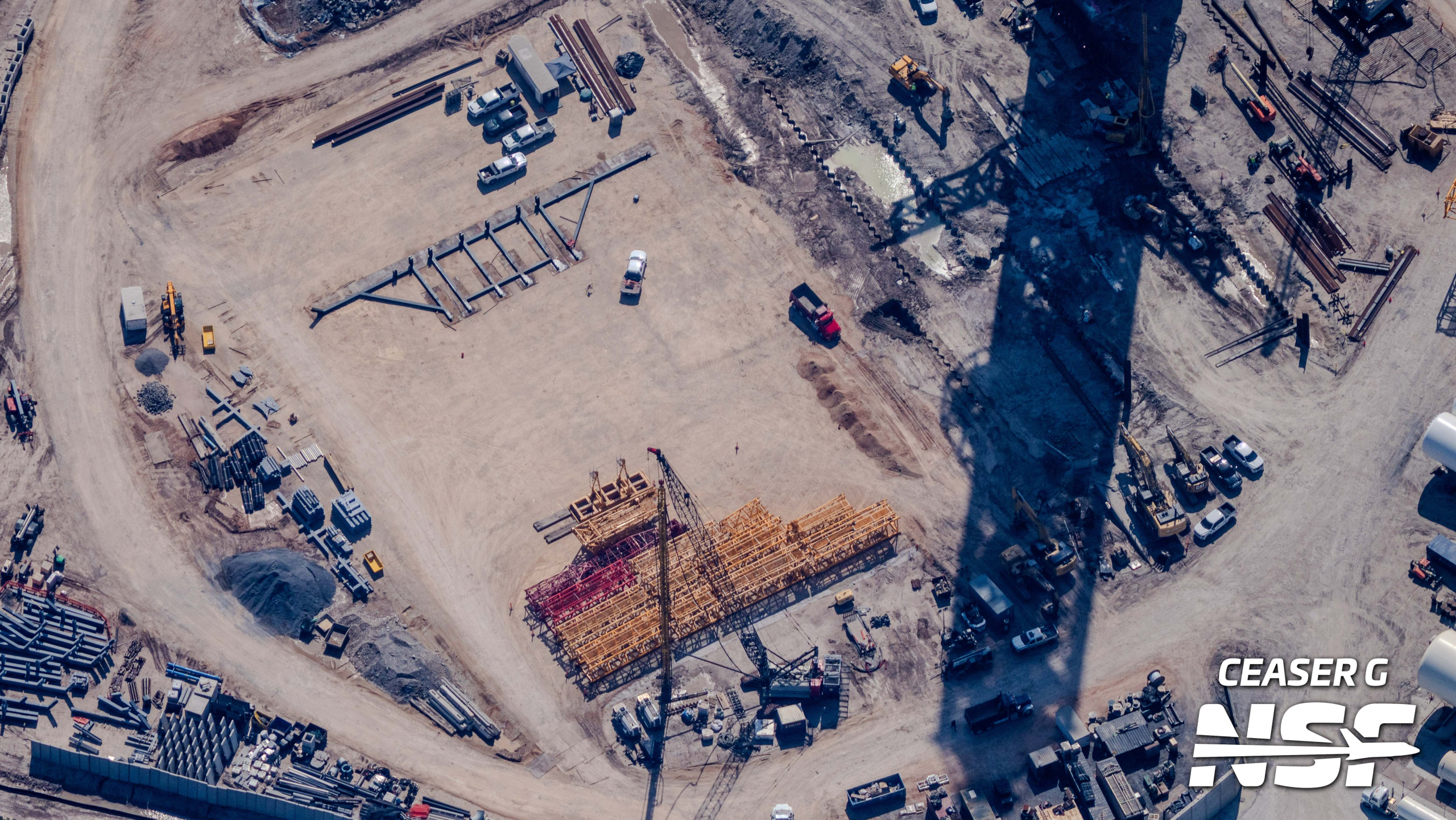

More than six months after completing Flight 11, SpaceX has made notable strides in the transformation of Pad 1 into a modern launch facility comparable to Pad 2. Following the demolition of the old infrastructure, the teams are now preparing to excavate the trench, indicating a pivotal moment in the ongoing renovation efforts.
The conversion work on Pad 1 has progressed rapidly, with the essential elements such as Continuous Flight Auger piles, sheet piles, and deep soil mixing now finished. With these tasks completed, excavation work is set to begin, including the installation of tiebacks that will stabilize the sheet piles during the construction phase. While there is still significant work ahead before the trench is fully excavated and a concrete floor can be installed, current progress appears to be on schedule.
In addition to the trench work, the components for the water buckets designated for Pad 1 have begun arriving at SpaceX’s Sanchez facility for assembly. This time, the construction method has been adjusted, with teams opting to preassemble sections of five pipes rather than building them one by one as was done for Pad 2. Furthermore, parts for the second level of the launch mount, which include the critical hold-down arms, are also arriving at Sanchez, awaiting assembly.
To expedite the process, crews are constructing the side service structure in a nearby staging area, which will be ready to be installed once the trench is developed. When the time comes for placement, the Buckner LR11000 crane is expected to be employed to lift the preassembled structure into position.
In a recent update, SpaceX used the same crane to remove six smaller liquid methane tanks from the launch site, of which one had never been used. These tanks have been relocated to a road adjacent to the port and may either be transported to another SpaceX location or sold. The other two older tanks have been moved alongside newer equipment, bringing the total count of liquid methane storage tanks to eight, solidifying SpaceX’s methane storage strategy.
Looking ahead, the Buckner LR11000 also has plans to take down the outdated Ship Quick Disconnect arm. This component may require either significant retrofitting or a complete rebuild, contingent on its operational viability.
As preparations for Pad 1 continue, attention shifts toward Pad 2, which is nearing completion ahead of its anticipated launch, potentially scheduled for mid to late May. Crews are actively testing various systems, including the tank farm’s readiness and the ship quick disconnect mechanism’s functionality, in preparation for the stacking of a ship atop the booster.
Recent tests have highlighted both successes and challenges. SpaceX has successfully conducted comprehensive retraction tests simulating launch sequences, yet issues surfaced with the water deluge system, which caused disturbances during two static-fire tests of Booster 19. An incident during a recent deluge test involved a gas generator explosion, although the impact was limited to the top structure.
As for the next flight, Booster 20 and Ship 40 are in the pipeline, with Booster 20 currently undergoing its final modifications before it heads to Massey’s for cryogenic proof testing. Ship 40 has already rolled out for similar evaluations at the same facility, with ongoing assessments of its flaps and other components. While the timeline for these vehicles to be flight-ready remains tentative, the gap between Flights 12 and 13 is expected to be shorter than in previous cycles, reflecting SpaceX’s continual adaptation to streamline its launch preparations.










Related Posts


Stay Informed With the Latest & Most Important News
Previous Post
Next Post


Advertisement
-
 01Two Black Holes Observed Circling Each Other for the First Time
 -
 02From Polymerization-Enabled Folding and Assembly to Chemical Evolution: Key Processes for Emergence of Functional Polymers in the Origin of Life
 -
 03Astronomy 101: From the Sun and Moon to Wormholes and Warp Drive, Key Theories, Discoveries, and Facts about the Universe (The Adams 101 Series)
 -
 04True Anomaly hires former York Space executive as chief operating officer
 -
 05Φsat-2 begins science phase for AI Earth images
 -
 06Hurricane forecasters are losing 3 key satellites ahead of peak storm season − a meteorologist explains why it matters
 -
 07Binary star systems are complex astronomical objects − a new AI approach could pin down their properties quickly