
Now Reading: Spectral Signatures From The Habitable Zone
-
01
Spectral Signatures From The Habitable Zone


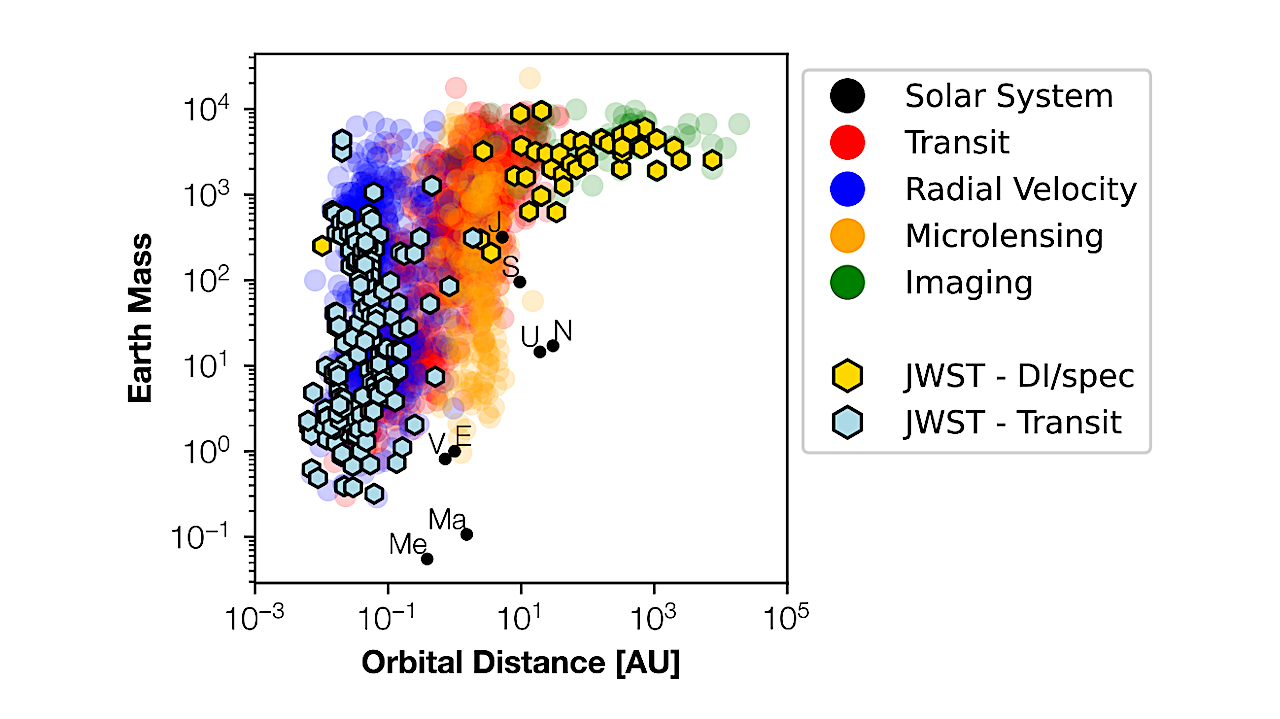
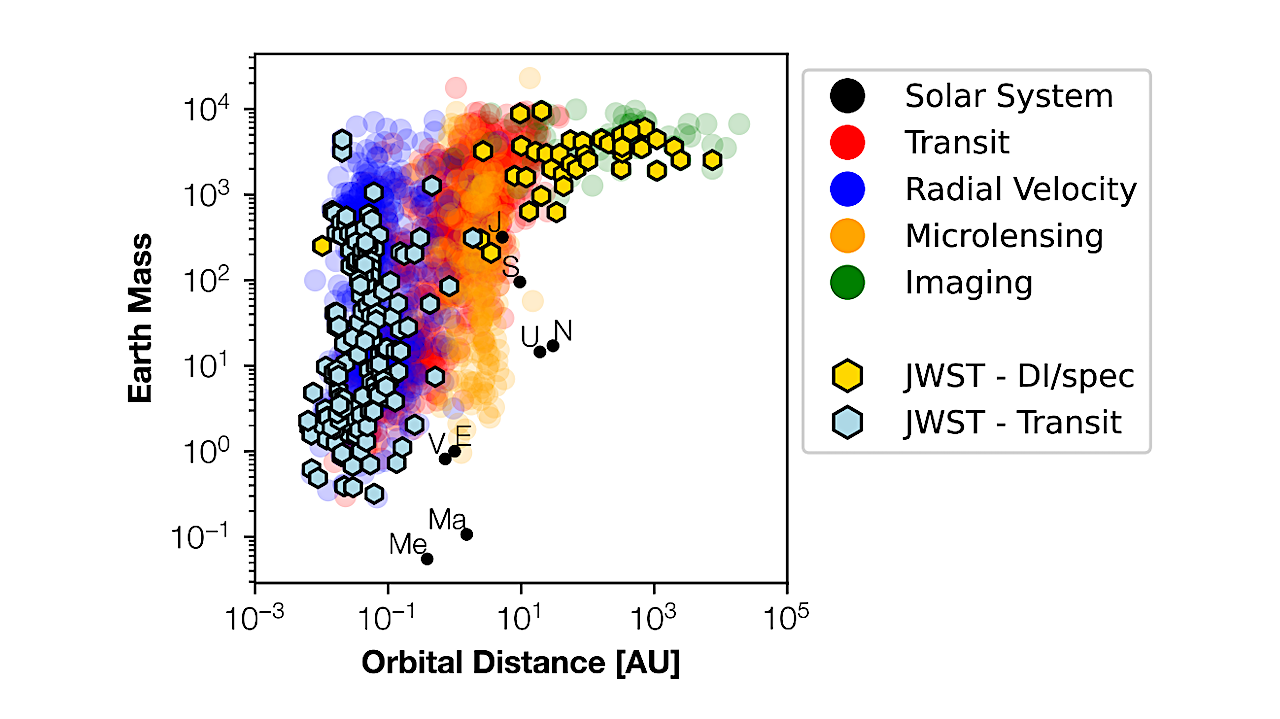
The mass versus orbital distance of currently discovered and characterized exoplanets. Solar system planets are indicated as well. The hexagonal icons, indicating spectroscopic characterization studied done using JWST, are adopted from Espinoza & Perrin (2025). Direct imaging, currently limited to far out and large planets, will have to advance in sensitivity and contrast ratio to reach Earth-like planets. — astro-ph.EP
This work describes the context and approach for the detection of spectroscopic signatures from planets in the habitable zone of nearby stars.
By understanding the limitations of current observatories, future telescopes can be understood, and their ability to characterize the atmospheres of exoplanets estimated. An example calculation is given for the signal-to-noise analysis for a planet like the current Earth of oxygen as a biosignature, and (an enhanced abundance) of hydrogen iodine as a technosignature.
In the optimistic estimate, Earth is easily detected, O2 characterized in 20 hours, but signals from enhance HI are only visible after hundreds of hours, indicating the signals are too weak to realistically constrain.
Vincent Kofman
Comments: In Advancing the Search for Technosignatures, Proceedings of IAU Symposium #404 (forthcoming)
Subjects: Earth and Planetary Astrophysics (astro-ph.EP)
Cite as: arXiv:2604.08993 [astro-ph.EP] (or arXiv:2604.08993v1 [astro-ph.EP] for this version)
https://doi.org/10.48550/arXiv.2604.08993
Focus to learn more
Submission history
From: Vincent Kofman
[v1] Fri, 10 Apr 2026 05:57:46 UTC (523 KB)
https://arxiv.org/abs/2604.08993
Astrobiology, exoplanet,











Related Posts
Stay Informed With the Latest & Most Important News

Advertisement
-
 01Two Black Holes Observed Circling Each Other for the First Time
 -
 02From Polymerization-Enabled Folding and Assembly to Chemical Evolution: Key Processes for Emergence of Functional Polymers in the Origin of Life
 -
 03Astronomy 101: From the Sun and Moon to Wormholes and Warp Drive, Key Theories, Discoveries, and Facts about the Universe (The Adams 101 Series)
 -
 04True Anomaly hires former York Space executive as chief operating officer
 -
 05Φsat-2 begins science phase for AI Earth images
 -
 06Hurricane forecasters are losing 3 key satellites ahead of peak storm season − a meteorologist explains why it matters
 -
 07Binary star systems are complex astronomical objects − a new AI approach could pin down their properties quickly