
Now Reading: Sub-Neptunes As Soot Factories: Deep Atmosphere Hydrocarbon Formation and Quenching as the Origin of Sub-Neptune Aerosol Trends
-
01
Sub-Neptunes As Soot Factories: Deep Atmosphere Hydrocarbon Formation and Quenching as the Origin of Sub-Neptune Aerosol Trends

Sub-Neptunes As Soot Factories: Deep Atmosphere Hydrocarbon Formation and Quenching as the Origin of Sub-Neptune Aerosol Trends

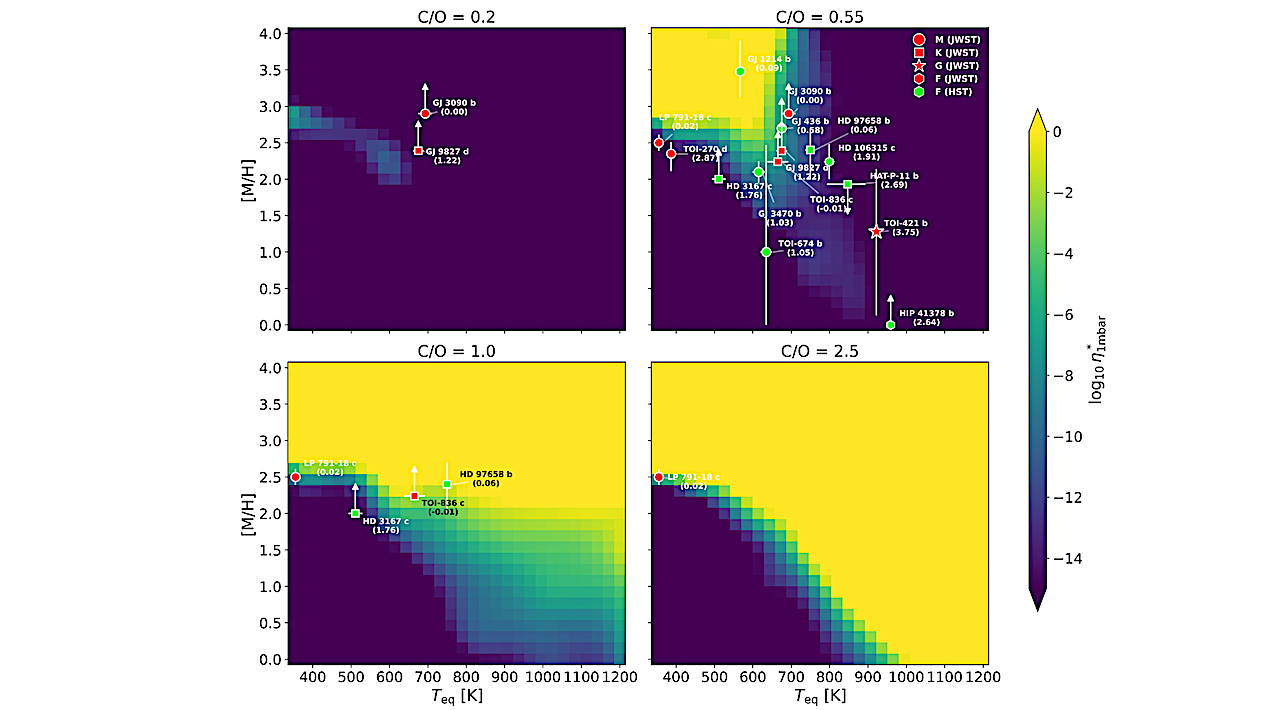
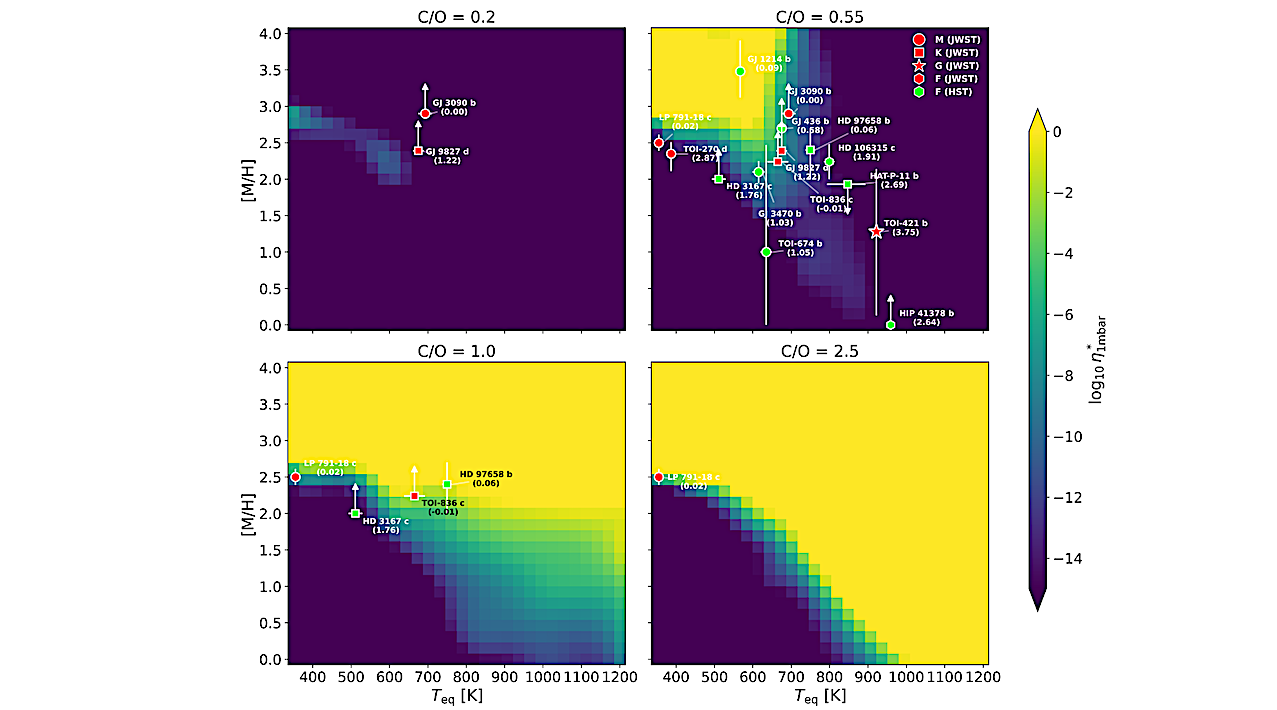
2D color map as a function of Teq and [M/H], where the color denotes the logarithm of the photochemistry effect-included sooting propensity at P =1 mbar, η∗1mbar, as defined in Section 3.3. Each panel corresponds to a different C/O, spanning 0.2 to 2.5, as indicated. Markers with error bars indicate the observations for which [M/H] constraints have been reported in the literature. All planets are assumed to have a solar C/O ratio of 0.55 by default and are plotted in the upper right-hand panel. However, for planets with indications from the literature that their atmospheric C/O may deviate from the solar value (LP 791-18 c, HD 3167 c, GJ 3090 b, GJ 9827 d, TOI-836 c, and HD 97658 b), we additionally plot their locations in the corresponding non-solar C/O panels to illustrate the sensitivity of their interpretation to the assumed C/O ratio. Numbers in parentheses denote the signal amplitude of the 1.4 µm H2O or CH4 absorption band in the corresponding observations, expressed in units of atmospheric scale heights and assuming a mean molecular weight of 3.05 adopted from Brande et al. (2024); Roy et al. (2025). Color denotes the observatory from which the signal amplitude was derived, with JWST shown in red and HST shown in lime. Marker shapes denote host star spectral type, with circles for M type, squares for K type, stars for G type, and hexagons for F type. References and adopted atmospheric parameters for each plotted planet are provided in Table D2 in Appendix D — astro-ph.EP
Recent population-level studies of sub-Neptune atmospheres have identified a parabolic trend in transmission spectrum amplitude for planets with Teq ~ 500-800 K. While the trend has been commonly attributed to hydrocarbon aerosols, we lack a first-principles explanation of its underlying chemical mechanism.
Previous work has focused on the role of methane photolysis and subsequent polymerization, but with limited reaction networks that truncated at C2-species and couldn’t reproduce the observed parabolic trend.
In this work, enabled by a computer-automated, rate-based chemical network generator, we construct the most comprehensive carbon reaction network for exoplanet atmospheres to date. We explicitly model the formation of polycyclic aromatic hydrocarbons (PAHs), which are well established as soot precursors in combustion chemistry.
We calculate the chemical timescales of hydrocarbon species through an eigenvalue timescale method and model their quenched abundances across a range of C/O, metallicities, and Teq.
In this framework, the deep atmosphere acts as a “soot factory” analogous to a combustion engine, transporting the ingredients for hydrocarbon aerosol formation to the JWST-observable region of the atmosphere, where it may be further augmented by photochemistry.
We find that the predicted abundances of PAHs peak near 600 K, and fall off toward higher and lower Teq, in agreement with the observed parabolic trend and existing JWST and HST observations. We also show that PAH abundances are expected to vary with C/O and metallicity, thus providing a natural explanation for observed diversity among planets with similar Teq.
Jeehyun Yang, Eliza M.-R. Kempton, Arjun B. Savel
Comments: 14 pages, 6 figures, resubmitted after first revision at ApJL. Comments are welcome
Subjects: Earth and Planetary Astrophysics (astro-ph.EP)
Cite as: arXiv:2604.11919 [astro-ph.EP] (or arXiv:2604.11919v1 [astro-ph.EP] for this version)
https://doi.org/10.48550/arXiv.2604.11919
Focus to learn more
Submission history
From: Jeehyun Yang
[v1] Mon, 13 Apr 2026 18:07:10 UTC (14,633 KB)
https://arxiv.org/abs/2604.11919
Astrobiology, exoplanet,










Related Posts
Stay Informed With the Latest & Most Important News
Advertisement
-
 01Two Black Holes Observed Circling Each Other for the First Time
 -
 02From Polymerization-Enabled Folding and Assembly to Chemical Evolution: Key Processes for Emergence of Functional Polymers in the Origin of Life
 -
 03Astronomy 101: From the Sun and Moon to Wormholes and Warp Drive, Key Theories, Discoveries, and Facts about the Universe (The Adams 101 Series)
 -
 04True Anomaly hires former York Space executive as chief operating officer
 -
 05Φsat-2 begins science phase for AI Earth images
 -
 06Hurricane forecasters are losing 3 key satellites ahead of peak storm season − a meteorologist explains why it matters
 -
 07Binary star systems are complex astronomical objects − a new AI approach could pin down their properties quickly