
Now Reading: The Catastrophic Consequences of Agnosticism for Life Searches and a Possible Workaroun
-
01
The Catastrophic Consequences of Agnosticism for Life Searches and a Possible Workaroun

The Catastrophic Consequences of Agnosticism for Life Searches and a Possible Workaroun

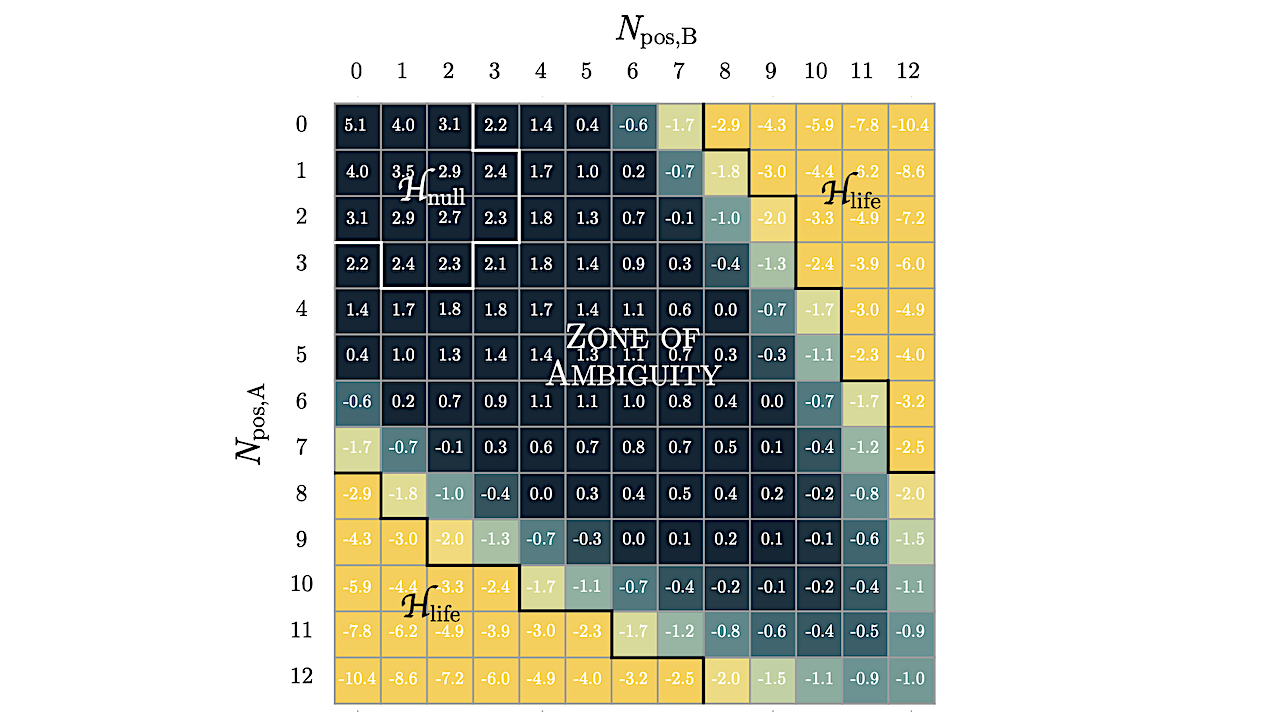
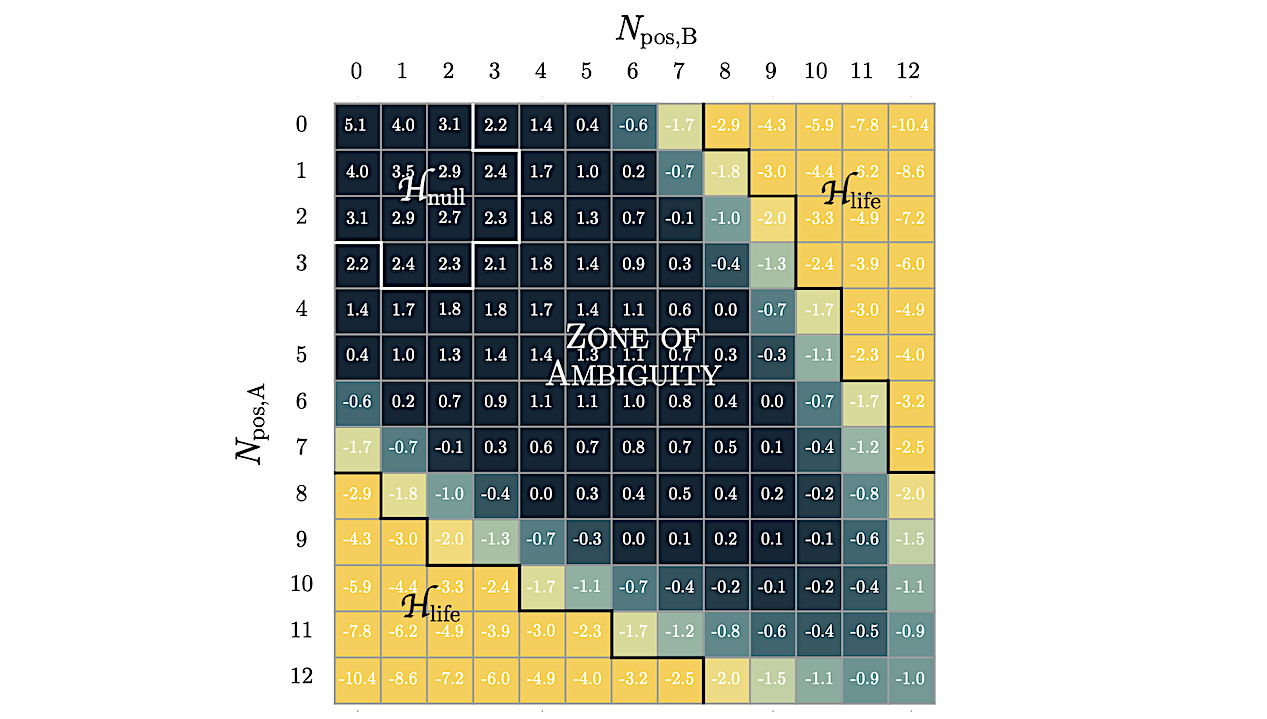
Grid plot of the log-Bayes factor for the null (no life) hypothesis versus
the affirmative (life) hypothesis (Kf0) when a sample of Ntot = 24 targets are split into
two groups with differing life rates but a global confounder rate. Although a large zone
of ambiguity persists, the life hypothesis can be strongly claimed in 40 of 169 possible
outcomes. For comparison, with a monolithic population we find that no outcomes could
ever achieve this. — astro-ph.IM
Planned and ongoing searches for life, both biological and technological, confront an epistemic barrier concerning false positives – namely, that we don’t know what we don’t know.
The most defensible and agnostic approach is to adopt diffuse (uninformative) priors, not only for the prevalence of life, but also for the prevalence of confounders. We evaluate the resulting Bayes factors between the null and life hypotheses for an idealized experiment with Npos positive labels (biosignature detections) among Ntot targets with various priors.
Using diffuse priors, the consequences are catastrophic for life detection, requiring at least ∼104 (for some priors ∼1013) surveyed targets to ever obtain “strong evidence” for life. Accordingly, an HWO-scale survey with Ntot∼25 would have no prospect of achieving this goal.
A previously suggested workaround is to forgo the agnostic confounder prior, by asserting some upper limit on it for example, but we find that the results can be highly sensitive to this choice – as well as difficult to justify. Instead, we suggest a novel solution that retains agnosticism: by dividing the sample into two groups for which the prevalence of life differs, but the confounder rate is global.
We show that a Ntot=24 survey could expect 24% of possible outcomes to produce strong life detections with this strategy, rising to ≥50% for Ntot≥76. However, AB-testing introduces its own unique challenges to survey design, requiring two groups with differing life prevalence rates (ideally greatly so) but a global confounder rate.
David Kipping
Comments: Submitted to AAS journals
Subjects: Instrumentation and Methods for Astrophysics (astro-ph.IM); Applications (stat.AP)
Cite as: arXiv:2605.02969 [astro-ph.IM] (or arXiv:2605.02969v1 [astro-ph.IM] for this version)
https://doi.org/10.48550/arXiv.2605.02969
Focus to learn more
Submission history
From: David Kipping
[v1] Sun, 3 May 2026 13:19:46 UTC (519 KB)
https://arxiv.org/abs/2605.02969
Astrobiology,










Related Posts

Stay Informed With the Latest & Most Important News
Previous Post
Next Post


Advertisement
-
 01Two Black Holes Observed Circling Each Other for the First Time
 -
 02From Polymerization-Enabled Folding and Assembly to Chemical Evolution: Key Processes for Emergence of Functional Polymers in the Origin of Life
 -
 03Astronomy 101: From the Sun and Moon to Wormholes and Warp Drive, Key Theories, Discoveries, and Facts about the Universe (The Adams 101 Series)
 -
 04True Anomaly hires former York Space executive as chief operating officer
 -
 05Φsat-2 begins science phase for AI Earth images
 -
 06Hurricane forecasters are losing 3 key satellites ahead of peak storm season − a meteorologist explains why it matters
 -
 07Binary star systems are complex astronomical objects − a new AI approach could pin down their properties quickly