
Now Reading: The Influences of Hydrogen-Silicate-Iron Miscibility on the Demographics of Sub-Neptunes and Super-Earths
-
01
The Influences of Hydrogen-Silicate-Iron Miscibility on the Demographics of Sub-Neptunes and Super-Earths

The Influences of Hydrogen-Silicate-Iron Miscibility on the Demographics of Sub-Neptunes and Super-Earths

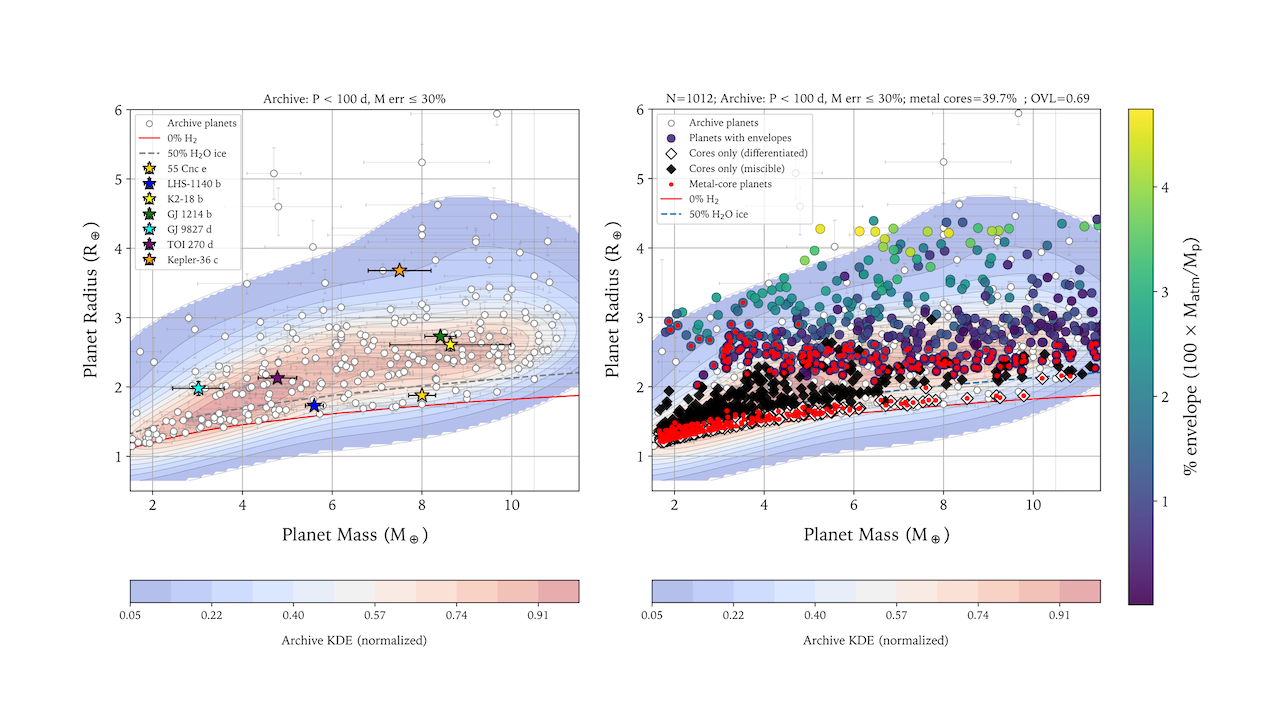
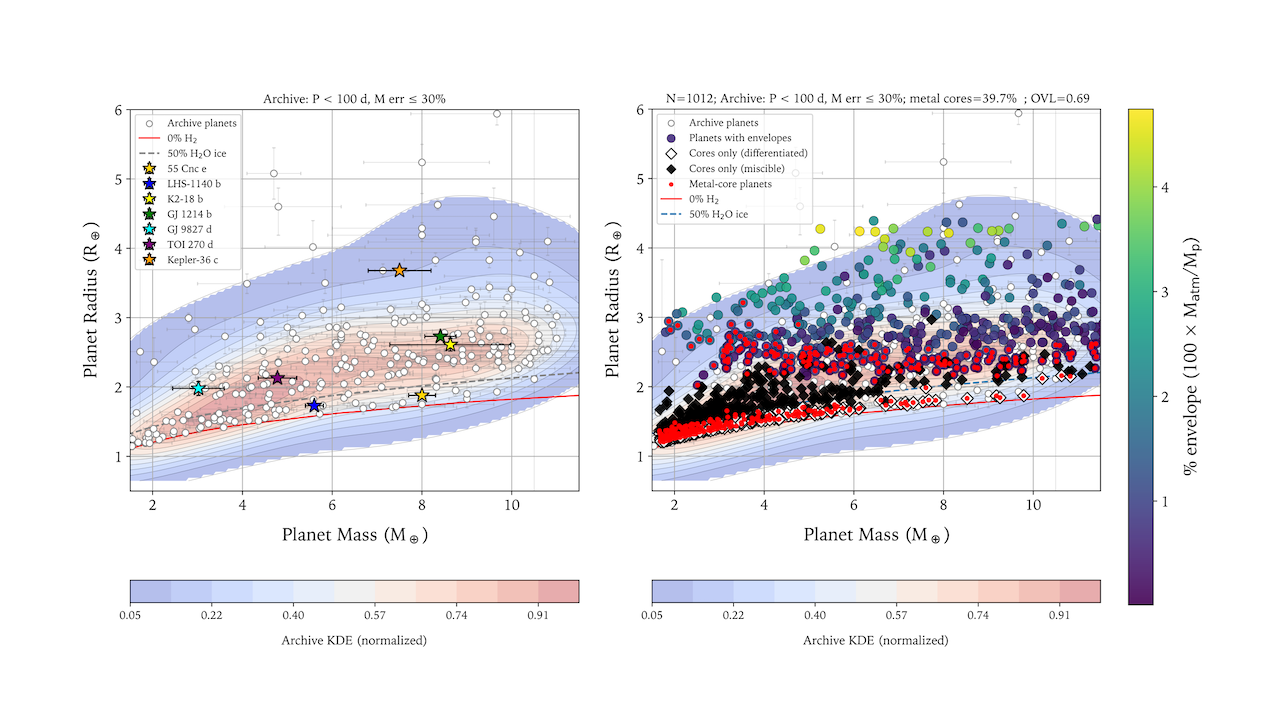
LEFT – Mass versus radius diagram for 261 archive planets, together with several example planets discussed in the text. Planets all have periods 100 days and mass precision of less than or equal to 30%. Contours are for equal kernel density, illustrating the density of points. No points are shown below the pure Earth-like mass vs. density curve since these planets are not included in our models. Also shown is a curve for 50% by mass water ice, based on an Earth-like core mixed with low-pressure water ice, cf. Aguichine et al. (2021). RIGHT – Comparison of model planets with observed planets in mass vs. radius space. Archive data, shown as white circles with error bars, define contours of equal kernel density (KDE contours). The colors of the model data points reflect their mass fractions of envelopes (in percent), with the exception of the white diamonds. Colored circles with no red dot have entirely miscible interiors with H2-rich envelopes. Colored circles with red dots have H2-rich envelopes and have discrete, Fe-rich metal cores. Black diamonds are fully miscible interiors that no longer have envelopes of hydrogen. White diamonds with red dots are differentiated interiors with Fe-rich metal cores that have been stripped of their primary H2-rich envelopes. — astro-ph.EP
Models based on variable miscibility among hydrogen, molten silicate, and molten iron, coupled with atmospheric escape, can reproduce the observed occurrence density structure of sub-Neptunes and super-Earths in mass-radius space.
The models are also consistent with the radius gap and the observed radius-period relationship exhibited by these planets. The degree of overlap between predicted and observed planetary occurrences suggests that hydrogen-silicate-iron miscibility may serve as a unifying concept for the formation and evolution of these planet classes.
The well-defined equilibrium conditions at the boundary between supercritical magma oceans and the overlying hydrogen-rich envelopes are important features of the models. Planets formed with less than ~1 % hydrogen by mass develop discrete, terrestrial-like metallic cores, while those accreting greater hydrogen concentrations are predicted to have fully miscible interiors and no discrete metal cores.
Hydrogen-silicate-iron miscibility provides an overarching explanation for the full range of sub-Neptune and super-Earth architectures based on the accreted hydrogen mass fraction and the phase equilibria governing silicate, iron metal, and H2 miscibility.
Edward D. Young, Aaron Werlen
Comments: Submitted to ApJ
Subjects: Earth and Planetary Astrophysics (astro-ph.EP)
Cite as: arXiv:2604.28135 [astro-ph.EP] (or arXiv:2604.28135v1 [astro-ph.EP] for this version)
https://doi.org/10.48550/arXiv.2604.28135
Focus to learn more
Submission history
From: Edward Young
[v1] Thu, 30 Apr 2026 17:18:21 UTC (15,100 KB)
https://arxiv.org/abs/2604.28135
Astrobiology, exoplanet,











Related Posts

Stay Informed With the Latest & Most Important News


Advertisement
-
 01Two Black Holes Observed Circling Each Other for the First Time
 -
 02From Polymerization-Enabled Folding and Assembly to Chemical Evolution: Key Processes for Emergence of Functional Polymers in the Origin of Life
 -
 03Astronomy 101: From the Sun and Moon to Wormholes and Warp Drive, Key Theories, Discoveries, and Facts about the Universe (The Adams 101 Series)
 -
 04True Anomaly hires former York Space executive as chief operating officer
 -
 05Φsat-2 begins science phase for AI Earth images
 -
 06Hurricane forecasters are losing 3 key satellites ahead of peak storm season − a meteorologist explains why it matters
 -
 07Binary star systems are complex astronomical objects − a new AI approach could pin down their properties quickly