
Now Reading: Three-dimensional Transport-induced Chemistry On Temperate Sub-Neptune K2-18b, Part II: The Combined Effects Of Atmospheric Dynamics And Chemical Reactions
-
01
Three-dimensional Transport-induced Chemistry On Temperate Sub-Neptune K2-18b, Part II: The Combined Effects Of Atmospheric Dynamics And Chemical Reactions

Three-dimensional Transport-induced Chemistry On Temperate Sub-Neptune K2-18b, Part II: The Combined Effects Of Atmospheric Dynamics And Chemical Reactions

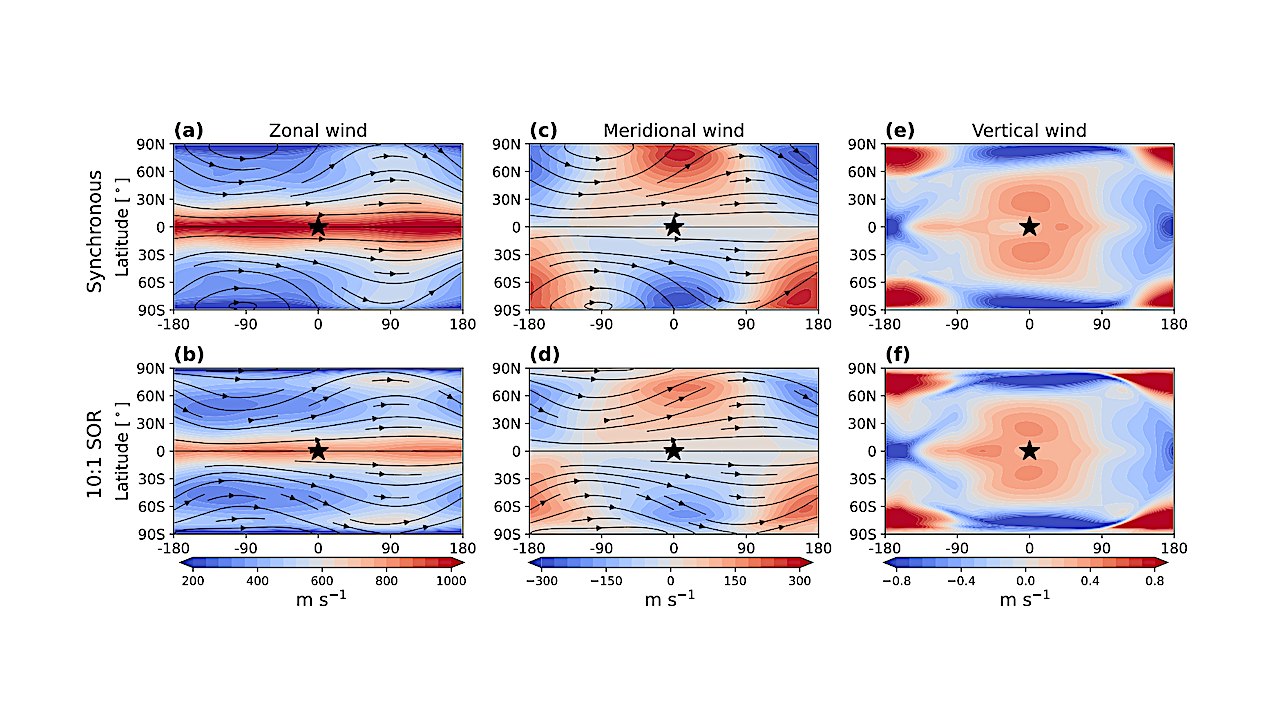
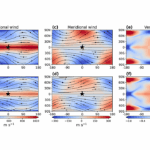
Wind structures for the synchronous and 10:1 SOR simulations, reproduced from fig. 5 of Part I and included here for reference. Columns from left to right show the horizontal distribution of zonal wind, meridional wind, and vertical wind at 0.001 bar. Streamlines indicate the direction of the horizontal flow. Results are shown in the heliocentric frame to more clearly illustrate the wind patterns. Black star-shaped markers indicate the location of the substellar point. The first and second rows show results from the synchronous and 10:1 SOR simulations as examples, with the wind patterns in other simulations being similar. — astro-ph.EP
The upper atmospheres of temperate sub-Neptunes are strongly influenced by atmospheric dynamics due to their cool equilibrium temperature and thereby longer chemical timescales than the atmospheric dynamical timescales.
In this study, we used a three-dimensional (3D) general circulation model to investigate the transport-induced disequilibrium chemistry and vertical mixing on temperate gas-rich mini-Neptunes, using K2-18b as an example. We model K2-18b assuming 180 times solar metallicity and consider it as either a synchronous or an asynchronous rotator, exploring spin-orbit resonances of 2:1, 6:1, and 10:1.
We find that the vertical transport affects the chemical structure significantly, making CO2 and CO more abundant (∼10−3) in the upper atmosphere compared to the chemical equilibrium abundance (<10−15), and horizontal winds further homogenize the chemical composition zonally in this region. Molecular abundances in the photosphere generally agree across different rotation periods.
We employ a passive tracer in the model to estimate the one-dimensional (1D) equivalent eddy-diffusion coefficient (Kzz) of K2-18b, providing a parameter useful for future 1D atmospheric models.
Additionally, synthetic transmission spectra generated from our model are compared with the JWST observations, and we find that our model can provide a comparable fit to the observations. This work offers a 3D perspective on transport-induced chemistry on a temperate sub-Neptune and derives vertical mixing parameters to support 1D modelling.
Jiachen Liu, Duncan Christie, Jun Yang, Krisztian Kohary
Comments: Resubmitted to MNRAS after addressing referee’s comments
Subjects: Earth and Planetary Astrophysics (astro-ph.EP)
Cite as: arXiv:2604.07987 [astro-ph.EP] (or arXiv:2604.07987v1 [astro-ph.EP] for this version)
https://doi.org/10.48550/arXiv.2604.07987
Focus to learn more
Submission history
From: Jiachen Liu
[v1] Thu, 9 Apr 2026 08:55:46 UTC (3,159 KB)
https://arxiv.org/abs/2604.07987
Astrobiology, exoplanet,











Related Posts
Stay Informed With the Latest & Most Important News

Advertisement
-
 01Two Black Holes Observed Circling Each Other for the First Time
 -
 02From Polymerization-Enabled Folding and Assembly to Chemical Evolution: Key Processes for Emergence of Functional Polymers in the Origin of Life
 -
 03Astronomy 101: From the Sun and Moon to Wormholes and Warp Drive, Key Theories, Discoveries, and Facts about the Universe (The Adams 101 Series)
 -
 04True Anomaly hires former York Space executive as chief operating officer
 -
 05Φsat-2 begins science phase for AI Earth images
 -
 06Hurricane forecasters are losing 3 key satellites ahead of peak storm season − a meteorologist explains why it matters
 -
 07Binary star systems are complex astronomical objects − a new AI approach could pin down their properties quickly