
Now Reading: Understanding HWO’s Field of Regard and Characterization Requirement Trade Space with a Dynamic Observation Scheduling Algorithm
-
01
Understanding HWO’s Field of Regard and Characterization Requirement Trade Space with a Dynamic Observation Scheduling Algorithm

Understanding HWO’s Field of Regard and Characterization Requirement Trade Space with a Dynamic Observation Scheduling Algorithm

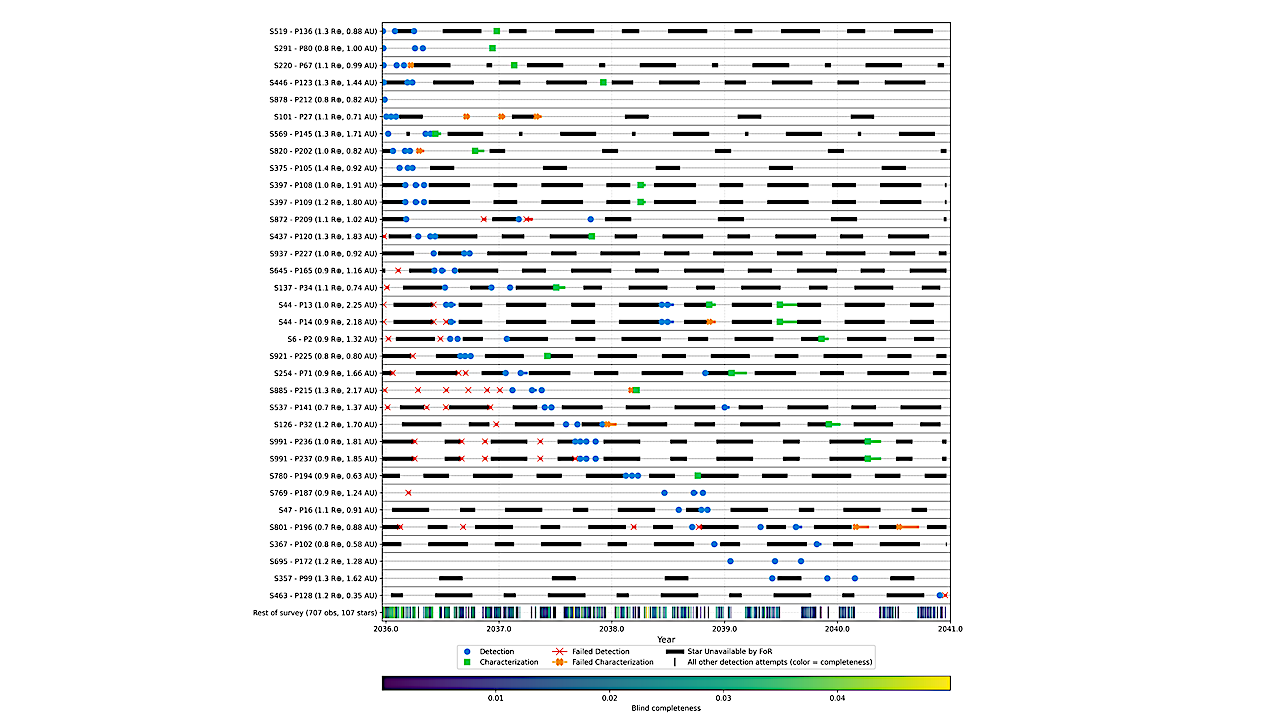
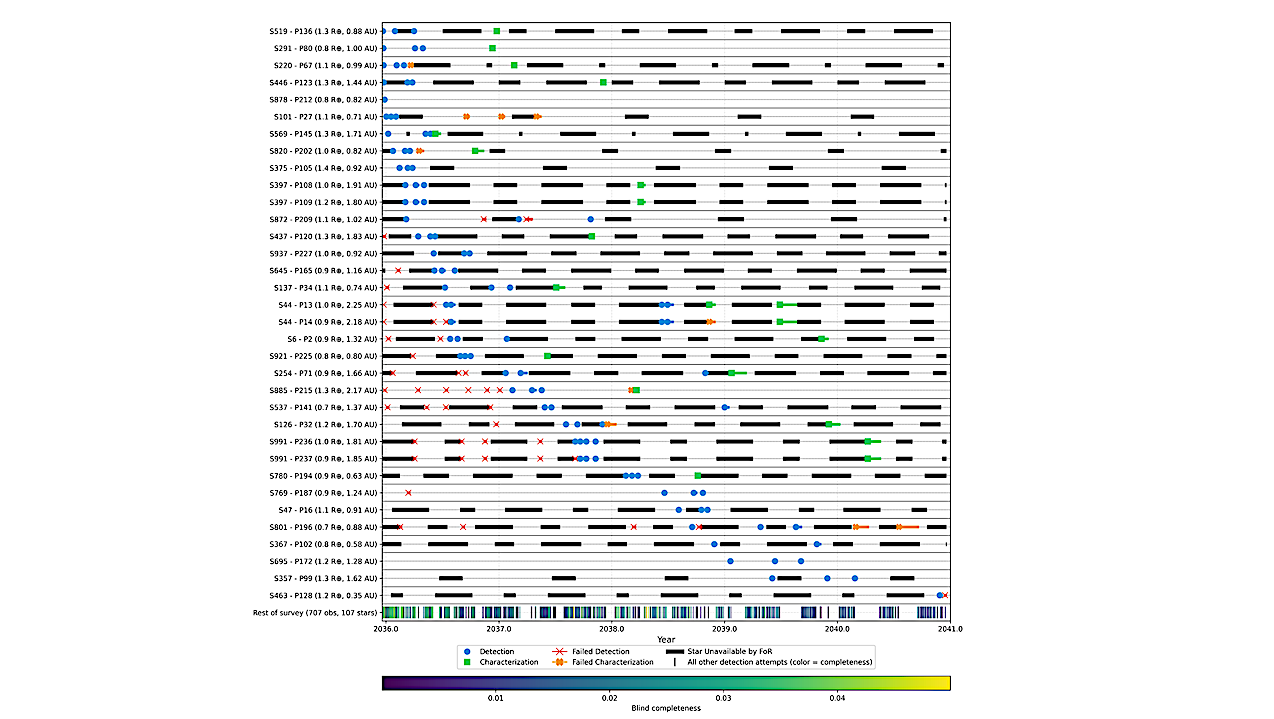
Example mission schedule for a 5 year mission, a 6.5 m inscribed aperture, one required characterization, and FoR of 75◦. The mission detected 34 EECs and characterized 20 of them. The bottom row of the figure shows all blind observations of stars without a detected EEC, with each observation’s opacity representing the completeness of the observation. All other rows show observations of an EEC that was detected during the course of the mission. The black bars indicate that the star was blocked by the FoR constraint. Each detection and characterization observation includes a line showing the duration of the observation. — astro-ph.IM
The Habitable Worlds Observatory (HWO) aims to image and characterize at least 25 ExoEarth candidates (EECs). Achieving this goal requires a detailed understanding of the observatory’s design trade space, including the operational efficiency of the EEC survey.
This study quantifies the impact of two critical parameters: the instantaneous field of regard (FoR) and the number of characterization observations required per EEC (Nchar). We introduce a novel dynamic scheduling algorithm implemented within the EXOSIMS framework that models information gain during the mission. The scheduler models the orbital information known about each planet and forecasts detection probabilities to make scheduling decisions.
We explore a multi-dimensional trade space, varying aperture size (6.5 m and 8.0 m), dedicated EEC survey time (2.5, 5.0, 7.5 years), Nchar (1 to 4), and FoR (15∘ to 135∘). Our results demonstrate that the FoR is a major driver of the mission yield, with the yield decreasing significantly when the FoR is less than 90∘.
We find that increasing Nchar imposes a significant cost to mission yield, as each additional characterization required reduces yield by approximately 22%. The cumulative impact of requiring four characterizations instead of one lowers the yield by approximately 52%. This harsh penalty can be partially mitigated by increasing the survey duration.
The relative yield loss when increasing Nchar from 1 to 2 is 38% for a 2.5 year survey and 14% for a 7.5 year survey. Our results highlight the complex interactions between HWO’s engineering constraints and science requirements, and emphasize that the EEC survey efficiency is a critical component of HWO’s design space.
Corey Spohn, Christopher C. Stark, Dmitry Savransky, Natasha Latouf
Comments: 45 pages, 7 figures, 5 tables. Accepted for publication in JATIS, HWO Pre-Formulation Special Section
Subjects: Instrumentation and Methods for Astrophysics (astro-ph.IM); Earth and Planetary Astrophysics (astro-ph.EP)
Cite as: arXiv:2604.22023 [astro-ph.IM] (or arXiv:2604.22023v1 [astro-ph.IM] for this version)
https://doi.org/10.48550/arXiv.2604.22023
Focus to learn more
Submission history
From: Corey Spohn
[v1] Thu, 23 Apr 2026 19:32:29 UTC (2,758 KB)
https://arxiv.org/abs/2604.22023
Astrobiology, Astronomy, exoplanet,










Related Posts

Stay Informed With the Latest & Most Important News
Previous Post
Next Post


Advertisement
-
 01Two Black Holes Observed Circling Each Other for the First Time
 -
 02From Polymerization-Enabled Folding and Assembly to Chemical Evolution: Key Processes for Emergence of Functional Polymers in the Origin of Life
 -
 03Astronomy 101: From the Sun and Moon to Wormholes and Warp Drive, Key Theories, Discoveries, and Facts about the Universe (The Adams 101 Series)
 -
 04True Anomaly hires former York Space executive as chief operating officer
 -
 05Φsat-2 begins science phase for AI Earth images
 -
 06Hurricane forecasters are losing 3 key satellites ahead of peak storm season − a meteorologist explains why it matters
 -
 07Binary star systems are complex astronomical objects − a new AI approach could pin down their properties quickly