
Now Reading: Uniform Reinterpretation of Rocky Exoplanet Secondary Eclipse Observations and the Impact of Stellar and Orbital Uncertainties
-
01
Uniform Reinterpretation of Rocky Exoplanet Secondary Eclipse Observations and the Impact of Stellar and Orbital Uncertainties

Uniform Reinterpretation of Rocky Exoplanet Secondary Eclipse Observations and the Impact of Stellar and Orbital Uncertainties

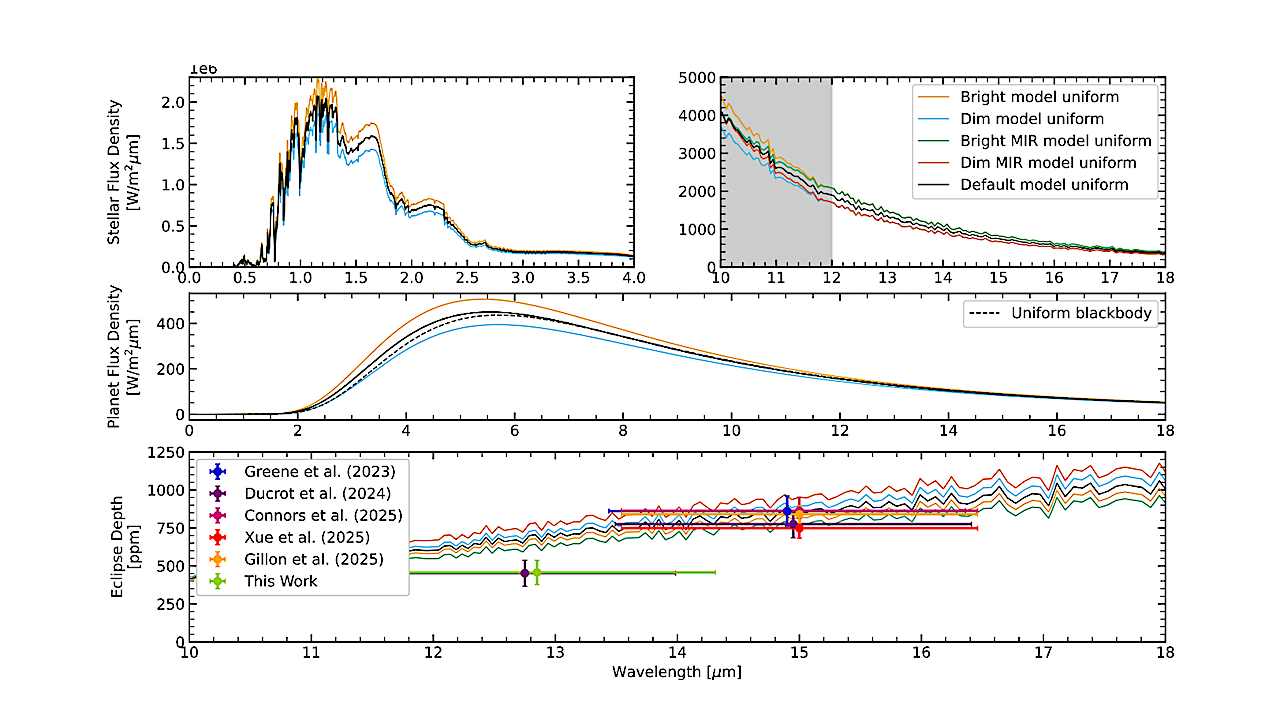
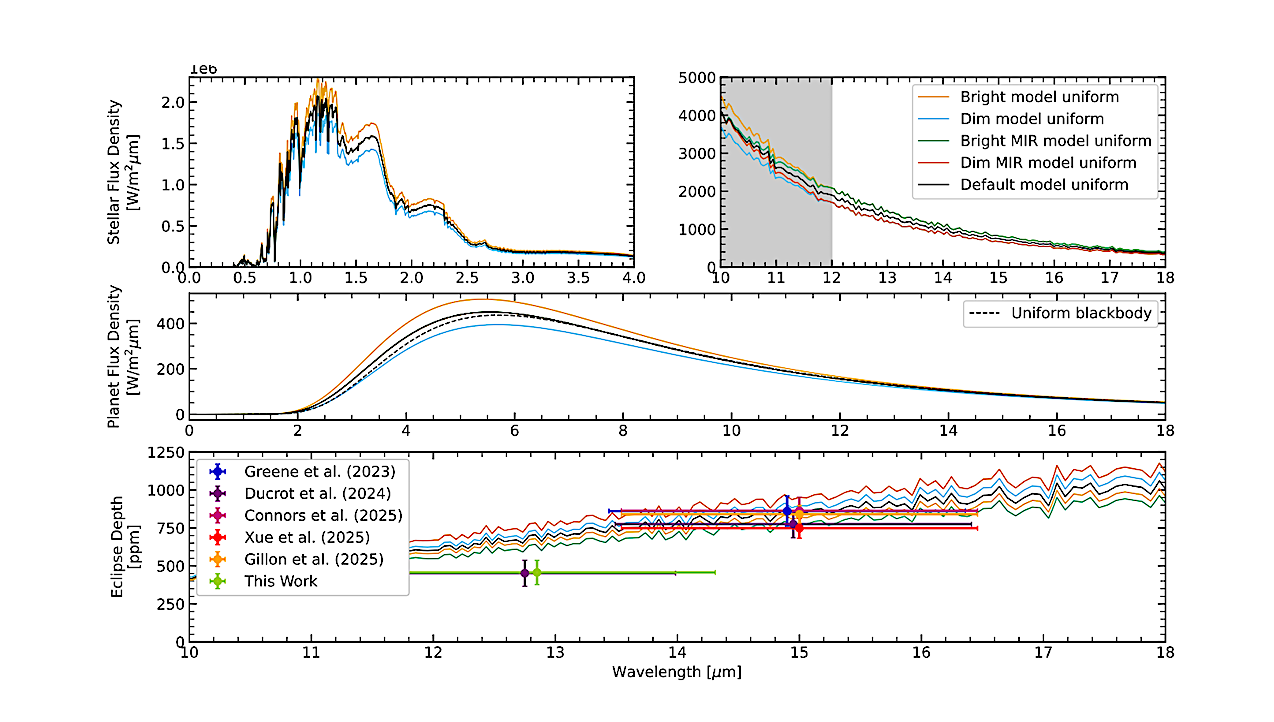
Eclipse spectra of various surface models from Paragas et al. (2025) as simulated by JESTER, compared to the observed eclipse spectra LTT 1445 A b (Wachiraphan et al. 2024) and GJ 1132 b (Xue et al. 2024). Model uncertainty is calculated following Section 3.2. Significant model overlap renders photometric observations incapable of producing strong constraints on the planet’s composition, though exogeological study may remain possible through spectroscopy as the shape and location of wavelength dependent spectral features are preserved. — astro-ph.EP
Secondary eclipse observations are a powerful way to investigate whether or not a rocky exoplanet hosts an atmosphere, as an atmospheric presence would transport heat to the nightside and render the dayside colder than anticipated.
The interpretation of the secondary eclipse observations relies, however, on models based on imperfect knowledge of the host star properties and the system parameters. Any uncertainties in such astrophysical variables will propagate into both atmospheric and bare-rock models, potentially leading to poorly constrained results and erroneous conclusions.
In this work, we introduce a framework to efficiently account for the stellar and orbital uncertainties when modeling the emission spectra of rocky exoplanets, and demonstrate its use by reanalyzing the current suite of rocky exoplanets with published eclipse observations.
Our analysis reveals notable uncertainty in the predicted eclipse depth even for a simple dark (AB=0) bare rock as a result of the finite precision of the system’s parameters and treatment of the host star’s flux.
In some cases, the model uncertainty is comparable to the observational uncertainty, further complicating our capability to constrain an atmospheric presence from secondary-eclipse observations. From our modeling schematic, we derive a linear correlation between the model uncertainty and the error in Rp/R∗, ap/R∗, and T∗, therefore enabling a more robust compositional analysis in future studies.
The model uncertainty serves as a fundamental precision limit to surface analyses, and must be mitigated to strongly constrain the composition of exoplanets in future eclipse observations.
Christopher Monaghan, Björn Benneke, Nicholas J. Connors, Louis-Philippe Coulombe, Pierre-Alexis Roy
Comments: 26 pages, 15 figures, 3 tables, accepted for publication in AJ
Subjects: Earth and Planetary Astrophysics (astro-ph.EP); Instrumentation and Methods for Astrophysics (astro-ph.IM)
Cite as: arXiv:2604.15421 [astro-ph.EP] (or arXiv:2604.15421v1 [astro-ph.EP] for this version)
https://doi.org/10.48550/arXiv.2604.15421
Focus to learn more
Related DOI:
https://doi.org/10.3847/1538-3881/ae5ba5
Focus to learn more
Submission history
From: Christopher Monaghan
[v1] Thu, 16 Apr 2026 18:00:00 UTC (34,834 KB)
https://arxiv.org/abs/2604.15421
Astrobiology, Exoplanet,










Related Posts

Stay Informed With the Latest & Most Important News



Advertisement
-
 01Two Black Holes Observed Circling Each Other for the First Time
 -
 02From Polymerization-Enabled Folding and Assembly to Chemical Evolution: Key Processes for Emergence of Functional Polymers in the Origin of Life
 -
 03Astronomy 101: From the Sun and Moon to Wormholes and Warp Drive, Key Theories, Discoveries, and Facts about the Universe (The Adams 101 Series)
 -
 04True Anomaly hires former York Space executive as chief operating officer
 -
 05Φsat-2 begins science phase for AI Earth images
 -
 06Hurricane forecasters are losing 3 key satellites ahead of peak storm season − a meteorologist explains why it matters
 -
 07Binary star systems are complex astronomical objects − a new AI approach could pin down their properties quickly