
Now Reading: Waves on other planets vary widely, new MIT study suggests
-
01
Waves on other planets vary widely, new MIT study suggests


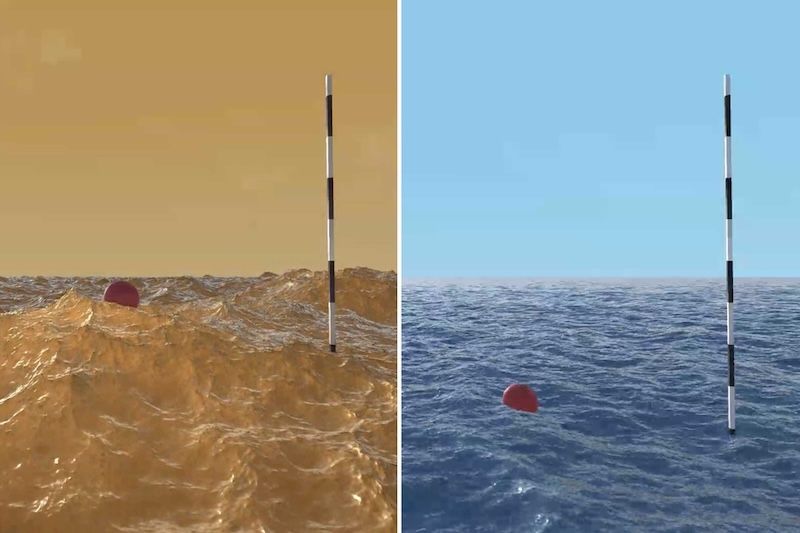
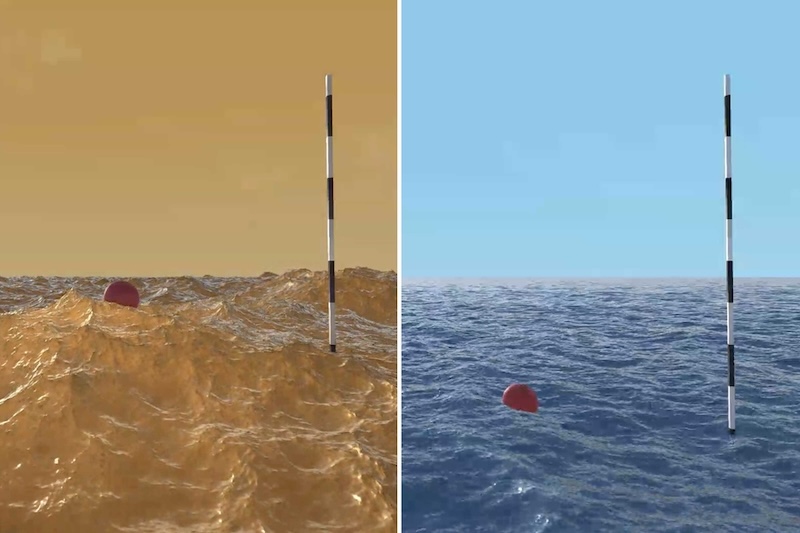
Waves on Saturn’s large moon Titan vs. waves on Earth. A new study from researchers at MIT shows that waves on other worlds – including planets outside our solar system – should vary greatly. Video via MIT.
- We’ve all seen waves on lakes or oceans. How would wave action be different on other planets, or moons, outside our solar system?
- Waves would vary greatly on other worlds, researchers from MIT say in a new study called PlanetWaves.
- These waves could be in water like on Earth, or other more exotic liquids, like the methane/ethane lakes and seas on Saturn’s moon Titan.
Waves on other planets
We’re all familiar with waves on Earth, which vary from gentle ripples on a summer day to giant tidal waves. But what would waves be like on other planets? In our solar system, we can look for clues on Saturn’s large moon Titan, which has lakes and seas of methane/ethane. And also what might waves have looked like on ancient Mars, with its long-gone water lakes and probable ocean? On April 16, 2026, researchers at the Massachusetts Institute of Technology (MIT) said in a new study that waves would likely vary greatly from planet to planet, or moon to moon.
The study looked at Titan, ancient Mars and three different exoplanets that might have surface liquids, ranging from water to lava.
The new peer-reviewed paper was published in JGR Planets on April 3, 2026.
The PlanetWaves model
For the new study, the researchers developed a new scientific model called the PlanetWaves model. The model can predict how waves might behave in oceans or lakes on other rocky planets or moons. The study included Saturn’s moon Titan, ancient Mars and three exoplanets. It can also take into account different kinds of liquids. For example, Titan’s oceans and lakes are composed of liquid hydrocarbons – methane and ethane – instead of water.
According to the model, a gentle wind would be sufficient to create large waves on Titan. But on the exoplanet 55-Cancri e, hurricane-force winds would barely make a ripple. Scientists think that 55-Cancri e is likely covered in an ocean or lakes of lava. Study author Andrew Ashton, an associate scientist at the Woods Hole Oceanographic Institution (WHOI), said:
On Earth, we get accustomed to certain wave dynamics. But with this model, we can see how waves behave on planets with different liquids, atmospheres and gravity, which can kind of challenge our intuition.
Titan, land of lakes
Titan is of particular interest to the scientists. It’s a moon, but it’s also the only other body in our solar system, our local neighborhood of space, known to have lakes and seas on its surface. And it’s a lot closer to us than exoplanets orbiting distant suns. As co-author Taylor Perron, the Cecil and Ida Green Professor of Earth, Atmospheric and Planetary Sciences at MIT, noted:
Anywhere there’s a liquid surface with wind moving over it, there’s potential to make waves. For Titan, the tantalizing thing is that we don’t have any direct observation of what these lakes look like. So we don’t know for sure what kind of waves might exist there. Now this model gives us an idea.
It should be noted that we do have visual observations of the lakes, but only from radar on the former Cassini spacecraft. The global orangish haze or “smog” that surrounds Titan completely obscures the view from us in regular light.
In the future, NASA might send a probe directly to one of the lakes on Titan. But it would need to withstand any waves that might occur. Una Gaylin Schneck, a graduate student in MIT’s Department of Earth, Atmospheric and Planetary Sciences (EAPS), is the lead author. She said:
You would want to build something that can withstand the energy of the waves. So it’s important to know what kind of waves these instruments would be up against.
Modeling Wind-Driven Waves on Other Planets – Applications to Mars, Titan, and Exoplanets: agupubs.onlinelibrary.wiley.com/doi/full/10…. -> Waves hit different on other planets: news.mit.edu/2026/waves-h… – waves should vary widely from one planet to another, according to a new model.
Various factors involved
What kinds of waves a planet or moon has will depend on various conditions. This can include the strength of the world’s gravity, the density and composition of its atmosphere and the composition of its surface liquids. Schneck said:
There have been attempts in the past to predict how gravity will affect waves on other planets. But they don’t quantify other factors such as the composition of the liquid that is making waves. That was the big leap with this project.
As for the liquids involved, there are factors such as density, viscosity and surface tension. Atmospheric pressure will also help determine what kinds of waves form. Ashton said:
Imagine a completely still lake. We’re trying to figure out the first puff that will make those first little tiny ripples, on up to a full ocean wave.
Testing how to make waves on Titan
Using the PlanetWaves model, the researchers tested wave-making processes. The first tests used data from buoys on Lake Superior. The model successfully predicted the wind speeds needed to create waves and how big the waves would be.
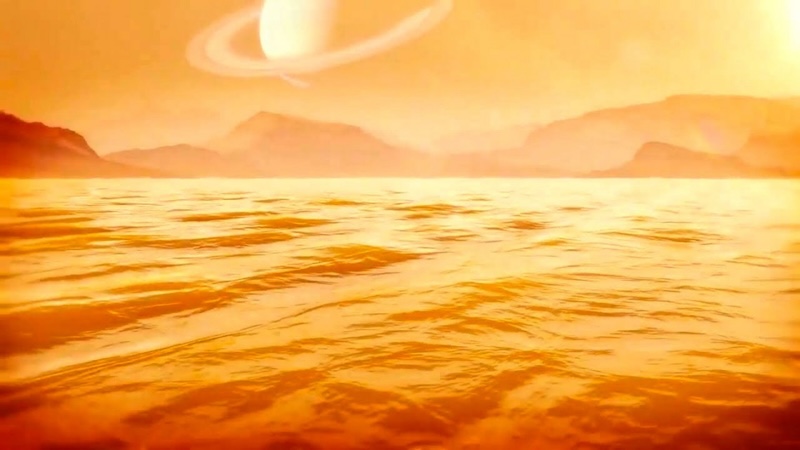
The researchers then used that data to look at the lakes and seas of Titan. Even though the liquids are methane and ethane, not water, the model showed that waves should easily form on Titan. This is largely due to Titan’s weaker gravity and lower atmospheric pressure. Schneck explained:
It kind of looks like tall waves moving in slow motion. If you were standing on the shore of this lake, you might feel only a soft breeze but you would see these enormous waves flowing toward you, which is not what we would expect on Earth.
Models like PlanetWaves might also help solve other related mysteries on Titan, such as why deltas seem to be mostly absent where the rivers meet the lakes and seas. Perron said:
Unlike on Earth, where there is often a delta where a river meets the coast, on Titan there are very few things that look like deltas, even though there are plenty of rivers and coasts. Could waves be responsible for this? These are the kinds of mysteries that this model will help us solve.
Waves on Mars’ ancient ocean?
Next, the researchers applied the data to ancient Mars. We know there were once many lakes on its surface. And there is growing evidence for an ancient ocean. Winds in the previously thicker atmosphere could have easily produced waves. But the model showed that as the atmosphere gradually thinned and was mostly lost to space, waves would have required stronger winds to form.
Waves on 3 exoplanets
Lastly, the research team looked at three different exoplanets.
LHS 1140 b is a “cool super-Earth,” meaning that it is colder and larger than Earth. Scientists think the planet might host liquid water, with an eyeball ocean. But due to its size, it has stronger gravity. The model showed that the same wind on Earth would generate much smaller waves of water on this planet, due to the difference in gravity. This planet is also one of 45 best planets to search for alien life for the new ‘Project Hail Mary’ study.
Next, Kepler 1649 b is a Venus-like planet, which has a gravity similar to Earth’s. It’s thought to have lakes of sulfuric acid, which is about twice as dense as water. The model suggested that it would take strong winds to make even a ripple on those lakes.
Finally, 55-Cancri e. It’s a hot lava world with both higher gravity than Earth and a much denser, more viscous surface liquid. Scientists suspect that the planet hosts oceans of liquefied rock. The researchers found that hurricane-force winds, about 80 miles per hour (129 km per hour), would generate only small waves of a few centimeters in height. The denser liquid makes it harder for waves to form.
Bottom line: A new study from MIT suggests that waves on other worlds should vary greatly. Scientists are looking at the lakes and seas of Saturn’s moon Titan for clues.
Source: Modeling Wind-Driven Waves on Other Planets: Applications to Mars, Titan, and Exoplanets
Read more: Shorelines of Titan’s seas likely shaped by waves
Read more: What causes ocean waves?
The post Waves on other planets vary widely, new MIT study suggests first appeared on EarthSky.










Related Posts
Stay Informed With the Latest & Most Important News
Previous Post
Next Post

Advertisement
-
 01Two Black Holes Observed Circling Each Other for the First Time
 -
 02From Polymerization-Enabled Folding and Assembly to Chemical Evolution: Key Processes for Emergence of Functional Polymers in the Origin of Life
 -
 03Astronomy 101: From the Sun and Moon to Wormholes and Warp Drive, Key Theories, Discoveries, and Facts about the Universe (The Adams 101 Series)
 -
 04True Anomaly hires former York Space executive as chief operating officer
 -
 05Φsat-2 begins science phase for AI Earth images
 -
 06Hurricane forecasters are losing 3 key satellites ahead of peak storm season − a meteorologist explains why it matters
 -
 07Binary star systems are complex astronomical objects − a new AI approach could pin down their properties quickly