
Now Reading: Atmospheric Collapse And Habitability On Tidally-Locked Exoplanets
-
01
Atmospheric Collapse And Habitability On Tidally-Locked Exoplanets


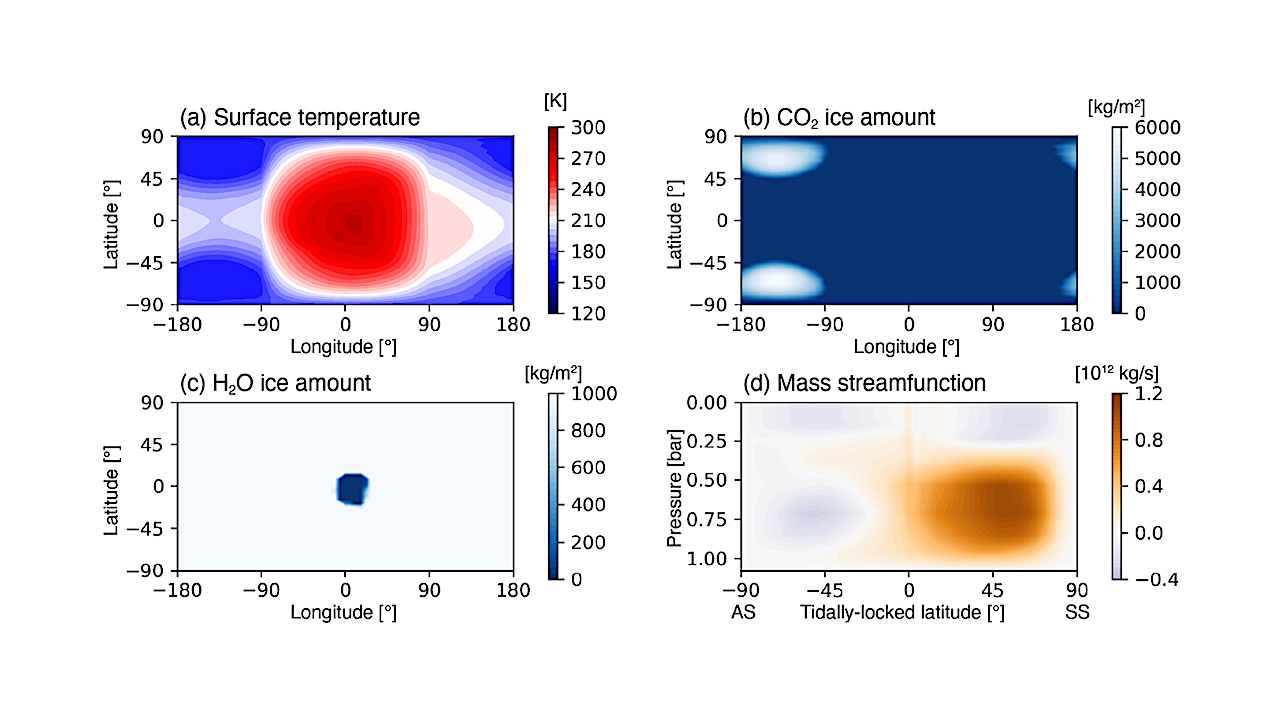

Atmospheric conditions in the case with Sp = 0.4 S0, pN2 = 1.0 bar, pCO2 = 0.1 bar. Each case shows (a) horizontal distribution of surface temperature, (b) horizontal distribution of CO2 ice amount (c) horizontal distribution of H2O ice amount, and (d) mass streamfunction between the substellar point (SS) and antistellar point (AS) in tidally-locekd coordinate. In (a), (b), and (c), 0°of latitude and of longitude corresponds to the substellar point (SS). Note that horizontal axis in (d) represents the latitude in tidally-locked coordinate and the mass flux where the value is positive is anticlockwise circulation. — astro-ph.EP
The habitability of terrestrial exoplanets orbiting M dwarfs is a key topic in the search for extraterrestrial life.
The climates of these planets differ significantly from the Earth’s due to their likely tidal locking, resulting in a hotter dayside and a colder nightside caused by uneven stellar irradiation.
On tidally-locked planets around the outer edge of the habitable zone (HZ), although the definition of the classical HZ requires thick CO2 atmosphere, CO2 can condense onto the surface, leading to the reduction of greenhouse effect.
However, the dayside permanent stellar irradiation could maintain a surface liquid water area. The onset of atmospheric collapse and the persistence of surface liquid water are governed by global heat redistribution which is influenced by factors such as atmospheric mass, stellar irradiation, and greenhouse effects.
In this study, we used a three-dimensional global climate model to investigate the impact of atmospheric collapse on the presence of dayside surface liquid water. Our results indicate that surface liquid water could counter-intuitively persist despite atmospheric collapse. This is because the loss of atmospheric CO2 weakens not only the greenhouse effect but also daynight heat transport, leading to less redistribution of the energy of dayside insolation to the nightside.
While atmospheric collapse is typically seen as an obstacle to maintaining a habitable climate, our findings suggest that it could play a positive role in sustaining surface liquid water on tidally-locked planets. Our work provides new light into the relationship between atmospheric collapse and planetary habitability.
Keigo Taniguchi, Takanori Kodama, Martin Turbet, Guillaume Chaverot, Ehouarn Millour, Hidenori Genda
Comments: 14 pages, 4 figures, accepted for publication in The Astrophysical Journal
Subjects: Earth and Planetary Astrophysics (astro-ph.EP)
Cite as: arXiv:2603.09260 [astro-ph.EP] (or arXiv:2603.09260v1 [astro-ph.EP] for this version)
https://doi.org/10.48550/arXiv.2603.09260
Focus to learn more
Submission history
From: Takanori Kodama
[v1] Tue, 10 Mar 2026 06:49:07 UTC (845 KB)
https://arxiv.org/abs/2603.09260
Astrobiology, exoplanet,










Related Posts
Stay Informed With the Latest & Most Important News


Advertisement
-
 01Two Black Holes Observed Circling Each Other for the First Time
 -
 02From Polymerization-Enabled Folding and Assembly to Chemical Evolution: Key Processes for Emergence of Functional Polymers in the Origin of Life
 -
 03Astronomy 101: From the Sun and Moon to Wormholes and Warp Drive, Key Theories, Discoveries, and Facts about the Universe (The Adams 101 Series)
 -
 04True Anomaly hires former York Space executive as chief operating officer
 -
 05Φsat-2 begins science phase for AI Earth images
 -
 06Hurricane forecasters are losing 3 key satellites ahead of peak storm season − a meteorologist explains why it matters
 -
 07Binary star systems are complex astronomical objects − a new AI approach could pin down their properties quickly