
Now Reading: Tianwen-2 Target Asteroid (469219) Kamo’oalewa Probably Develops An Itokawa-compositional But Ultra-highly Space-weathered Surface
-
01
Tianwen-2 Target Asteroid (469219) Kamo’oalewa Probably Develops An Itokawa-compositional But Ultra-highly Space-weathered Surface

Tianwen-2 Target Asteroid (469219) Kamo’oalewa Probably Develops An Itokawa-compositional But Ultra-highly Space-weathered Surface

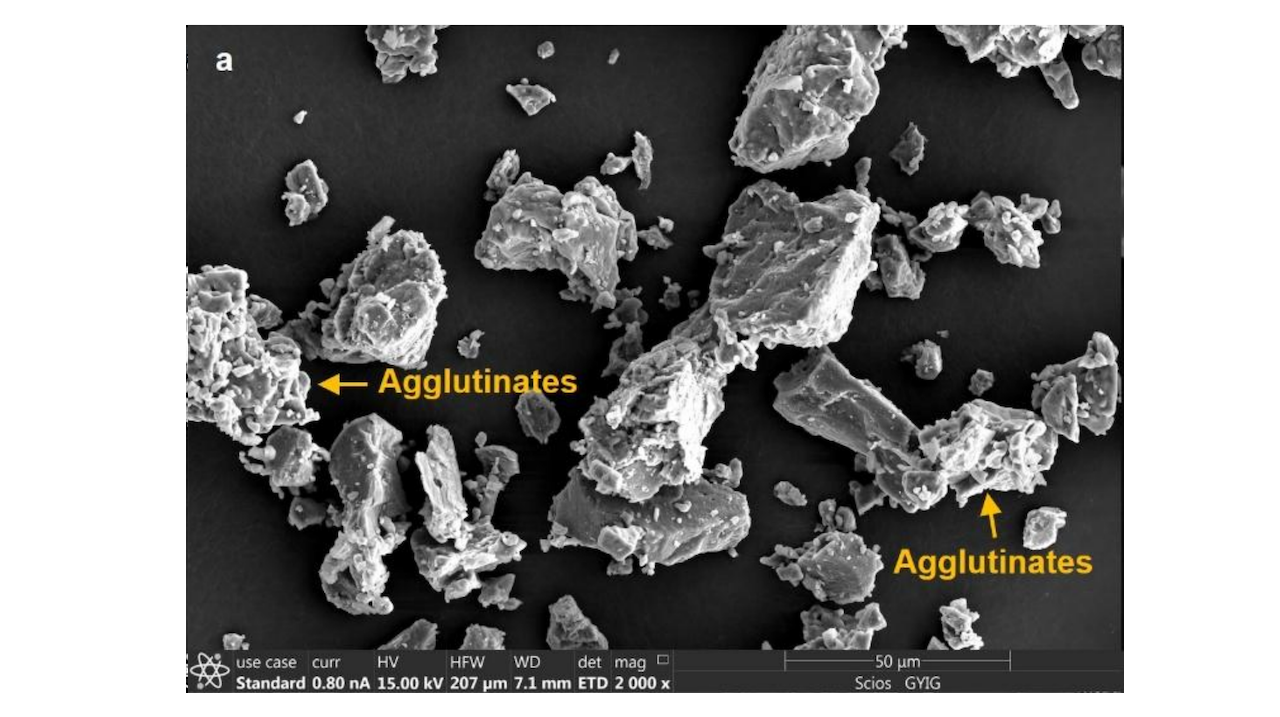
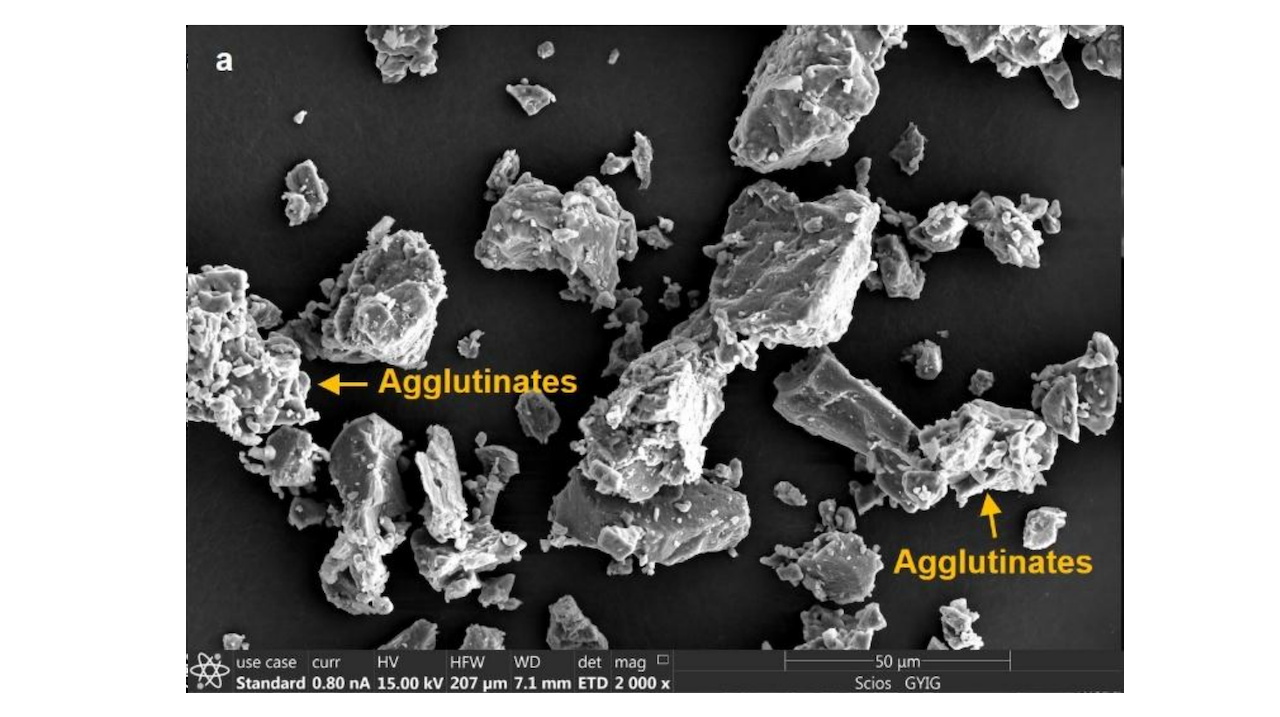
Micro-characteristics of 40 mJ × 80 times laser-irradiated Kheneg Ljouâd powders observed by scanning electron microscopy (SEM) and transmission electron microscopy (TEM). a SEM secondary electron image of irradiated powder. — astro-ph.EP
China’s Tianwen-2 mission plans to return samples from a small, rapidly spinning Earth quasi-satellite (469219) Kamo’oalewa. Previous studies linked Kamo’oalewa to lunar composition and origin.
Here, we propose another scenario. We reanalyzed the reflectance spectrum of Kamo’oalewa and obtained an absorption band center at 1.001+-0.028 um (error is 1sigma), consistent with LL chondrites.
We then conducted space weathering (SW) experiments on meteorites and found that highly space-weathered LL chondrite powder (but not slab) successfully reproduced the reflectance spectrum of Kamo’oalewa.
We further traced the dynamical origin of Kamo’oalewa and found that it probably originated from the v6 secular resonance, and more specifically, the Flora family. Kamo’oalewa exhibits a similar composition to Itokawa and 7 objects in the Flora family, but with a higher degree of space weathering.
We, therefore, proposed that Kamo’oalewa probably originated from the Flora family and developed an Itokawa-compositional, highly space-weathered, fine-regolith-dominated surface.
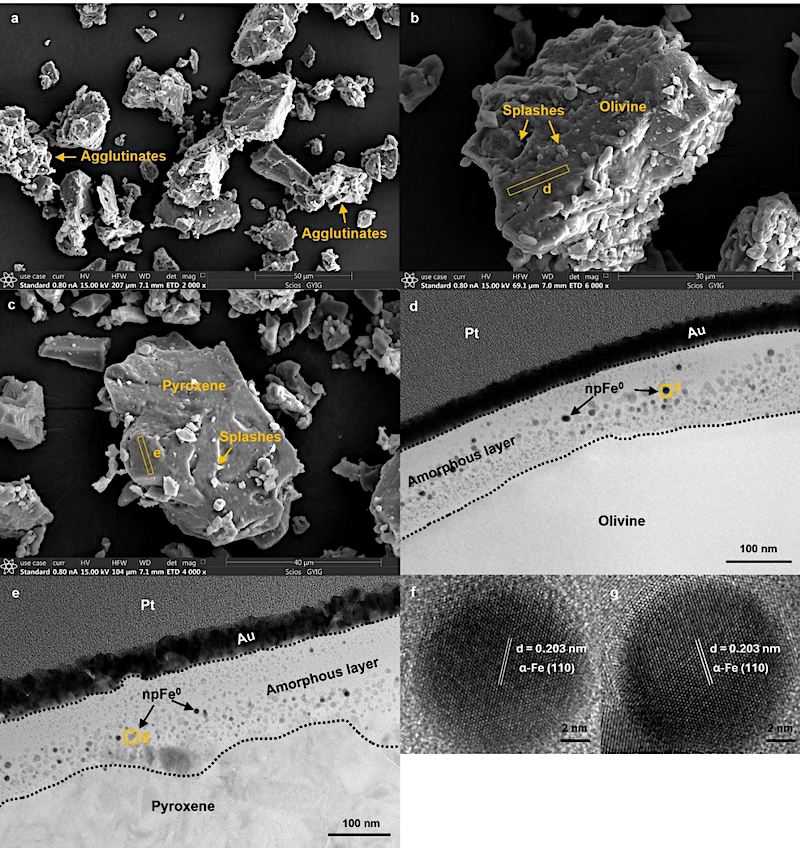
Micro-characteristics of 40 mJ × 80 times laser-irradiated Kheneg Ljouâd powders observed by scanning electron microscopy (SEM) and transmission electron microscopy (TEM). a SEM secondary electron image of irradiated powder. b SEM secondary electron image of olivine grain in irradiated powder. c SEM secondary electron image of pyroxene grain in irradiated powder. d TEM bright field image of FIB section sampled from box in (b). e TEM bright field image of FIB section sampled from box in (c). f TEM high-resolution image of npFe0 in (d). g TEM high-resolution images of npFe0 in (e). After irradiation, the roundness of grains increased, and agglutinates appeared (a). Meanwhile, abundant fine sediments and splashes are distributed on the surface of olivine and pyroxene grains (b–c). Laser irradiation also produces amorphous rims and npFe0 particles on the surface of olivine and pyroxene grains (d–e). The interplanar spacing is d = 0.203 nm, consistent with the spacing of a crystal lattice plane (110) of α-Fe (f–g). — astro-ph.EP
Pengfei Zhang, Guozheng Zhang, Zichen Wei, Mikael Granvik, Xiaoran Yan, Pengyue Wang, Qinwei Zhang, Ronghua Pang, Wen-Han Zhou, Te Jiang, Pierre Vernazza, Takahiro Hiroi, Edward Cloutis, Francesca DeMeo, Pierre Beck, Wing-Huen Ip, Marco Fenucci, Yongxiong Zhang, Michael Marsset, Yunbo Niu, Xuejin Lu, Xing Wu, Honglei Lin, Shoucun Hu, Bin Cheng, Haibin Zhao, Xiaobin Wang, Xiaoping Lu, Yonglong Zhang, Zongcheng Ling, Jiang Zhang, Sizhe Zhao, Cateline Lantz, Jooyeon Geem, Zhiping He, Juntao Wang, Liyong Zhou, Xiliang Zhang, Shijei Li, Sen Hu, Wei Yang, Xiongyao Li, Xiaoping Zhang, Jiahui Liu, Peng Zhang, Guang Zhang, Yangting Lin, Yang Li
Comments: 28 pages, 8 figures, under revision in Nature Communications
Subjects: Earth and Planetary Astrophysics (astro-ph.EP)
Cite as: arXiv:2603.28102 [astro-ph.EP](or arXiv:2603.28102v1 [astro-ph.EP] for this version)
https://doi.org/10.48550/arXiv.2603.28102
Focus to learn more
Submission history
From: Pengfei Zhang
[v1] Mon, 30 Mar 2026 07:03:39 UTC (1,629 KB)
https://arxiv.org/abs/2603.28102
astrobiology, exoplanet, astrochemistry, astrogeology,










Related Posts
Stay Informed With the Latest & Most Important News
Advertisement
-
 01Two Black Holes Observed Circling Each Other for the First Time
 -
 02From Polymerization-Enabled Folding and Assembly to Chemical Evolution: Key Processes for Emergence of Functional Polymers in the Origin of Life
 -
 03Astronomy 101: From the Sun and Moon to Wormholes and Warp Drive, Key Theories, Discoveries, and Facts about the Universe (The Adams 101 Series)
 -
 04True Anomaly hires former York Space executive as chief operating officer
 -
 05Φsat-2 begins science phase for AI Earth images
 -
 06Hurricane forecasters are losing 3 key satellites ahead of peak storm season − a meteorologist explains why it matters
 -
 07Binary star systems are complex astronomical objects − a new AI approach could pin down their properties quickly