
Now Reading: Reassessing Planetary Composition: Evidence Of Rock-dominated Envelopes In Uranus And Neptune
-
01
Reassessing Planetary Composition: Evidence Of Rock-dominated Envelopes In Uranus And Neptune

Reassessing Planetary Composition: Evidence Of Rock-dominated Envelopes In Uranus And Neptune

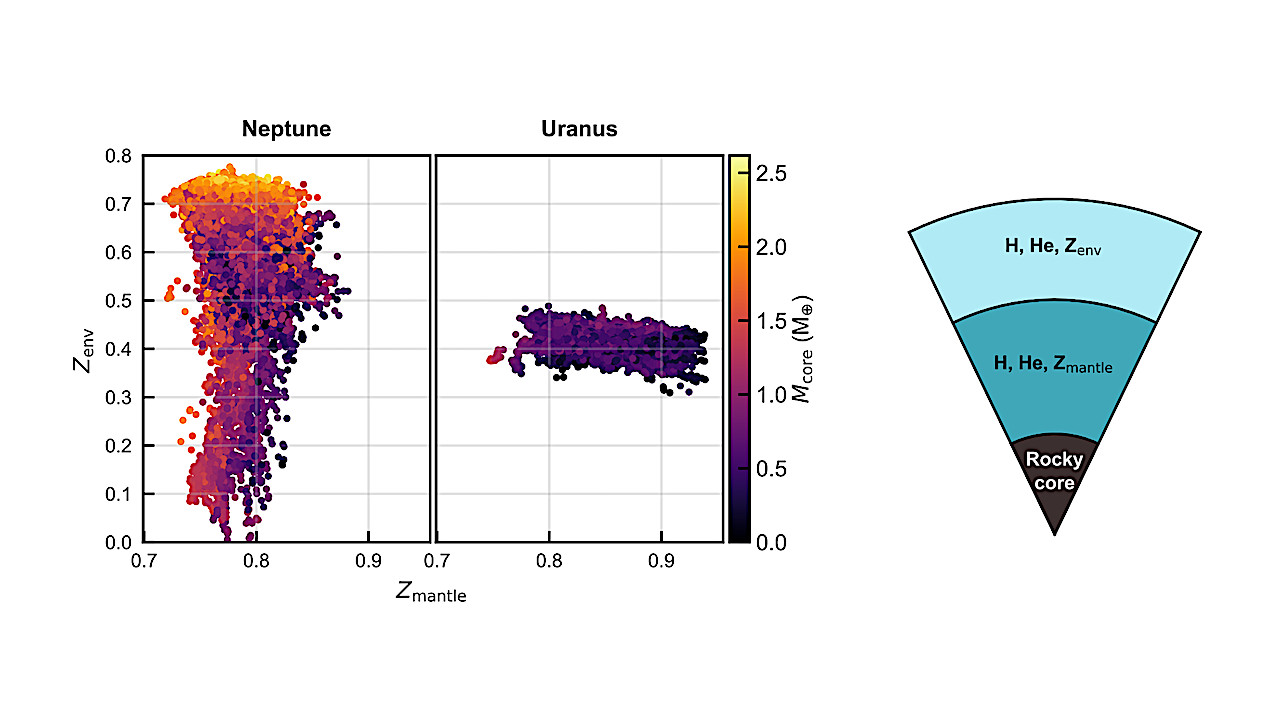

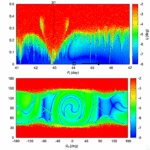
Details of the interior models of Uranus and Neptune. Top: Illustration of the three-layer internal structure model assumed. Both the envelope and mantle contain hydrogen, helium, ices, and rocks, with the mantle expected to have a higher concentration of ices and rocks. The core is composed entirely of rocks. Bottom: Envelope metallicity versus mantle metallicity for interior models of Uranus and Neptune. Each dot represents a model that fits both the gravitational data and radius of the respective planet. The color scale indicates the core mass. — astro-ph.EP
Although Uranus and Neptune are commonly classified as ice giants, their exact compositions remain poorly constrained. Recent studies of outer Solar System bodies challenge the traditional view that these planets are primarily ice-dominated, suggesting that refractory material plays a more significant role.
Determining the proportions of ice and rock within Uranus and Neptune is essential for understanding their formation and the evolutionary history of the Solar System. In this work we computed interior structure models for both planets and explored, within a Bayesian framework, the range of compositions that satisfy the available observational constraints.
We quantified the resulting ice and rock fractions and analyzed their impact on the inferred internal structure. Our results suggest that the envelopes of both Uranus and Neptune are systematically enriched in refractory material, with median rock fractions of approximately 60% within the heavy-element component, similar to Pluto, Kuiper belt objects, and comets.
In contrast, the deep interiors of the two planets exhibit distinct compositions: Neptune is best fit by relatively rock-rich mantles (median rock fraction of ~ 55%), whereas Uranus is inferred to have more ice-rich mantles (median rock fraction of ~ 41%), consistent with a more strongly stratified structure. These results point to compositional differences between Uranus and Neptune that may reflect divergent formation and evolutionary pathways.
Vanesa Ramirez, Yamila Miguel, Saburo Howard
Comments: 21 pages, 6 figures, 2 tables, accepted for publication in A&A
Subjects: Earth and Planetary Astrophysics (astro-ph.EP)
Cite as: arXiv:2604.13020 [astro-ph.EP] (or arXiv:2604.13020v1 [astro-ph.EP] for this version)
https://doi.org/10.48550/arXiv.2604.13020
Focus to learn more
Submission history
From: Vanesa Ramirez
[v1] Tue, 14 Apr 2026 17:55:51 UTC (7,322 KB)
https://arxiv.org/abs/2604.13020
Astrobiology, exoplanet,











Related Posts
Stay Informed With the Latest & Most Important News


Advertisement
-
 01Two Black Holes Observed Circling Each Other for the First Time
 -
 02From Polymerization-Enabled Folding and Assembly to Chemical Evolution: Key Processes for Emergence of Functional Polymers in the Origin of Life
 -
 03Astronomy 101: From the Sun and Moon to Wormholes and Warp Drive, Key Theories, Discoveries, and Facts about the Universe (The Adams 101 Series)
 -
 04True Anomaly hires former York Space executive as chief operating officer
 -
 05Φsat-2 begins science phase for AI Earth images
 -
 06Hurricane forecasters are losing 3 key satellites ahead of peak storm season − a meteorologist explains why it matters
 -
 07Binary star systems are complex astronomical objects − a new AI approach could pin down their properties quickly