
Now Reading: NASA wants to use a fleet of MoonFall drones to scout the lunar south pole: ‘We believe we can do it’
-
01
NASA wants to use a fleet of MoonFall drones to scout the lunar south pole: ‘We believe we can do it’

NASA wants to use a fleet of MoonFall drones to scout the lunar south pole: ‘We believe we can do it’

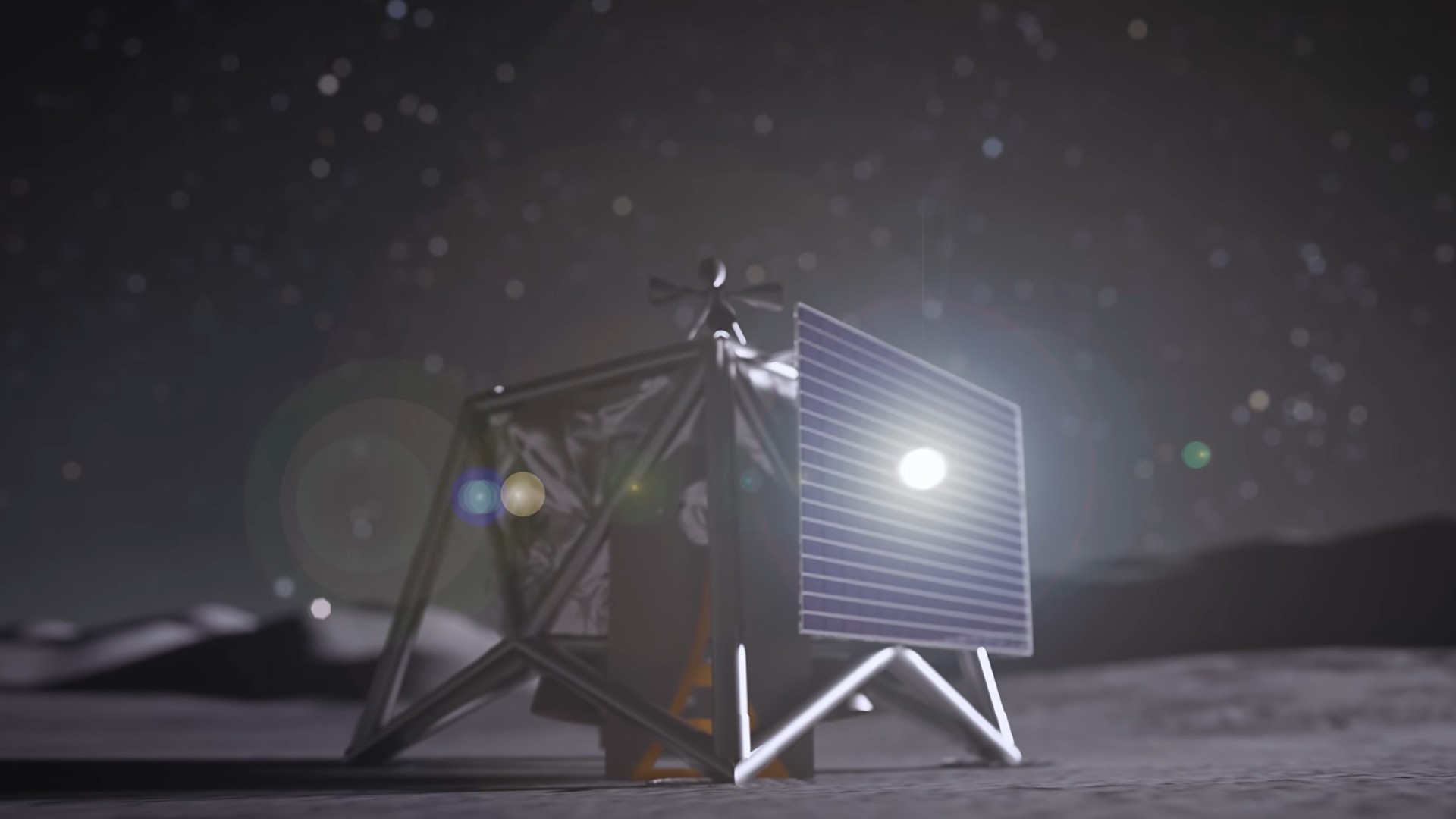
Last month, NASA chief Jared Isaacman ripped off the Band-Aid on the space agency’s back-to-the-moon agenda, calling for a large overhaul of NASA’s Artemis Program. One of his announcements was a speedy series of robotic missions to scout, conduct experiments and prepare for surface operations ahead of any “rebooting” of the lunar landscape by astronauts in 2028.
As part of NASA’s “Ignition” event on March 24, Isaacman called for clearing away needless obstacles that impede progress, said the agency would “unleash the workforce and industrial might of our nation” to return to the lunar landscape and build a moon base.
Standing on the shoulders of Ingenuity
Ray Baker is the project lead for the MoonFall project at NASA’s Jet Propulsion Laboratory (JPL) in Pasadena, California.
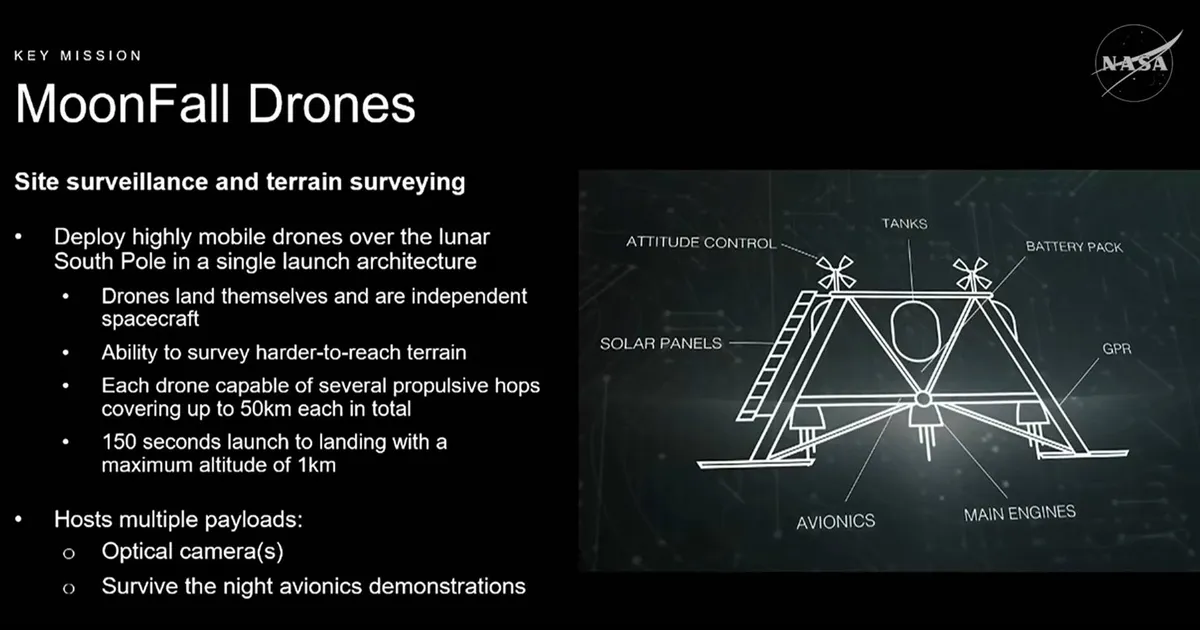
MoonFall involves the release of four camera and sensor-laden “drones” over a still-to-be-selected site at the lunar south pole, Baker told Space.com. “Our goal is that each drone can cover a range of roughly 30 miles [50 kilometers],” he said, “and get that done by the end of 2028.”
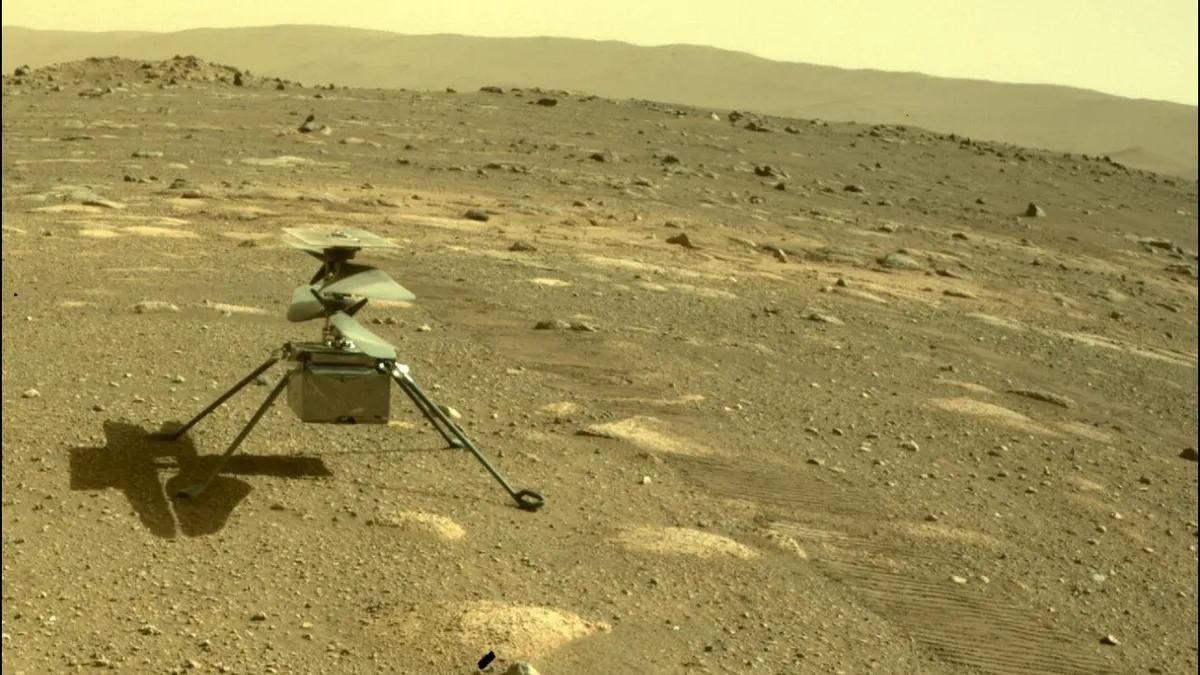
Those drones are empowered by the same know-how and gutsy, can-do spirit that enabled the Ingenuity Mars helicopter to perform 72 flights during the now-on-duty Perseverance rover mission at the Red Planet’s Jezero Crater.
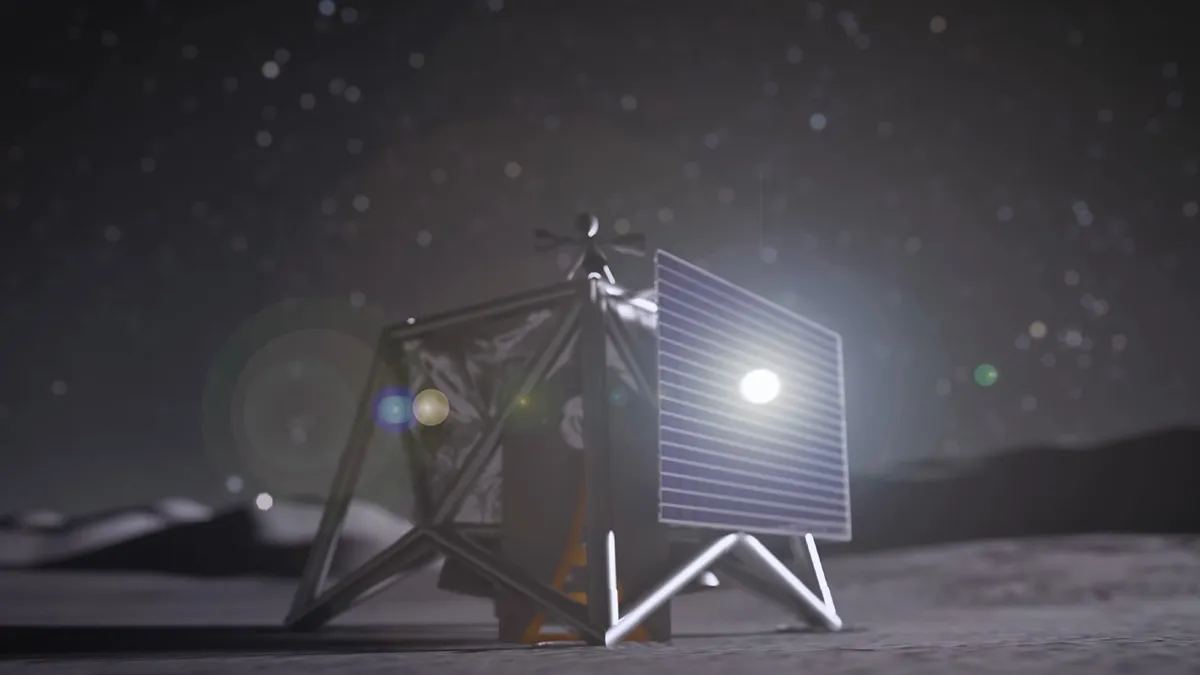
“We get to stand on their shoulders,” Baker said.” We’re going to marry our success from Ingenuity, all that knowledge, all that skill and success, and couple that with an industry capability. We’re going to get this done,” he said.
Baker said that the four drones will each carry a set of 10 cameras and science gear, so 40 in all dispatched over the rocky and rough lunar vista. Imagery produced by the drones will be stitched together to form an unprecedented view of the moonscape, he said, ideal for plotting out future landing sites for Artemis crews as well as the planting of lunar base hardware.
One thing that is different from the past but quickly evolving is drawing from a new and emerging space industry. “They have a lot of capability and that’s something that we’re going to heavily lean into and leverage, along with our JPL capabilities,” said Baker.
The Ingenuity Mars helicopter was imbued with off-the-shelf commercial electronics, many of them typical of what you can find in mobile phones. But it also had the built-in smarts to do hazard detection and avoidance as it jumped from one piece of Mars real estate to another.
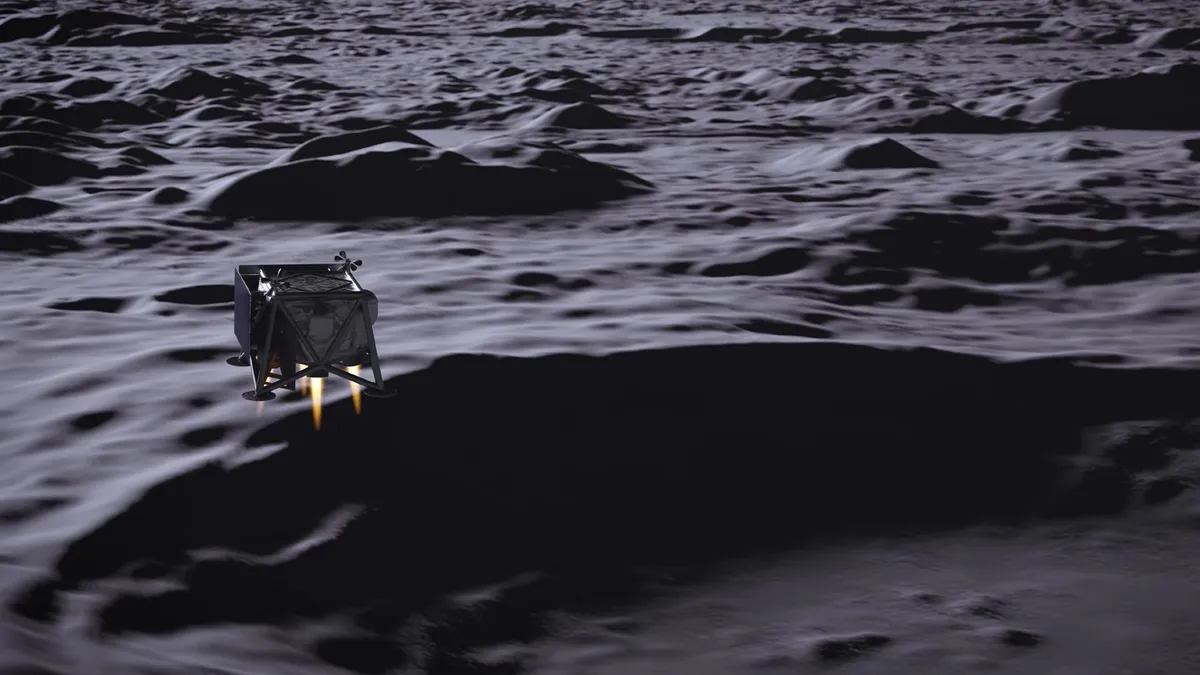
Similarly, for MoonFall drones hopping from spot to spot, Baker said, when they get close to their respective landing sites each will appraise what it can see and plop down at the safest local area.
What milestones are ahead for MoonFall?
Things are moving quickly for MoonFall.
“We’re looking forward to selecting our industry partners and getting this done. It’s going to be a really exciting ride,” Baker said. “By June of this year we’re hoping to have our major partners selected.”
Looking ahead, MoonFall prototype hardware is already in hand or now in work.
“We’ve got development milestones later this year that include captive carry tests of project hardware to check out navigational and control sensors,” said Baker. Spacecraft integration and testing is slated for late summer of 2027, he said, with delivery of MoonFall to the launch site in 2028.
“It’s going to be fast-paced. We believe we can do it,” Baker noted.
It’s unclear how much the MoonFall project will cost.
“NASA is still working out details of cost and budget, so we can’t provide those details just yet. But we’re confident that, in partnership with industry, JPL has the skills and the technology to deliver on schedule,” Baker said.
Deploying the drones mid-descent above the moon is highly advantageous because the additional cost and risk of a full propulsive lander are avoided, said Baker.
“In addition, the mission will leverage industry capabilities for the transfer and braking stage as well as the drone mechanical and propulsion systems,” Baker added. “As such, this mission fits well within the [NASA] administrator’s objectives of reducing costs for more shots on goal.”










Related Posts
Stay Informed With the Latest & Most Important News
Previous Post
Next Post
Advertisement
-
 01Two Black Holes Observed Circling Each Other for the First Time
 -
 02From Polymerization-Enabled Folding and Assembly to Chemical Evolution: Key Processes for Emergence of Functional Polymers in the Origin of Life
 -
 03Astronomy 101: From the Sun and Moon to Wormholes and Warp Drive, Key Theories, Discoveries, and Facts about the Universe (The Adams 101 Series)
 -
 04True Anomaly hires former York Space executive as chief operating officer
 -
 05Φsat-2 begins science phase for AI Earth images
 -
 06Hurricane forecasters are losing 3 key satellites ahead of peak storm season − a meteorologist explains why it matters
 -
 07Binary star systems are complex astronomical objects − a new AI approach could pin down their properties quickly