
Now Reading: Carbonaceous Chondrites Provide Evidence For Late-stage Planetesimal Formation In A Pressure Bump
-
01
Carbonaceous Chondrites Provide Evidence For Late-stage Planetesimal Formation In A Pressure Bump

Carbonaceous Chondrites Provide Evidence For Late-stage Planetesimal Formation In A Pressure Bump

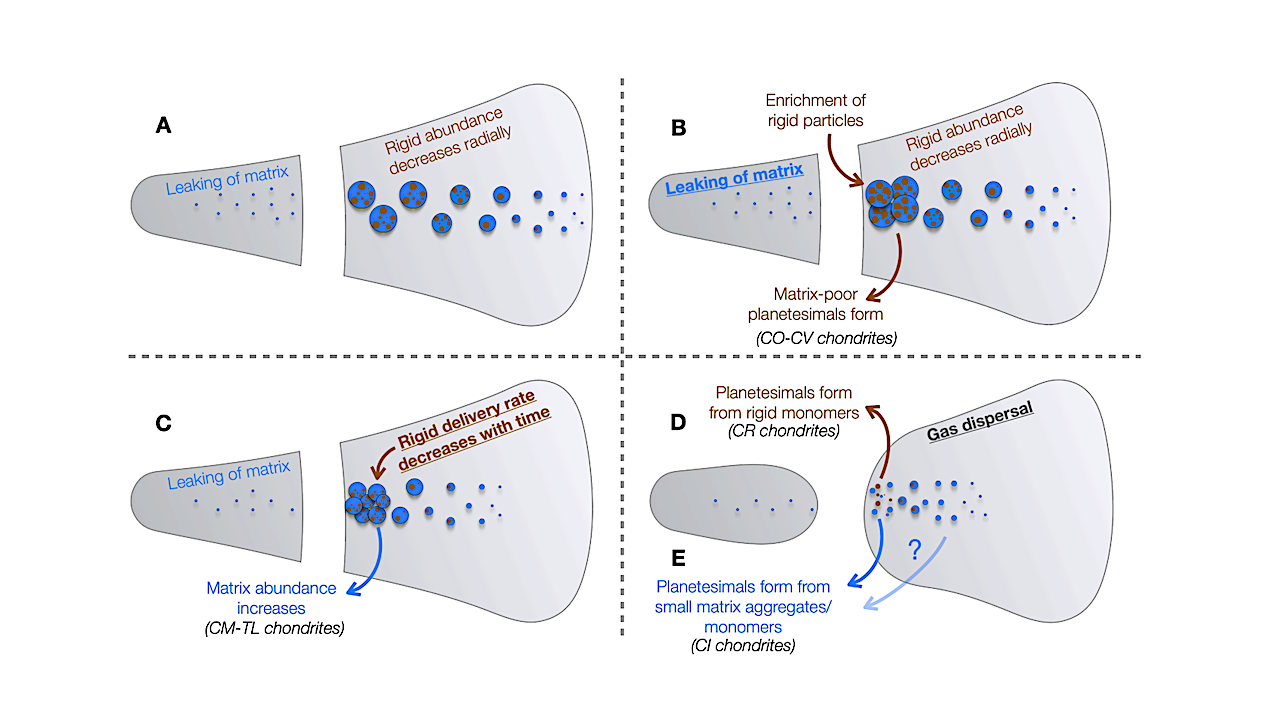
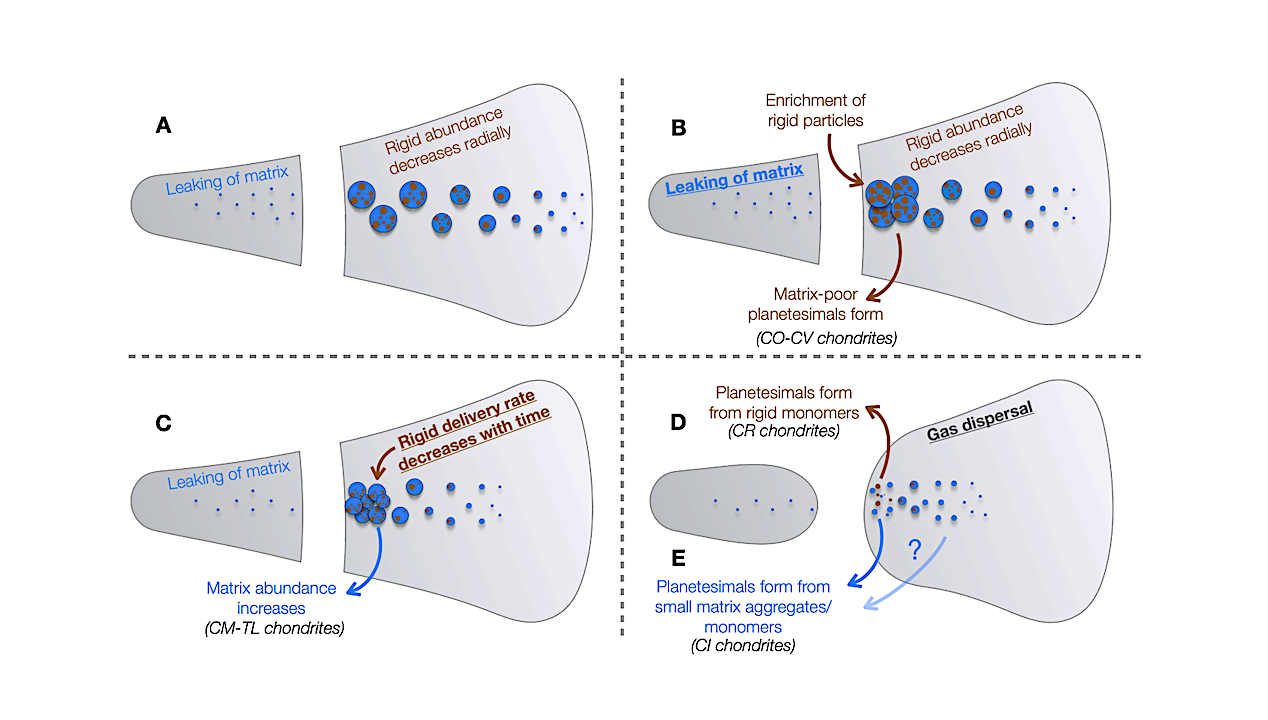
Schematic of the model for carbonaceous chondrite formation. We assume that chondrules and refractory inclusions are rigid particles, and that the matrix is fragile. Rigid and fragile materials can stick together to form larger pebbles. We highlight the dominant process at different times in bold and underlined. (A) Initially, ∼2 Myr after CAI formation, a gap is opened by a Jupiter-like planet. (B) Mostly fragile material passes through the gap, enriching the pressure bump with rigid particles. Planetesimal formation begins once the pebble-to-gas ratio becomes sufficiently high. (C) Then, the delivery of rigid particles to the pressure bump declines over time due to the faster radial drift (and thereby faster depletion in the outer disk) of the largest rigid monomers. (D) Afterwards, photoevaporation reduces the gas surface density by orders of magnitude and sub-millimeter-sized rigid particles reach pebble Stokes numbers. (E) Finally, as the gas density continues to decrease, particle sizes are further reduced to micrometer sizes. At this late stage, planetesimal formation may extend across the disk as the gap expands during photoevaporation. — astro-ph.EP
Carbonaceous chondrites are samples from planetesimals that formed 2-4 million years after solar system formation began.
They consist of distinct dust components formed at different times and locations in the accretion disk and whose abundances in carbonaceous chondrites vary over planetesimal formation time. The mechanism that led to this time-varied accretion is not understood, but is critical for understanding late-stage planetesimal formation.
Using a two-dimensional Monte Carlo simulation of dust evolution, we show that differences in dust filtering and delivery rates of distinct dust components to a planet-induced pressure bump in the disk reproduce the observed compositions and formation ages of the carbonaceous chondrites. This implies that carbonaceous chondrites likely formed in a single, long-lived dust trap, most likely outside of Jupiter’s orbit.
Because differentiated meteorites, which sample an earlier generation of planetesimals, exhibit similar isotopic variability as the chondrites, they likely have also formed in dust traps, implying these structures were the dominant site for planetesimal formation in the solar system.
Nerea Gurrutxaga, Joanna Drazkowska, Vignesh Vaikundaraman, Thorsten Kleine
Comments: Accepted for publication in ApJ
Subjects: Earth and Planetary Astrophysics (astro-ph.EP)
Cite as: arXiv:2604.16604 [astro-ph.EP] (or arXiv:2604.16604v1 [astro-ph.EP] for this version)
https://doi.org/10.48550/arXiv.2604.16604
Focus to learn more
Submission history
From: Nerea Gurrutxaga
[v1] Fri, 17 Apr 2026 18:00:05 UTC (6,613 KB)
https://arxiv.org/abs/2604.16604
Astrobiology, Astrochemistry, Astrogeology,










Related Posts


Stay Informed With the Latest & Most Important News



Advertisement
-
 01Two Black Holes Observed Circling Each Other for the First Time
 -
 02From Polymerization-Enabled Folding and Assembly to Chemical Evolution: Key Processes for Emergence of Functional Polymers in the Origin of Life
 -
 03Astronomy 101: From the Sun and Moon to Wormholes and Warp Drive, Key Theories, Discoveries, and Facts about the Universe (The Adams 101 Series)
 -
 04True Anomaly hires former York Space executive as chief operating officer
 -
 05Φsat-2 begins science phase for AI Earth images
 -
 06Hurricane forecasters are losing 3 key satellites ahead of peak storm season − a meteorologist explains why it matters
 -
 07Binary star systems are complex astronomical objects − a new AI approach could pin down their properties quickly