
Now Reading: Rover-Induced Mineral Transformations: Extent of the Effect for the Mars Science Laboratory and Opportunities for Future Landed Mission
-
01
Rover-Induced Mineral Transformations: Extent of the Effect for the Mars Science Laboratory and Opportunities for Future Landed Mission

Rover-Induced Mineral Transformations: Extent of the Effect for the Mars Science Laboratory and Opportunities for Future Landed Mission

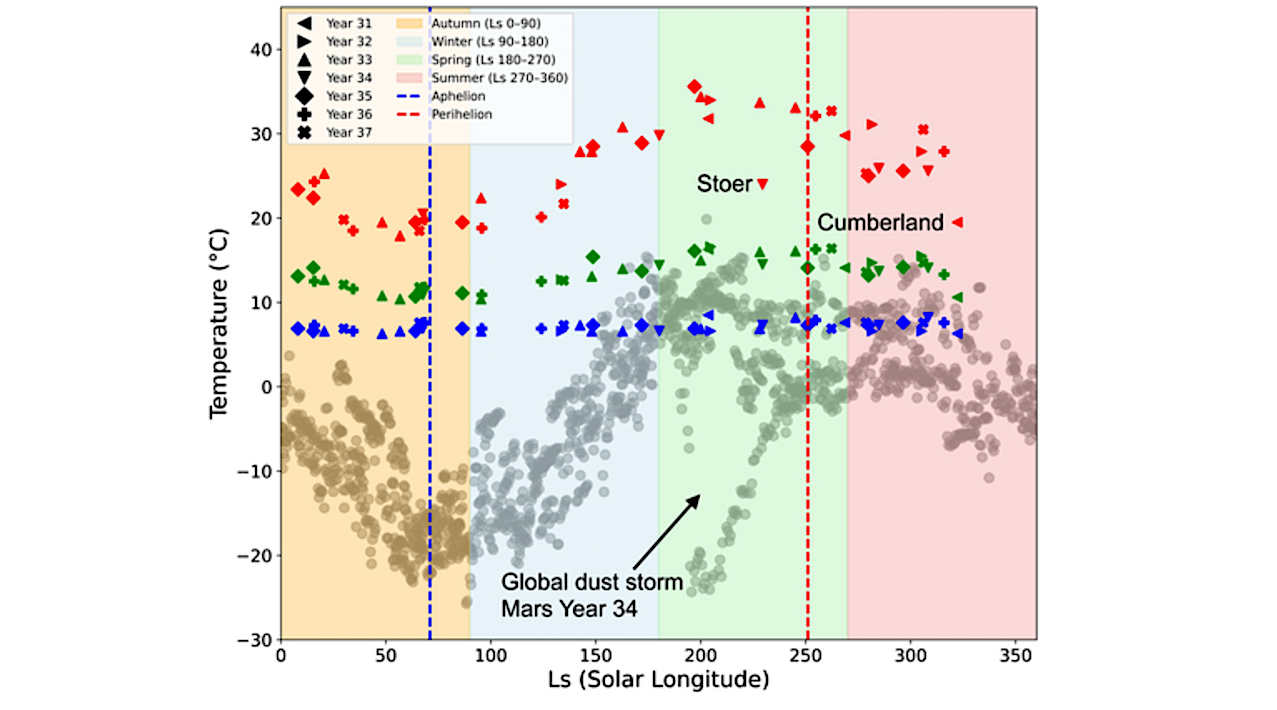

Compilation of the seasonal variation of the maximum (red markers), minimum (blue markers), and average (green markers) temperatures inside CheMin based on interior platinum resistance thermocouple number 2615 data including all drill holes up to “Kings Canyon” (sol 4266). Diurnal maximum ground temperatures for the first 2500 sols reported by Martínez et al. (2021) are plotted as gray circles. — JGR Planets
X-ray amorphous sulfate hydrates are a substantial component (up to 23 wt%) of the sedimentary rocks and sands analyzed to date by the Mars Science Laboratory Curiosity rover at Gale crater.
Recently, the CheMin X-ray diffractometer observed the amorphization of the crystalline sulfate starkeyite (MgSO4 · 4H2O) upon exposure to the dry and relatively warm atmosphere inside the rover body.
To assess the extent to which interactions between minerals and the rover environment contribute to the amorphous component, we investigated the stability of several hydrated minerals under Curiosity-like conditions. Our results show that highly hydrated minerals are more prone to transformation inside the rover than lower hydrates.
Minerals that readily become amorphous under rover conditions are also likely to be unstable when exposed to the dry Martian atmosphere during the warm periods at noon. We therefore suggest that much of the observed amorphization occurred at the Martian surface prior to sampling.
Future missions such as the Rosalind Franklin rover and Mars Life Explorer propose to drill into the substantially colder subsurface at Martian mid-latitudes and are likely to encounter temperature and humidity-sensitive cryohydrates. To evaluate the original mineral assemblage of rocks on such missions, it will be critical to maintain controlled temperature and relative humidity (RH) conditions inside the rover body.
We find that increasing ambient humidity may induce the recrystallization of amorphous salt hydrates, thus controlling RH and temperature inside the rover would significantly enhance the analytical capabilities of a next generation X-ray diffractometer on Mars.
Rover-Induced Mineral Transformations: Extent of the Effect for the Mars Science Laboratory and Opportunities for Future Landed Mission, JGR Planets (open access)
Astrobiology,











Related Posts



Stay Informed With the Latest & Most Important News
Previous Post
Next Post




Advertisement
-
 01Two Black Holes Observed Circling Each Other for the First Time
 -
 02From Polymerization-Enabled Folding and Assembly to Chemical Evolution: Key Processes for Emergence of Functional Polymers in the Origin of Life
 -
 03Astronomy 101: From the Sun and Moon to Wormholes and Warp Drive, Key Theories, Discoveries, and Facts about the Universe (The Adams 101 Series)
 -
 04True Anomaly hires former York Space executive as chief operating officer
 -
 05Φsat-2 begins science phase for AI Earth images
 -
 06Hurricane forecasters are losing 3 key satellites ahead of peak storm season − a meteorologist explains why it matters
 -
 07Binary star systems are complex astronomical objects − a new AI approach could pin down their properties quickly