
Now Reading: Exiting NRO director Chris Scolese’s legacy: commercial partnerships; public engagement
-
01
Exiting NRO director Chris Scolese’s legacy: commercial partnerships; public engagement

Exiting NRO director Chris Scolese’s legacy: commercial partnerships; public engagement

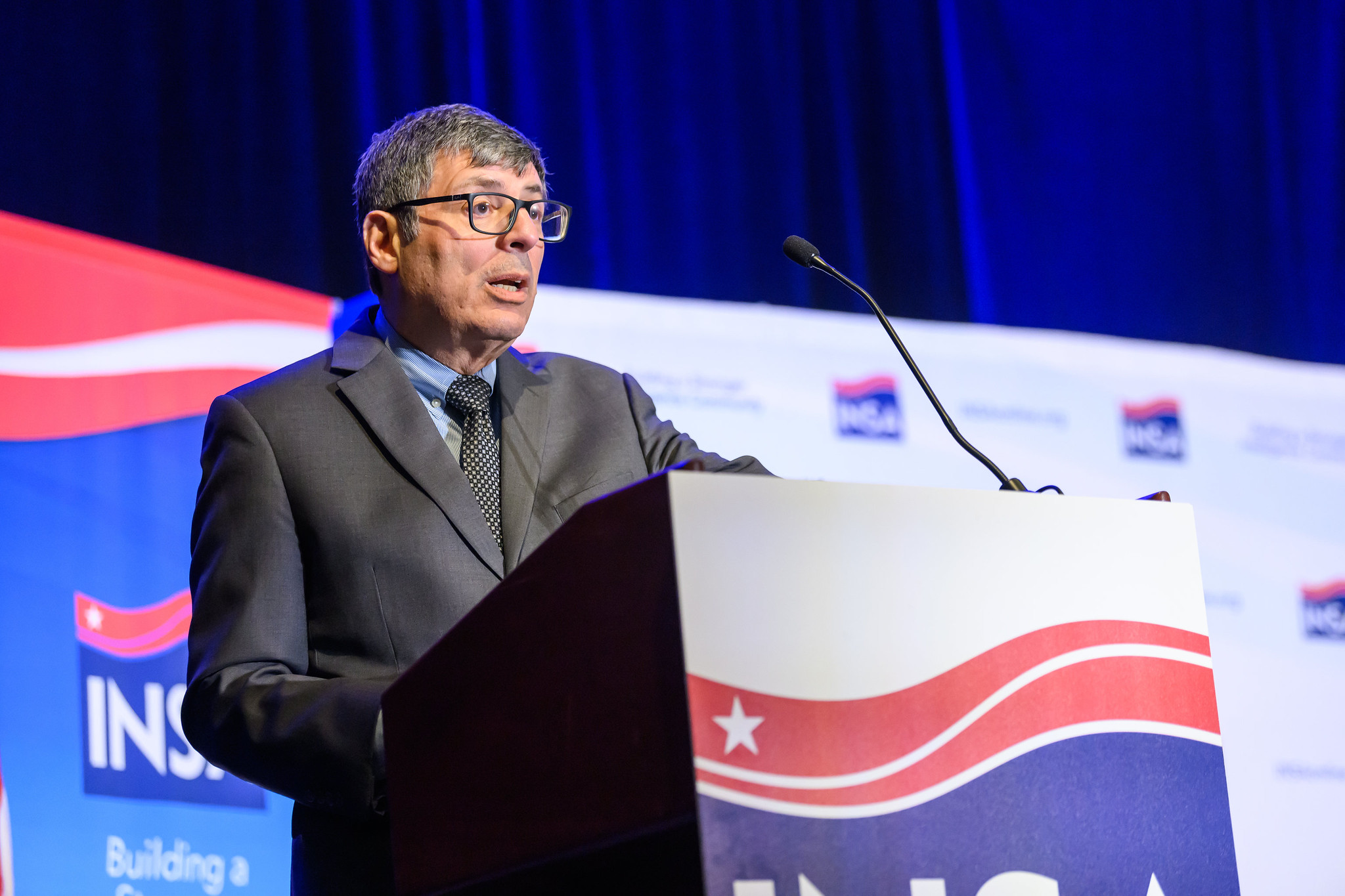

In a 2022 address to the Intelligence and National Security Alliance, the director of the National Reconnaissance Office, Chris Scolese, sounded a warning.
Record numbers of satellites were being launched, he said, and competitors including China and Russia were developing tools, on the ground and in orbit, that put American space infrastructure at risk.
But then he pivoted, describing the way humans for millennia have looked to the stars for light and promise.
“We, too, see the limitless potential of space,” he said.
Scolese, who took the helm of the secretive agency managing the Pentagon’s spy satellites in 2019, brought to the position a technologist’s understanding of risk, but also an irrepressible enthusiasm for the work, said Kari Bingen, director of the Aerospace Security Project at the Center for Strategic and International Studies think tank.
“You see him up close, and he has that kid-in-a-candy-store twinkle in his eye,” Bingen said. “It’s enticing, like, come work for us, because — wink, wink — we’re doing some cool stuff. And I can’t say more than that.”
The first presidential appointee to direct the NRO, Scolese is now coming to the end of a nearly seven-year tenure that has spanned three presidential administrations. On April 22, President Donald Trump nominated Roger Mason, a defense industry executive with a background in intelligence, as Scolese’s successor.
Bingen, who worked in the Pentagon as the principal undersecretary of defense for Intelligence from 2017 to January 2020, said she knew of Scolese by reputation in light of his previous seven years directing NASA’s Goddard Flight Center before they engaged personally. In Scolese, she saw someone who could set the proper tone during a time of change.
“You wanted somebody that understood the mission and the technology and the partnerships, and that was focused on the mission and delivering capabilities, you know, that was not highly political — that, frankly, could kind of keep their head down and focus on what the NRO needed to do and needed to deliver,” she said.
During a cordial confirmation hearing before the Senate Select Committee on Intelligence, Scolese promised broader engagement with commercial entities at the cusp of technological advancement and increased production speed to keep pace with adversaries. And he made good. In 2021, NRO inked a $1.8 billion classified contract with SpaceX subsidiary Starshield to build a “proliferated architecture” of hundreds of reconnaissance satellites in low Earth orbit.
Last March’s launch of the NROL-69 satellite mission on a SpaceX Falcon 9 rocket has the NRO on track to building the largest U.S. government-owned satellite network to date. As of 2025, the NRO had launched more than 200 satellites over two years.
Another key partnership involved the U.S. Space Force. While a classified collaboration between NRO and the Air Force began in 2017 and predated the Space Force, NRO and the Space Force quickly pursued several initiatives, including the 2023 launch of the SILENTBARKER surveillance constellation. Last year’s launch of NROL-145 as part of NRO’s proliferated architecture was also the result of a partnership with Space Force’s Space Systems Command.
Bingen said Scolese’s ability to communicate NRO’s mission and significance to the public has also advanced the office’s work. While the sensitive nature of NRO’s work has limited the ability of past directors to discuss it, she said Scolese has pursued opportunities to build awareness and advance recruiting. Notably, she added, NRO hosted a booth at the South by Southwest film festival in 2024 to expand its outreach to talented youth.
It really stands out to me how much he has done to talk about the NRO mission and their priorities and explain them publicly,” she said.
Bingen said effective communication will remain a critical need for NRO as it undergoes a leadership transition amid an increasingly transparent and heavily populated space domain.
“There’s just a lot more ability to see what’s happening up on orbit today,” she said. “And so, I think [leaders] have to adapt to the topics.”










Related Posts

Stay Informed With the Latest & Most Important News
Previous Post
Next Post




Advertisement
-
 01Two Black Holes Observed Circling Each Other for the First Time
 -
 02From Polymerization-Enabled Folding and Assembly to Chemical Evolution: Key Processes for Emergence of Functional Polymers in the Origin of Life
 -
 03Astronomy 101: From the Sun and Moon to Wormholes and Warp Drive, Key Theories, Discoveries, and Facts about the Universe (The Adams 101 Series)
 -
 04True Anomaly hires former York Space executive as chief operating officer
 -
 05Φsat-2 begins science phase for AI Earth images
 -
 06Hurricane forecasters are losing 3 key satellites ahead of peak storm season − a meteorologist explains why it matters
 -
 07Binary star systems are complex astronomical objects − a new AI approach could pin down their properties quickly