
Now Reading: The First Remotely Detected Biosignature May Not Be the Most Common: Implications for JWST and HWO
-
01
The First Remotely Detected Biosignature May Not Be the Most Common: Implications for JWST and HWO

The First Remotely Detected Biosignature May Not Be the Most Common: Implications for JWST and HWO

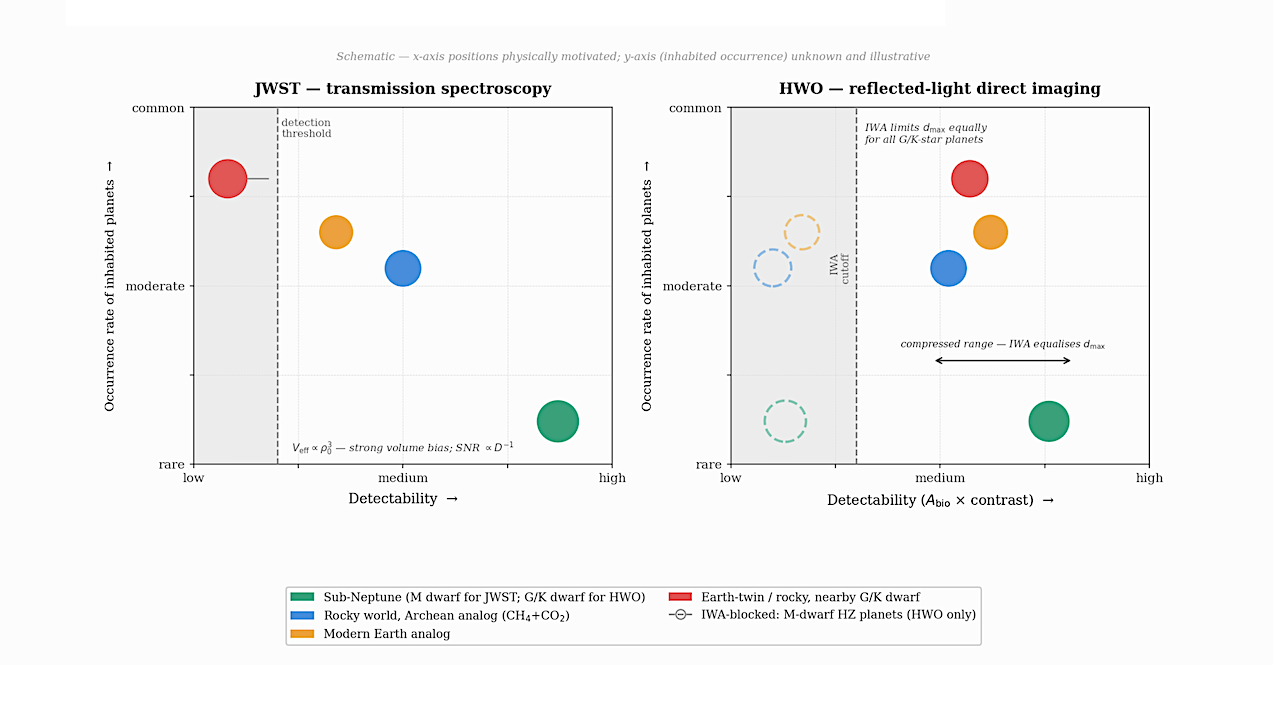
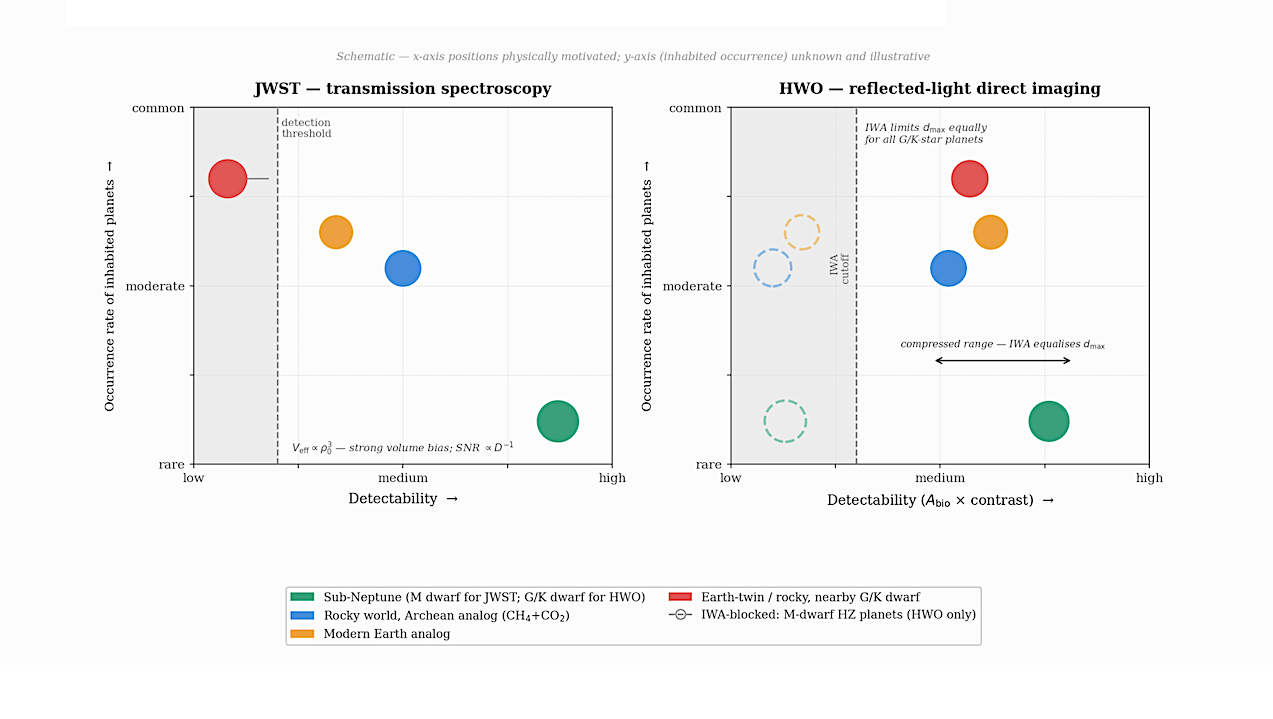
Schematic illustration of occurrence rate of inhabited planets versus observational detectability for JWST transmission spectroscopy (left) and HWO reflected-light direct imaging (right). Circle positions on the x-axis are physically motivated by the signal scalings of Section 2; y-axis positions are illustrative: the true occurrence rate of inhabited planets in any class is unknown. Left: The strong Veff ∝ ρ30 volume bias (Equations 11–14) places the sub-Neptune class (green) near the top of the JWST detectability hierarchy despite its assumed rarity as an inhabited world. Earth twin planets around Sun-like stars (red) fall below the detection threshold entirely, regardless of their occurrence rate. Right: habitable zone planets that are further away (dashed circles, shaded region) are blocked by HWO’s coronagraph inner working angle (θ ≲ IW A), including sub-Neptunes. Among accessible G/K star targets at ∼1 AU, the IWA can limit dmax similarly across all planet types, compressing the detectability range relative to the JWST panel and weakening the ρ30 volume bias. The residual spread reflects differences in biosignature feature depth Abio (Equation 8) and planet/star contrast. In both panels, the first biosignature detection is expected to be drawn from the high detectability or high accessibility tail, not from the most common inhabited world. — astro-ph.EP
The first detected member of a new astronomical class is often not representative of the underlying population, but instead reflects the selection effects of the observing technique that found it.
We apply this idea to the first remote detection of biosignatures with two leading near future strategies: JWST transmission spectroscopy and HWO reflected light direct imaging. Using the known signal scalings of the two methods together with a simple detectability model, we show how a rare but observationally favored planet class can dominate early detections even when it is intrinsically uncommon.
For JWST, an early biosignature detection is most likely to arise from a detectability favored outlier, such as a sub-Neptune or other atmosphere rich planet around a nearby M dwarf, rather than from a true Earth analog. For HWO, the situation is subtler. Among accessible habitable-zone targets around FGK-type stars, differences in maximum observable distance and hence in effective survey volume may be smaller than in the JWST case, weakening the volume bias.
At the same time, stellar-type-dependent photochemistry can alter biosignature abundances, so the first HWO biosignature may emerge from a balance between photochemical enhancement and geometric accessibility. Nevertheless, within the accessible sample, planets with stronger biosignature features and higher reflected light contrast may still be favored in early detections.
A first HWO biosignature could be a selection favored outlier and should not be assumed to represent inhabited rocky planets in general. Crucially, the longest lived biosphere on a planet is not necessarily its most spectrally detectable one. If the first detection turns out to be an outlier, that may still suggest that a more broader range of habitable environments awaits discovery.
Ravi Kopparapu
Comments: Accepted to The Astrophysical Journal Letters
Subjects: Earth and Planetary Astrophysics (astro-ph.EP); Astrophysics of Galaxies (astro-ph.GA); Instrumentation and Methods for Astrophysics (astro-ph.IM); Solar and Stellar Astrophysics (astro-ph.SR)
Cite as: arXiv:2605.16674 [astro-ph.EP] (or arXiv:2605.16674v1 [astro-ph.EP] for this version)
https://doi.org/10.48550/arXiv.2605.16674
Focus to learn more
Submission history
From: Ravi Kumar Kopparapu
[v1] Fri, 15 May 2026 22:26:19 UTC (422 KB)
https://arxiv.org/abs/2605.16674
Astrobiology,










Related Posts
Stay Informed With the Latest & Most Important News
Previous Post
Next Post
Advertisement
-
 01Two Black Holes Observed Circling Each Other for the First Time
 -
 02From Polymerization-Enabled Folding and Assembly to Chemical Evolution: Key Processes for Emergence of Functional Polymers in the Origin of Life
 -
 03Astronomy 101: From the Sun and Moon to Wormholes and Warp Drive, Key Theories, Discoveries, and Facts about the Universe (The Adams 101 Series)
 -
 04True Anomaly hires former York Space executive as chief operating officer
 -
 05Φsat-2 begins science phase for AI Earth images
 -
 06Hurricane forecasters are losing 3 key satellites ahead of peak storm season − a meteorologist explains why it matters
 -
 07Binary star systems are complex astronomical objects − a new AI approach could pin down their properties quickly