
Now Reading: Hidden Viruses Reshape One Of Earth’s Largest Carbon Systems
-
01
Hidden Viruses Reshape One Of Earth’s Largest Carbon Systems


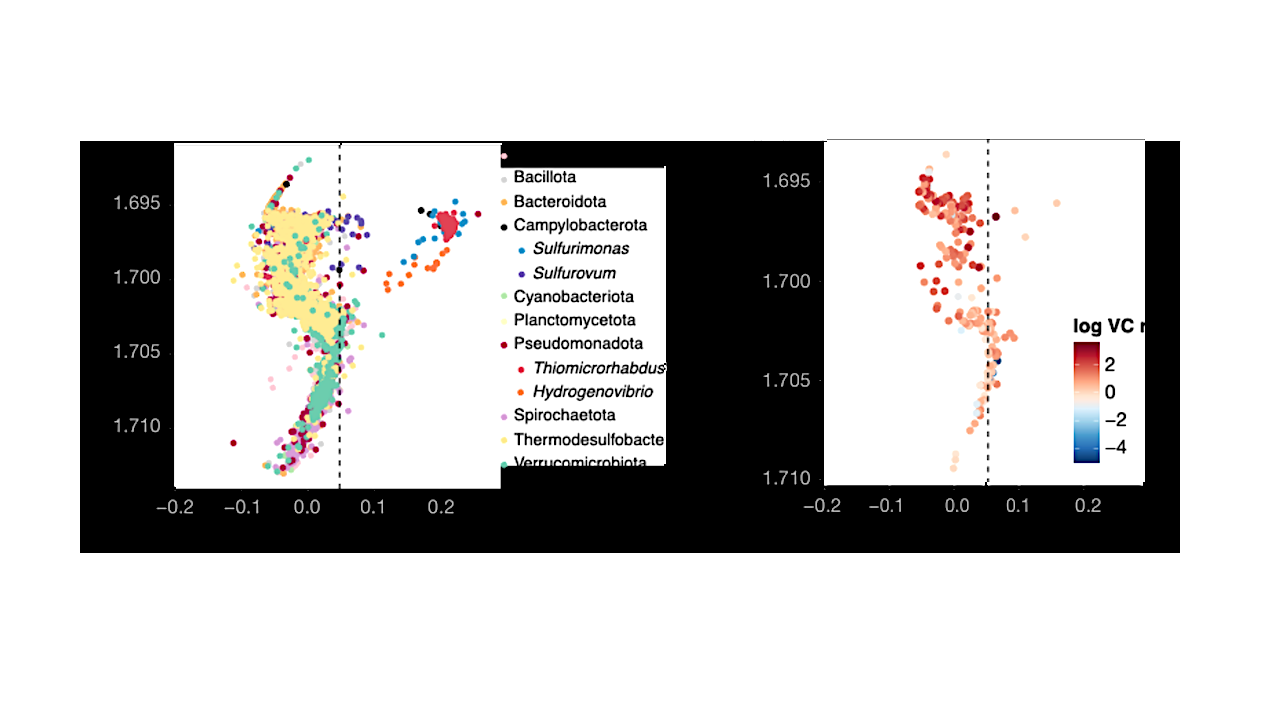
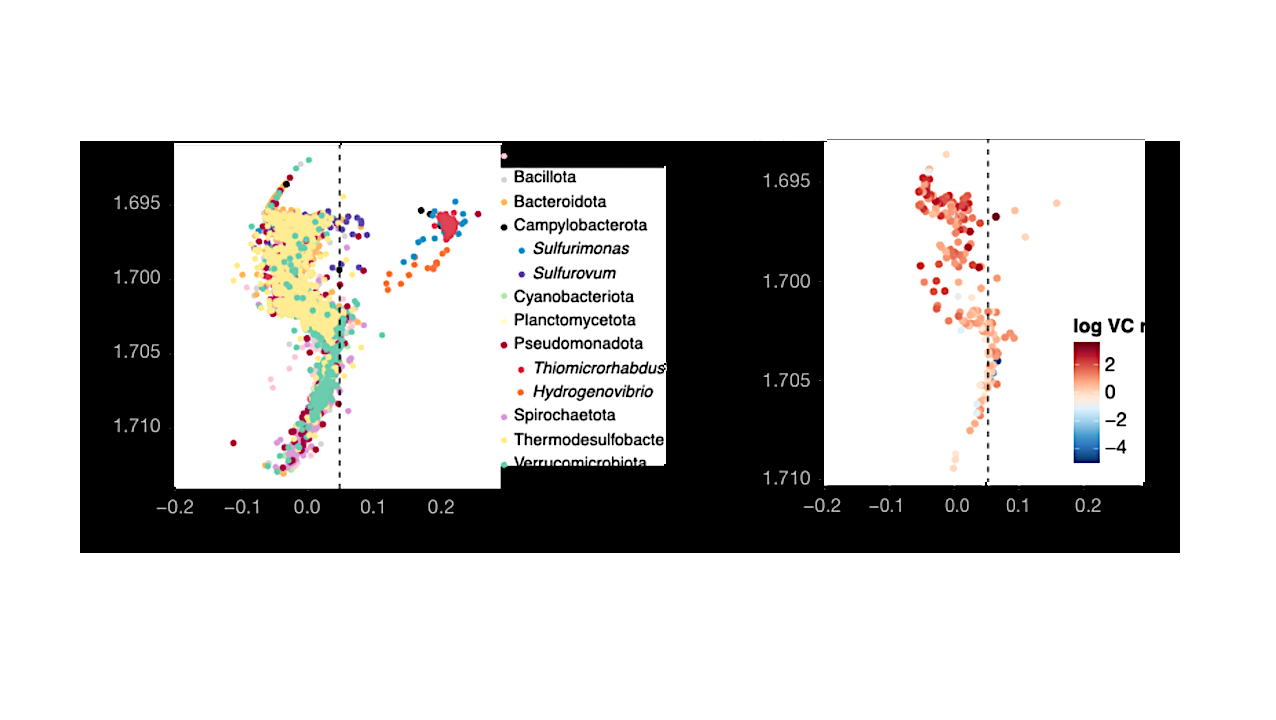
Isotopic enrichment of cellular and viral populations. Isotopic enrichment is determined by the contigs’ 13C Excess Atom Fraction (13C-EAF), plotted relative to the contigs’ average density in the 12C control, of cellular contigs from metagenome-assembled genomes (MAGs, left) and viral population genomes (right). Cellular contigs are colored by their MAG phylum- or genus- (italic) level assignments from the Genome Taxonomy Database, and only phyla with >100 contigs are visualized. Contigs above the dashed line indicated significant carbon incorporation (13C-EAF>0.049). Viral populations are colored by the log-ratio of their relative abundance in the virus-enriched to cell-enriched sample (VC ratio) in the environmental sample, approximating their reproductive strategy. Prophages are expected to have near-zero extracellular presence (negative log VC ratio), while populations producing viral particles are expected to have detectable extracellular presence (higher log VC ratio). Source data are provided as a Source Data file. — Nature Communciations
Viruses play a far more active role in Earth’s carbon cycle than previously understood, according to new research that reveals how they infect and control microbes responsible for carbon production in some of the planet’s largest, darkest ecosystems.
Aquatic environments absorb roughly 2.5 gigatonnes of atmospheric carbon each year, forming a critical buffer against climate change. While scientists have long studied how sunlight-driven microbes contribute to this process, far less is known about what happens in the vast, lightless environments beneath the surface.
A new study led by researchers at the University of North Carolina at Charlotte identifies viruses actively infecting chemoautotrophs, microbes that produce energy without sunlight and form the foundation of food webs in these dark environments.
Using a combination of metagenomics and stable isotope tracing, the research team tracked carbon as it moved from the environment into microbial DNA and into the viruses that infect those microbes.
The findings show that viruses actively target rare but highly productive microbial populations that drive carbon fixation in these systems.
“These microbes may be small in numbers, but they are doing an outsized share of the work by fueling the base of the food web,” said Elaine Luo, assistant professor of biological sciences and principal investigator. “We found that viruses are specifically targeting them, which has major implications for how carbon moves through these ecosystems.”
The study focused on chemoautotrophic bacteria that use sulfur and hydrogen as energy sources for carbon fixation. These organisms are found globally in environments ranging from deep-sea hydrothermal vents to oxygen-poor coastal waters. Despite their importance, viruses infecting these microbes have remained largely undetected.
By tracking a carbon isotope (¹³C) through both microbial and viral genomes, researchers were able to directly link viruses to their hosts, overcoming a longstanding limitation in environmental microbiology.
The results suggest that viral infection helps regulate these microbial populations and accelerates the release and recycling of carbon back into the environment.
That process matters at scale. Viral activity is estimated to recycle roughly 150 gigatonnes of carbon annually, about 25 times the amount moved by the ocean’s biological carbon pump that sequesters carbon to the deep sea.
“This research changes how we think about carbon cycling in vast marine ecosystems below the Earth’s sunlit layer,” said Luo. “Viruses aren’t just part of the system; they’re actively shaping it.”
Quantitative stable isotope probing (qSIP)-informed metagenomics identifies viruses infecting chemoautotrophs, Nature Communications (open access)
Astrobiology, Genomics,










Related Posts

Stay Informed With the Latest & Most Important News
Previous Post
Next Post



Advertisement
-
 01Two Black Holes Observed Circling Each Other for the First Time
 -
 02From Polymerization-Enabled Folding and Assembly to Chemical Evolution: Key Processes for Emergence of Functional Polymers in the Origin of Life
 -
 03Astronomy 101: From the Sun and Moon to Wormholes and Warp Drive, Key Theories, Discoveries, and Facts about the Universe (The Adams 101 Series)
 -
 04True Anomaly hires former York Space executive as chief operating officer
 -
 05Φsat-2 begins science phase for AI Earth images
 -
 06Hurricane forecasters are losing 3 key satellites ahead of peak storm season − a meteorologist explains why it matters
 -
 07Binary star systems are complex astronomical objects − a new AI approach could pin down their properties quickly