
Now Reading: Biosignatures: Evidence for Endogenous Collagen in Edmontosaurus Fossil BoneAnalytical Chemistry via PubMed
-
01
Biosignatures: Evidence for Endogenous Collagen in Edmontosaurus Fossil BoneAnalytical Chemistry via PubMed

Biosignatures: Evidence for Endogenous Collagen in Edmontosaurus Fossil BoneAnalytical Chemistry via PubMed


XPol with first order red filter micrograph of artificially decayed Meleagris proximal epiphysis of femur. (A) Gold and blue regions suggest bone collagen remnants. Scale bar 200 μm. (B) Gold regions turn blue and blue regions turn gold after rotating the stage showing birefringence that confirms collagen remnants. Lavender regions with little to no birefringence we interpret as collagen-depleted, similar to the patchy pattern of collagen that XPol reveals in fossil bone. — Analytical Chemistry via PubMed
Reports of proteins in fossilized bones have been a subject of controversy in the scientific literature because it is assumed that fossilization results in the destruction of all organic components.
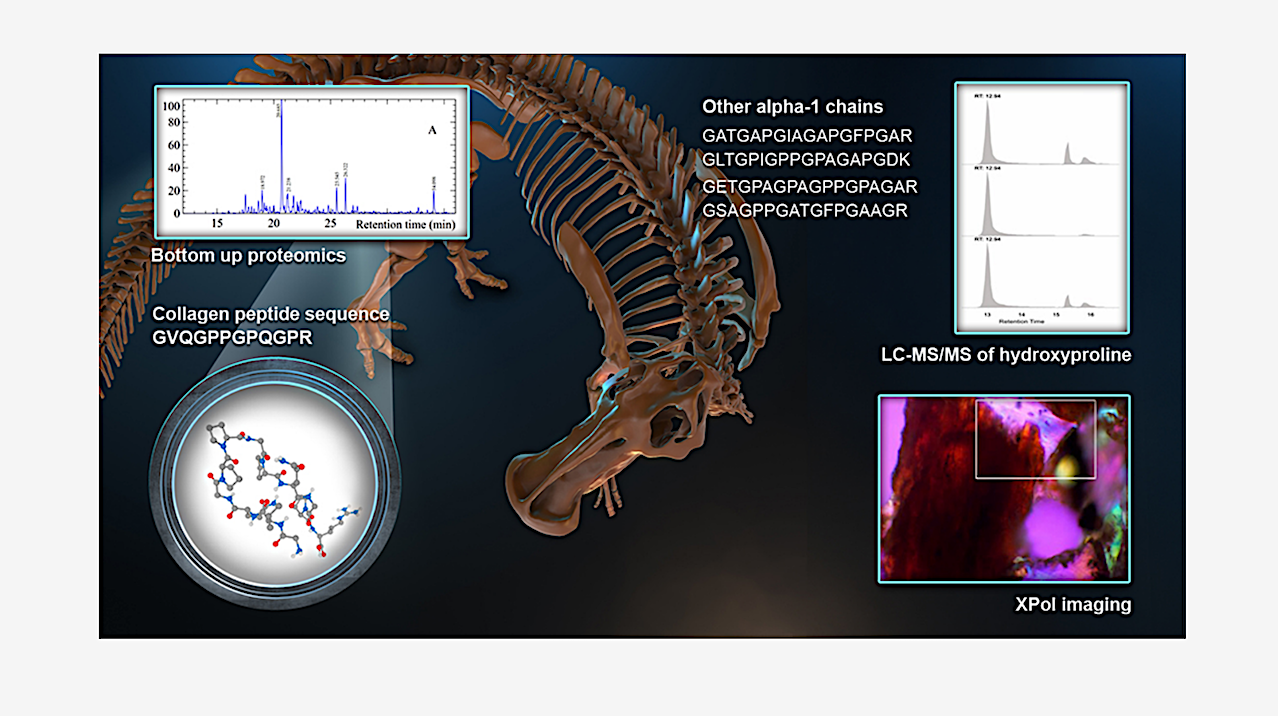
In this paper, a novel combination of analytical techniques is used to address this question for an exceptionally well-preserved Edmontosaurus sacrum excavated from the Upper Cretaceous strata of the South Dakota Hell Creek Formation. Cross-polarized light microscopy (XPol) shows birefringence consistent with collagen presence.
Tandem LC-MS unambiguously identified, and for the first time quantified, hydroxyproline, a unique collagen-indicator amino acid, in acid-digested samples from the Edmontosaurus.
LC-MS/MS bottom-up proteomics shows identical collagen peptide sequences previously identified and reported for another hadrosaur and a T. rex sample.
Biosignatures: Evidence for Endogenous Collagen in Edmontosaurus Fossil Bone, Analytical Chemistry via PubMed
Astrobiology, Genomics, Biochemistry,










Related Posts
Stay Informed With the Latest & Most Important News



Advertisement
-
 01Two Black Holes Observed Circling Each Other for the First Time
 -
 02From Polymerization-Enabled Folding and Assembly to Chemical Evolution: Key Processes for Emergence of Functional Polymers in the Origin of Life
 -
 03Astronomy 101: From the Sun and Moon to Wormholes and Warp Drive, Key Theories, Discoveries, and Facts about the Universe (The Adams 101 Series)
 -
 04True Anomaly hires former York Space executive as chief operating officer
 -
 05Φsat-2 begins science phase for AI Earth images
 -
 06Hurricane forecasters are losing 3 key satellites ahead of peak storm season − a meteorologist explains why it matters
 -
 07Binary star systems are complex astronomical objects − a new AI approach could pin down their properties quickly