
Now Reading: Dust Processing in Protoplanetary Discs From Infall to Dispersal: the Origin of Solar System Isotopic Heterogeneities
-
01
Dust Processing in Protoplanetary Discs From Infall to Dispersal: the Origin of Solar System Isotopic Heterogeneities

Dust Processing in Protoplanetary Discs From Infall to Dispersal: the Origin of Solar System Isotopic Heterogeneities

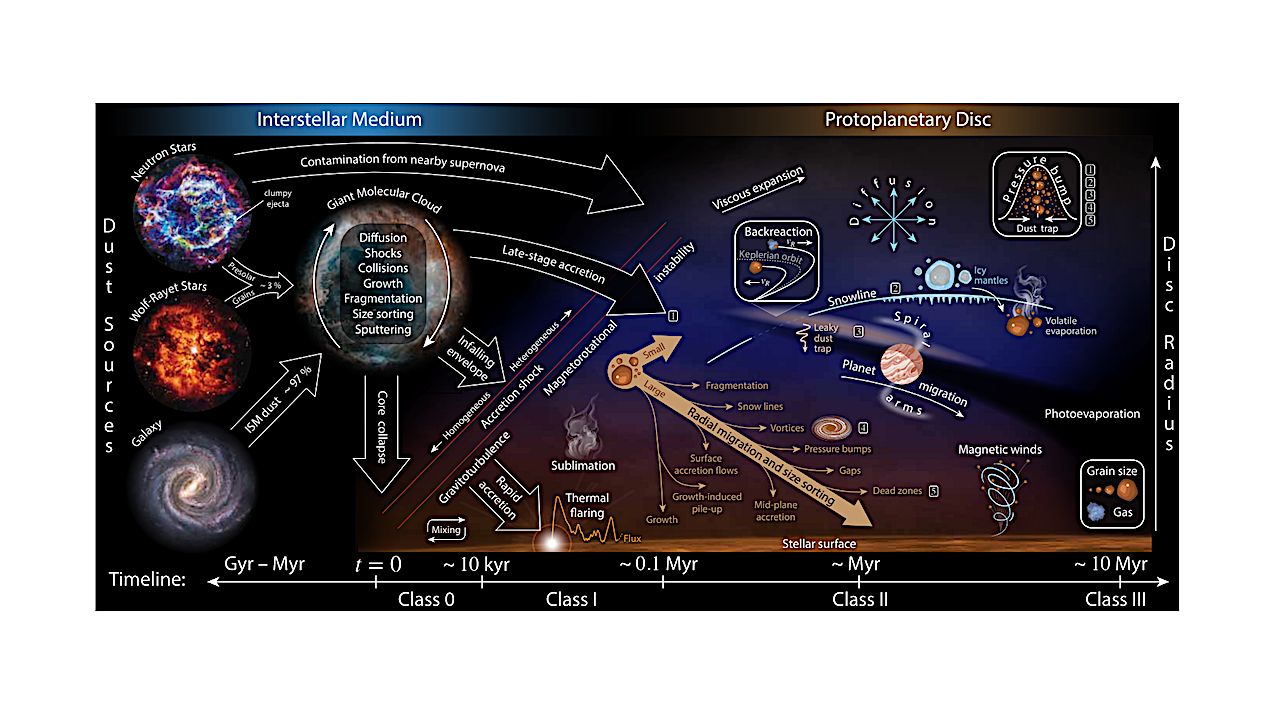
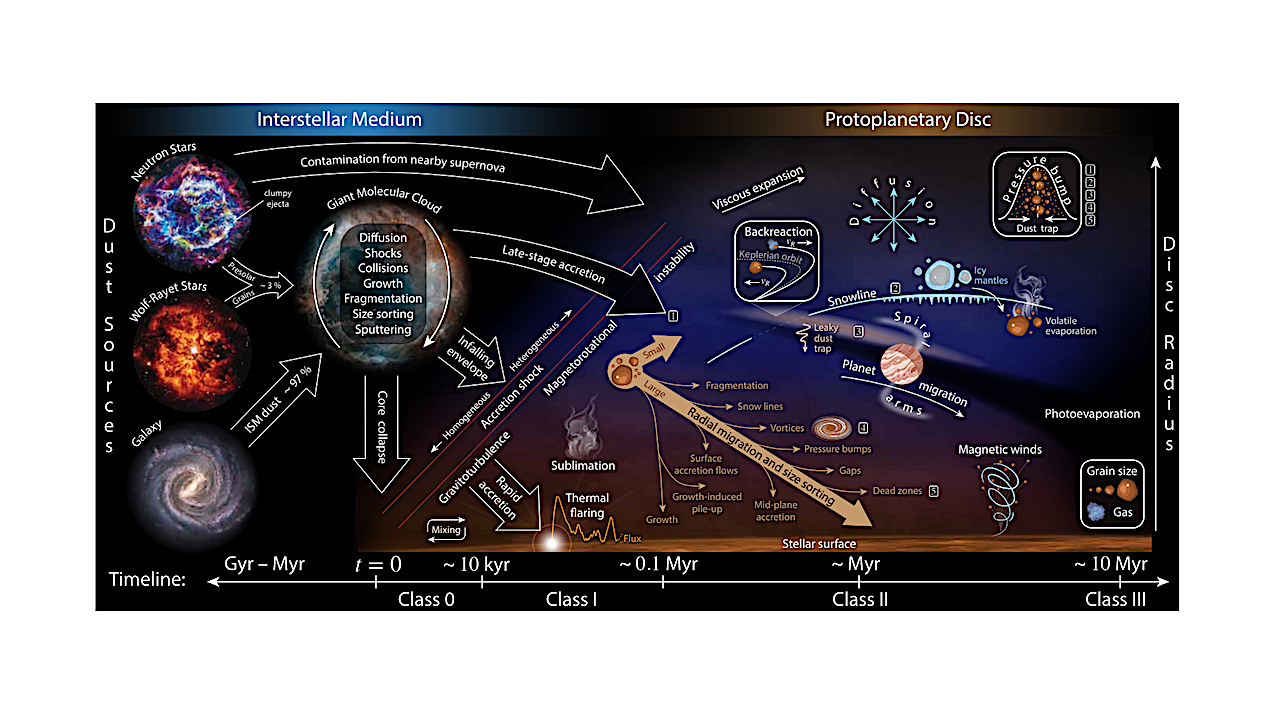
A schematic overview of key processes affecting dust on global scales, from its initial production in the interstellar medium (left) to the end of the protoplanetary disc phase (right). Arrows indicate transport and temporal evolution (horizontal axis), while the vertical axis in the disc representation corresponds to the cylindrical distance from the central star (bottom) to the outer disc (top). Infalling material and gravitoturbulence initially drive strong mixing and rapid accretion onto the star. As infall shifts outward and gradually subsides, the magnetorotational instability becomes the dominant mechanism governing disc evolution. Dust migrates and is aerodynamically size-sorted, with radial drift slowed or halted at local pressure maxima. The dust traps created by these pressure bumps can facilitate the formation of planetesimals, which are crucial building blocks of planets. Solids undergo varying degrees of thermal processing depending on distance from the star and transient heating events. Collectively, these processes influence isotopic heterogenety, volatile depletion, and the spatial distribution of solids ultimately shaping the composition of planetesimals and planetary bodies that emerge from the protoplanetary disc phase. — astro-ph.EP
The nucleosynthetic heterogeneity between different asteroids and planets is well established. These isotopic variations manifest themselves at the part per millions level or larger, in isotopes that were synthesised in various stellar environments.
To escape homogenisation, some of these isotopic signatures must have been preserved in dust, which ended up being heterogeneously distributed in the solar protoplanetary disc. The origin of the nucleosynthetic heterogeneity is still poorly constrained, potentially reflecting inherited isotope variations from the Sun’s parental molecular cloud and/or processing and redistribution during the subsequent protoplanetary disc phase with thermal processing and size sorting as major processes.
This chapter aims to provide a broad review of the dynamical, collisional, and thermal processes in protoplanetary discs — from initial infall to gas dispersal — that may have influenced the distribution and survival of the anomalous carrier phases, which finally accreted into asteroids and planets.
While several of these mechanisms have been considered in past studies, they are often examined in isolation, which impedes the assessment of how their effects may be altered or amplified by additional disc processes. Size sorting in particular has received little attention, and here we highlight that this process likely occurred in the disc and can induce nucleosynthetic heterogeneity.
By placing previous studies within the context of a comprehensive overview, we aim to clarify the broader physical framework in which anomalous carrier transport occurs and identify previously underexplored mechanisms that may have contributed to the final isotopic structure of the Solar System we see today.
Mark A. Hutchison, Maria Schönbächler, Lucio Mayer, Jean-David Bodénan
Comments: Chapter accepted for publication in the NCCR PlanetS Legacy Book: Benz, W. et al. (Eds), The National Center for Competence in Research, PlanetS: A Swiss-wide network expanding planetary sciences. Springer (2026)
Subjects: Earth and Planetary Astrophysics (astro-ph.EP); Astrophysics of Galaxies (astro-ph.GA); Solar and Stellar Astrophysics (astro-ph.SR)
Cite as: arXiv:2604.09122 [astro-ph.EP] (or arXiv:2604.09122v1 [astro-ph.EP] for this version)
https://doi.org/10.48550/arXiv.2604.09122
Focus to learn more
Submission history
From: Mark Hutchison
[v1] Fri, 10 Apr 2026 09:03:22 UTC (15,027 KB)
https://arxiv.org/abs/2604.09122
Astrobiology,










Related Posts
Stay Informed With the Latest & Most Important News
Previous Post
Next Post



Advertisement
-
 01Two Black Holes Observed Circling Each Other for the First Time
 -
 02From Polymerization-Enabled Folding and Assembly to Chemical Evolution: Key Processes for Emergence of Functional Polymers in the Origin of Life
 -
 03Astronomy 101: From the Sun and Moon to Wormholes and Warp Drive, Key Theories, Discoveries, and Facts about the Universe (The Adams 101 Series)
 -
 04True Anomaly hires former York Space executive as chief operating officer
 -
 05Φsat-2 begins science phase for AI Earth images
 -
 06Hurricane forecasters are losing 3 key satellites ahead of peak storm season − a meteorologist explains why it matters
 -
 07Binary star systems are complex astronomical objects − a new AI approach could pin down their properties quickly