
Now Reading: ESA and JAXA Forge Partnership for Planetary Defense with New Ramses Mission
-
01
ESA and JAXA Forge Partnership for Planetary Defense with New Ramses Mission


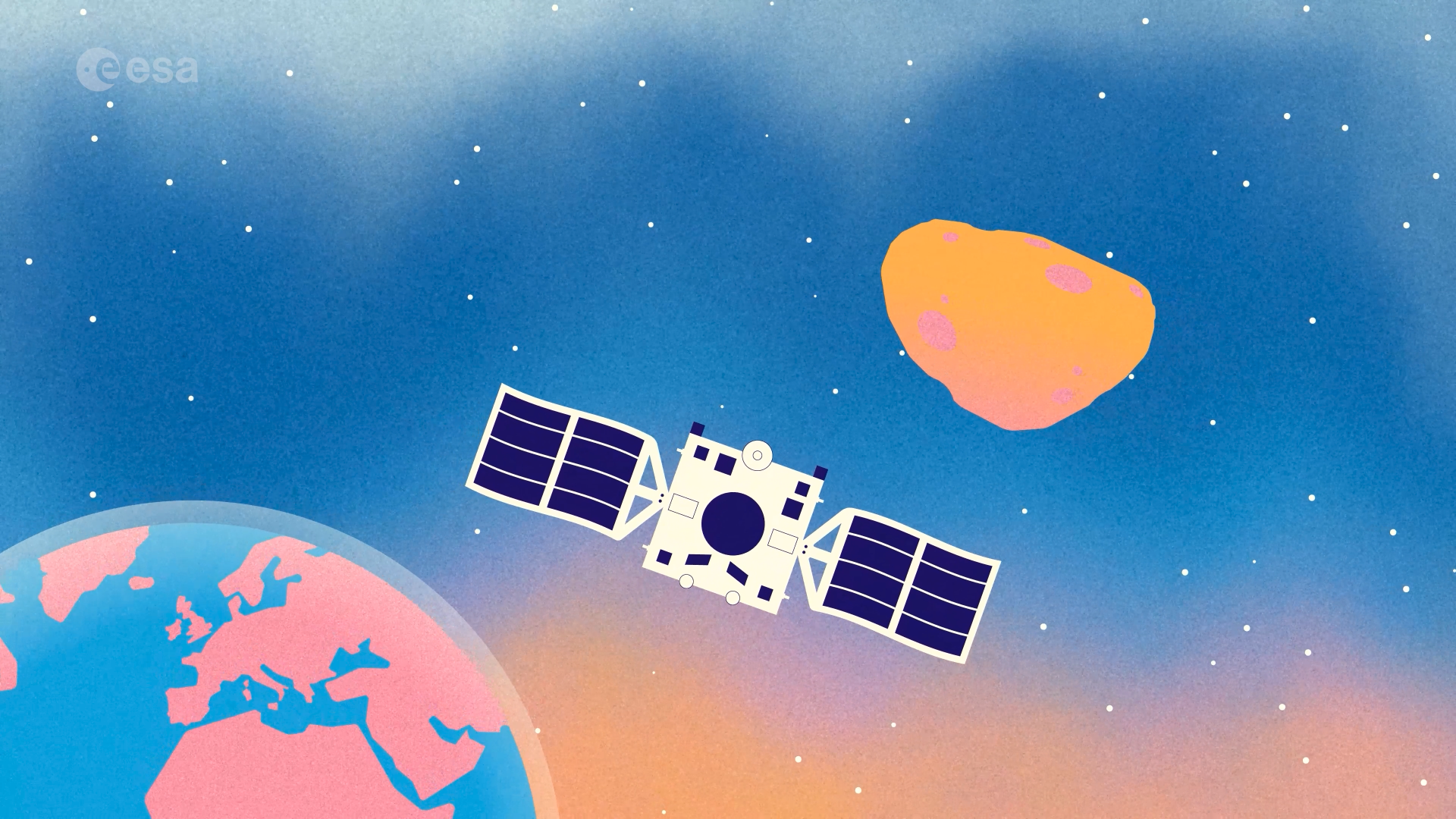

The European Space Agency (ESA) and the Japan Aerospace Exploration Agency (JAXA) have formalized their partnership in planetary defense through the signing of a Memorandum of Cooperation, alongside a specific agreement for the Rapid Apophis Mission for Space Safety (Ramses). The agreements were finalized on May 7, 2026, by ESA Director General Josef Aschbacher and JAXA President Hiroshi Yamakawa at the Italian Embassy in Berlin, with representatives from both European and Japanese institutions present. This initiative is supported by the Italian Space Agency (ASI) in conjunction with ESA’s decision to appoint OHB Italia as the primary contractor for the Ramses mission.
This latest step follows a joint declaration made in November 2024, where ESA and JAXA pledged to improve cooperative efforts in various areas including planetary defense initiatives. Aschbacher emphasized the collective global obligation for planetary safety, stating that the newly signed agreements mark a transition from mutual intentions to concrete collaborative action. He highlighted the importance of international alliances in the context of space. Yamakawa also expressed confidence in the partnership, commending ESA and its member nations for their commitment to advancing global lunar defense efforts.
Planetary defense represents a critical issue of global significance, working to identify, characterize, and monitor near-Earth objects for potential threats. By enhancing collaboration between ESA and JAXA, both agencies reaffirm their commitment to addressing these challenges collectively. ESA’s Space Safety program plays a pivotal role in this domain, particularly through the Near-Earth Object Coordination Centre, which specializes in monitoring asteroid threats and improving trajectory predictions. The agency’s Hera mission, in collaboration with JAXA, is set to enhance techniques for asteroid deflection by evaluating the Didymos binary asteroid system later this year.
The inaugural project stemming from their enhanced cooperation is the Ramses mission, scheduled for launch in 2028. This mission aims to observe the asteroid Apophis as it approaches Earth during its rare flyby in April 2029. Measuring approximately 375 meters, Apophis will pass within 32,000 kilometers of Earth’s surface—much closer than the Moon and geosynchronous satellites. Although there is no threat of impact, this event is notable, occurring only once every 5,000 to 10,000 years for an asteroid of this size, and will be visible to up to two billion observers on Earth.
Ramses will monitor Apophis during this flyby, studying how Earth’s gravity affects its physical characteristics and motion. By analyzing the changes before and after the event, scientists hope to glean critical information regarding asteroid composition and behavior, which could inform future deflection strategies. ESA will manage the spacecraft’s design and operations for Ramses, while JAXA will contribute essential elements such as solar arrays and an infrared imager, as well as launch the mission on its H3 rocket. This cooperative effort builds on JAXA’s involvement in ESA’s Hera mission and their ongoing partnership across various space endeavors.
With Apophis, scientists will have a unique opportunity to observe an asteroid in unprecedented proximity as it undergoes changes driven by Earth’s gravitational pull, marking a significant milestone in planetary defense research.










Related Posts

Stay Informed With the Latest & Most Important News
Previous Post
Next Post



Advertisement
-
 01Two Black Holes Observed Circling Each Other for the First Time
 -
 02From Polymerization-Enabled Folding and Assembly to Chemical Evolution: Key Processes for Emergence of Functional Polymers in the Origin of Life
 -
 03Astronomy 101: From the Sun and Moon to Wormholes and Warp Drive, Key Theories, Discoveries, and Facts about the Universe (The Adams 101 Series)
 -
 04True Anomaly hires former York Space executive as chief operating officer
 -
 05Φsat-2 begins science phase for AI Earth images
 -
 06Hurricane forecasters are losing 3 key satellites ahead of peak storm season − a meteorologist explains why it matters
 -
 07Binary star systems are complex astronomical objects − a new AI approach could pin down their properties quickly