
Now Reading: ESA readies launch of three advanced Earth observation satellites after successful tests
-
01
ESA readies launch of three advanced Earth observation satellites after successful tests

ESA readies launch of three advanced Earth observation satellites after successful tests

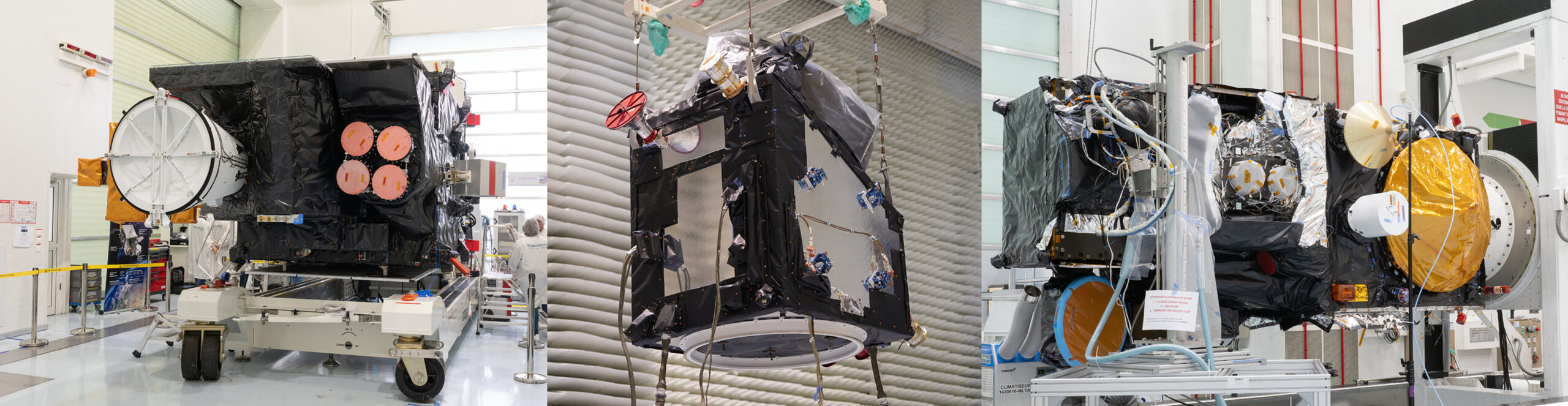

Three Earth observation satellites developed by the European Space Agency (ESA) and its partners have completed their functional and environmental tests, with preparations underway for their upcoming launch later this year. These satellites are set to be transported to the European spaceport in French Guiana after showcasing their final stages during a media event hosted by Thales Alenia Space in Cannes, France.
The satellites on display included the Fluorescence Earth Explorer satellite, known as FLEX, the Meteosat Third Generation Imager (MTG-I2), and the Copernicus programme’s Sentinel-3C satellite. Journalists were given a unique opportunity to photograph and interview key mission partners, gaining insights into the capabilities of these advanced spacecraft before they make their journey to the launch site. They are scheduled to lift off on ESA’s Ariane 6 and Vega-C launch vehicles.
Dirk Bernaerts, ESA’s Earth Explorer Missions Programme Manager, expressed enthusiasm about the launches, emphasizing the critical role these satellites will play in monitoring Earth’s ecosystems, weather forecasting, and climate observations. He underscored the importance of collaboration among European organizations for these missions’ success.
ESA’s Director of Earth Observation Programmes, Simonetta Cheli, acknowledged the dedication of all teams involved in the missions’ design and realization, highlighting the significant benefits that the data generated from these satellites will bring to individuals worldwide. She noted that this data will aid in timely weather warnings and enhance understanding of vital processes like photosynthesis, ultimately improving climate models.
FLEX, part of ESA’s FutureEO program, aims to provide a deeper understanding of vegetation health and its role in carbon and water cycles by detecting the faint fluorescence signal emitted by plants during photosynthesis. The satellite will operate in conjunction with Sentinel-3C, sharing the same orbit to improve data collection on atmospheric conditions and surface properties.
Sentinel-3C is the latest addition to the Sentinel-3 mission, contributing vital data for real-time responses and long-term climate monitoring across Earth’s surface, oceans, and atmosphere. It will join its predecessors to track phenomena such as sea-level rise and wildfires, providing essential observational data this is available free of charge to users globally.
The MTG-I2 satellite will enhance weather forecasting efforts in Europe with its state-of-the-art imaging capabilities, allowing for unprecedented detail in severe weather monitoring. The satellite is equipped with innovative instruments that continuously monitor lightning and rapidly evolving weather systems, thereby improving the accuracy of weather warnings crucial for safety in air travel. MTG-I2 is set for launch on Ariane 6 in the summer.
These three satellites exemplify European excellence in Earth observation, with extensive collaboration among firms and organizations across the continent. ESA is positioned to operate FLEX from its European Space Operations Centre in Darmstadt, Germany, while MTG-I2 and Sentinel-3C will be operated through partnerships between ESA and Eumetsat, alongside other key contributors in the space industry.










Related Posts
Stay Informed With the Latest & Most Important News
Previous Post
Next Post



Advertisement
-
 01Two Black Holes Observed Circling Each Other for the First Time
 -
 02From Polymerization-Enabled Folding and Assembly to Chemical Evolution: Key Processes for Emergence of Functional Polymers in the Origin of Life
 -
 03Astronomy 101: From the Sun and Moon to Wormholes and Warp Drive, Key Theories, Discoveries, and Facts about the Universe (The Adams 101 Series)
 -
 04True Anomaly hires former York Space executive as chief operating officer
 -
 05Φsat-2 begins science phase for AI Earth images
 -
 06Hurricane forecasters are losing 3 key satellites ahead of peak storm season − a meteorologist explains why it matters
 -
 07Binary star systems are complex astronomical objects − a new AI approach could pin down their properties quickly