
Now Reading: ExoNet: Multimodal Deep Learning for TESS Exoplanet Candidate Identification via Phase-Folded Light Curves, Stellar Parameters, and Multi-Head Attention Fusion
-
01
ExoNet: Multimodal Deep Learning for TESS Exoplanet Candidate Identification via Phase-Folded Light Curves, Stellar Parameters, and Multi-Head Attention Fusion

ExoNet: Multimodal Deep Learning for TESS Exoplanet Candidate Identification via Phase-Folded Light Curves, Stellar Parameters, and Multi-Head Attention Fusion

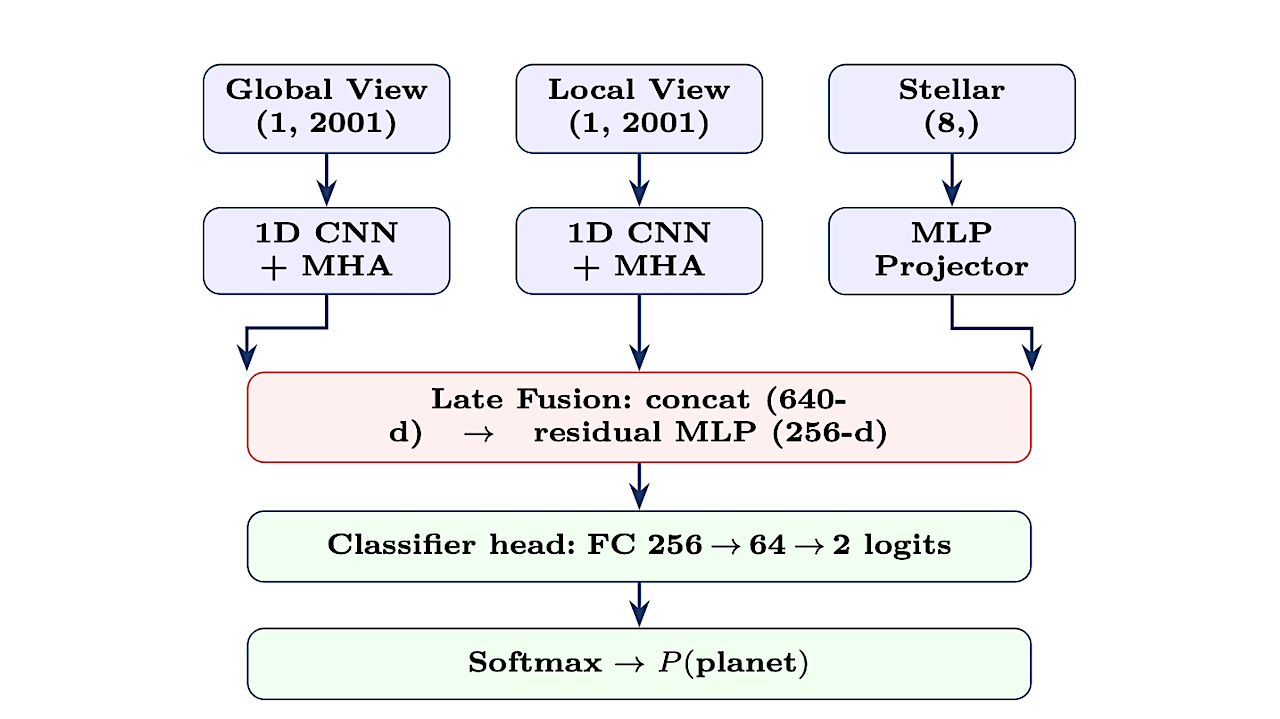
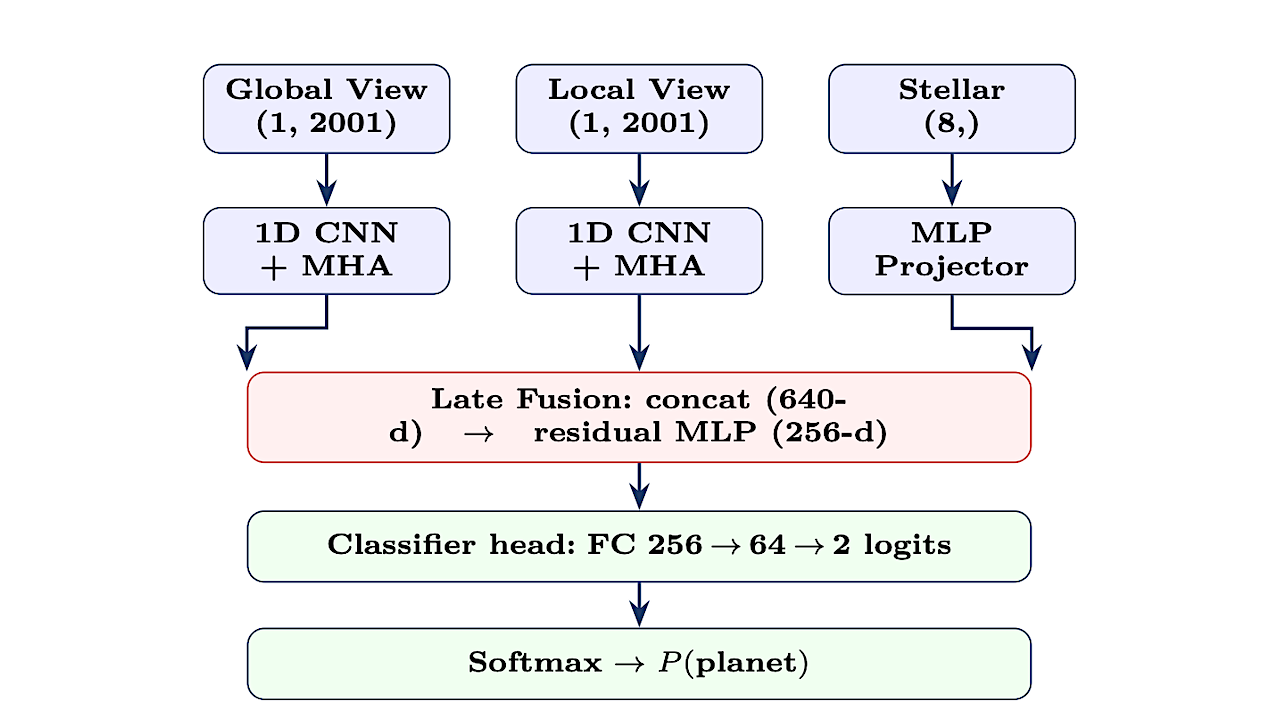
ExoNet architecture. Global and local CNN encoders each produce a 256-d embedding; the stellar MLP produces 128-d. All three are concatenated (640-d) and passed through a residual fusion MLP before the binary classifier head. — astro-ph.EP
NASA’s Transiting Exoplanet Survey Satellite (TESS) has identified thousands of exoplanet candidates, yet many remain unconfirmed due to the limitations of manual vetting processes.
This paper presents ExoNet, a multimodal deep learning framework that integrates phase-folded global and local light curve representations with stellar parameters using a late-fusion architecture combining 1D Convolutional Neural Networks and Multi-Head Attention.
Trained on labeled Kepler data, ExoNet achieves strong classification performance and demonstrates effective generalization to TESS data. Applied to 200 unconfirmed TESS planet candidates, the model identifies multiple high-confidence candidates, including several within the habitable zone.
The results highlight the effectiveness of multimodal fusion and attention mechanisms in automated exoplanet candidate validation.
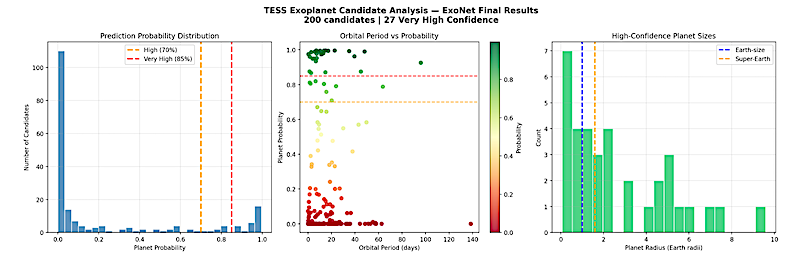
ExoNet predictions on 200 TESS Planet Candidates. Left: Probability distribution; dashed lines at 70% and 85%. Center: Orbital period vs. planet probability, colored by confidence tier. Right: Radius distribution of high-confidence candidates (≥ 70%). Md.Rashadul Islam
Comments: 8 pages, 4 figures, 4 tables
Subjects: Earth and Planetary Astrophysics (astro-ph.EP); Instrumentation and Methods for Astrophysics (astro-ph.IM); Machine Learning (cs.LG)
Cite as: arXiv:2604.15560 [astro-ph.EP] (or arXiv:2604.15560v1 [astro-ph.EP] for this version)
https://doi.org/10.48550/arXiv.2604.15560
Focus to learn more
Submission history
From: Md Rashadul Islam
[v1] Thu, 16 Apr 2026 22:26:29 UTC (415 KB)
https://arxiv.org/abs/2604.15560
Astrobiology, exoplanet,











Related Posts
Stay Informed With the Latest & Most Important News
Advertisement
-
 01Two Black Holes Observed Circling Each Other for the First Time
 -
 02From Polymerization-Enabled Folding and Assembly to Chemical Evolution: Key Processes for Emergence of Functional Polymers in the Origin of Life
 -
 03Astronomy 101: From the Sun and Moon to Wormholes and Warp Drive, Key Theories, Discoveries, and Facts about the Universe (The Adams 101 Series)
 -
 04True Anomaly hires former York Space executive as chief operating officer
 -
 05Φsat-2 begins science phase for AI Earth images
 -
 06Hurricane forecasters are losing 3 key satellites ahead of peak storm season − a meteorologist explains why it matters
 -
 07Binary star systems are complex astronomical objects − a new AI approach could pin down their properties quickly