
Now Reading: Laser-based Mass Spectrometry For The Detection Of Signatures Of Life Within Our Solar System
-
01
Laser-based Mass Spectrometry For The Detection Of Signatures Of Life Within Our Solar System

Laser-based Mass Spectrometry For The Detection Of Signatures Of Life Within Our Solar System

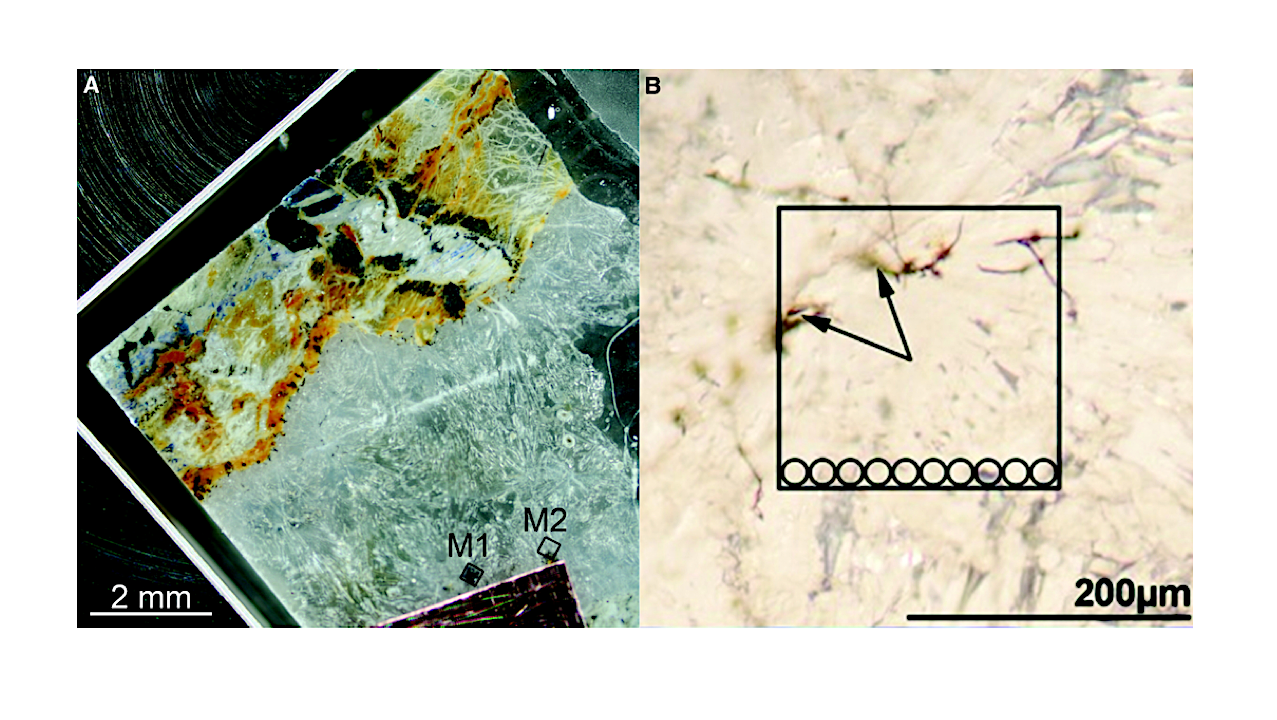
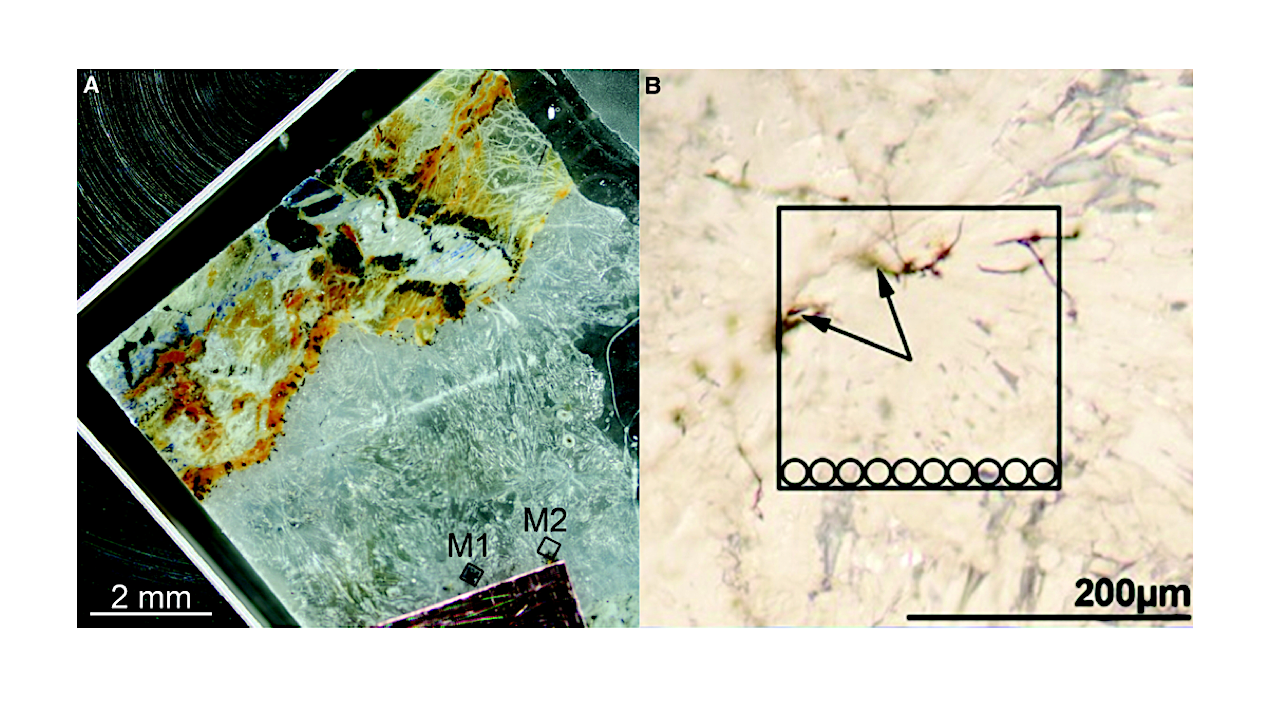
A: Microscope images of the aragonite host showing two survey areas (M1 and M2). B:
Area M1 showing micrometer-sized fossil structures in more detail. Figure adapted from Tulej et al., 2015.
The search for signatures of life beyond Earth has been a major goal of space research and astrobiology for decades. The combination of expanded knowledge on Solar System bodies from past missions and advancements in in-situ detection technologies may place humanity on the verge of discovering extraterrestrial life.
Here, we highlight the current measurement capabilities of Laser Ionisation Mass Spectrometry for the detection of several classes of signatures of life of high relevance to current astrobiology-focused missions.
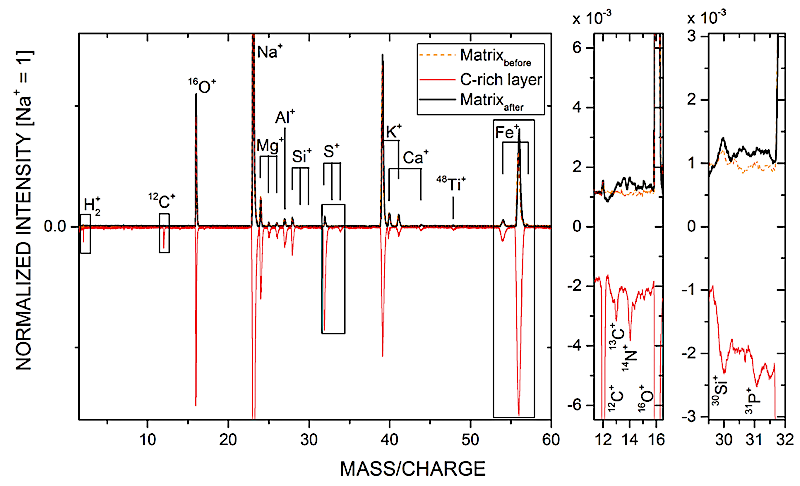
LMS measurement of a Martian mudstone analogue sample artificially inoculated with cells.
Compared to the matrix surrounding the carbon layer, a signal increase of the biologically relevant
elements can be observed. Figure taken from (47) . — astro-ph.EP
This includes the detection of microstructures within complex geological hosts by chemical depth profiling, sulphur isotope fractionation signatures, and the detection of various classes of organic molecules.
The recorded mass spectrometric data can be fed into network and machine learning analysis routines, which are powerful tools for the unbiased detection of signatures of life, including agnostic detection of biosignatures.
We demonstrate that Laser Ionisation Mass Spectrometry is a novel and promising technology for future application. on space exploration missions devoted to life detection.
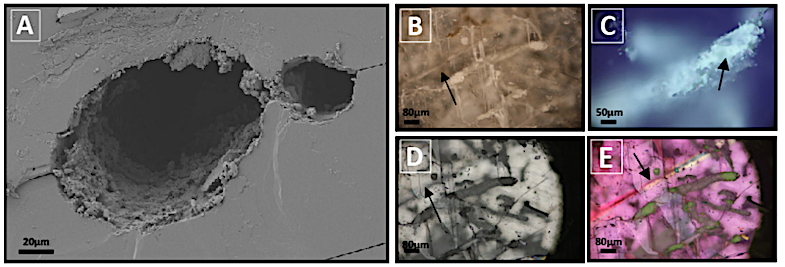
Optical microscopy and SEM images of the Messinian gypsum sample studied with LMS. For full figure including caption see (7). Figure adapted from (7), licensed under CC-BY 4.0. ) . — astro-ph.EP
Andreas Riedo, Salome Gruchola, Nikita J. Boeren, Peter Keresztes Schmidt, Luca N. Knecht, Youcef Sellam, Marek Tulej, Peter Wurz
Comments: Chapter accepted for publication in the NCCR PlanetS Legacy Book: Benz, W. et al. (Eds), The National Center for Competence in Research, PlanetS: A Swiss-wide network expanding planetary sciences. Springer (2026)
Subjects: Earth and Planetary Astrophysics (astro-ph.EP); Instrumentation and Methods for Astrophysics (astro-ph.IM)
Cite as: arXiv:2604.18749 [astro-ph.EP] (or arXiv:2604.18749v1 [astro-ph.EP] for this version)
https://doi.org/10.48550/arXiv.2604.18749
Focus to learn more
Submission history
From: Andreas Riedo
[v1] Mon, 20 Apr 2026 18:53:53 UTC (15,857 KB)
https://arxiv.org/abs/2604.18749
Astrobiology,










Related Posts
Stay Informed With the Latest & Most Important News
Advertisement
-
 01Two Black Holes Observed Circling Each Other for the First Time
 -
 02From Polymerization-Enabled Folding and Assembly to Chemical Evolution: Key Processes for Emergence of Functional Polymers in the Origin of Life
 -
 03Astronomy 101: From the Sun and Moon to Wormholes and Warp Drive, Key Theories, Discoveries, and Facts about the Universe (The Adams 101 Series)
 -
 04True Anomaly hires former York Space executive as chief operating officer
 -
 05Φsat-2 begins science phase for AI Earth images
 -
 06Hurricane forecasters are losing 3 key satellites ahead of peak storm season − a meteorologist explains why it matters
 -
 07Binary star systems are complex astronomical objects − a new AI approach could pin down their properties quickly