
Now Reading: Exoplanet Climate Characterization With Transit Asymmetries
-
01
Exoplanet Climate Characterization With Transit Asymmetries


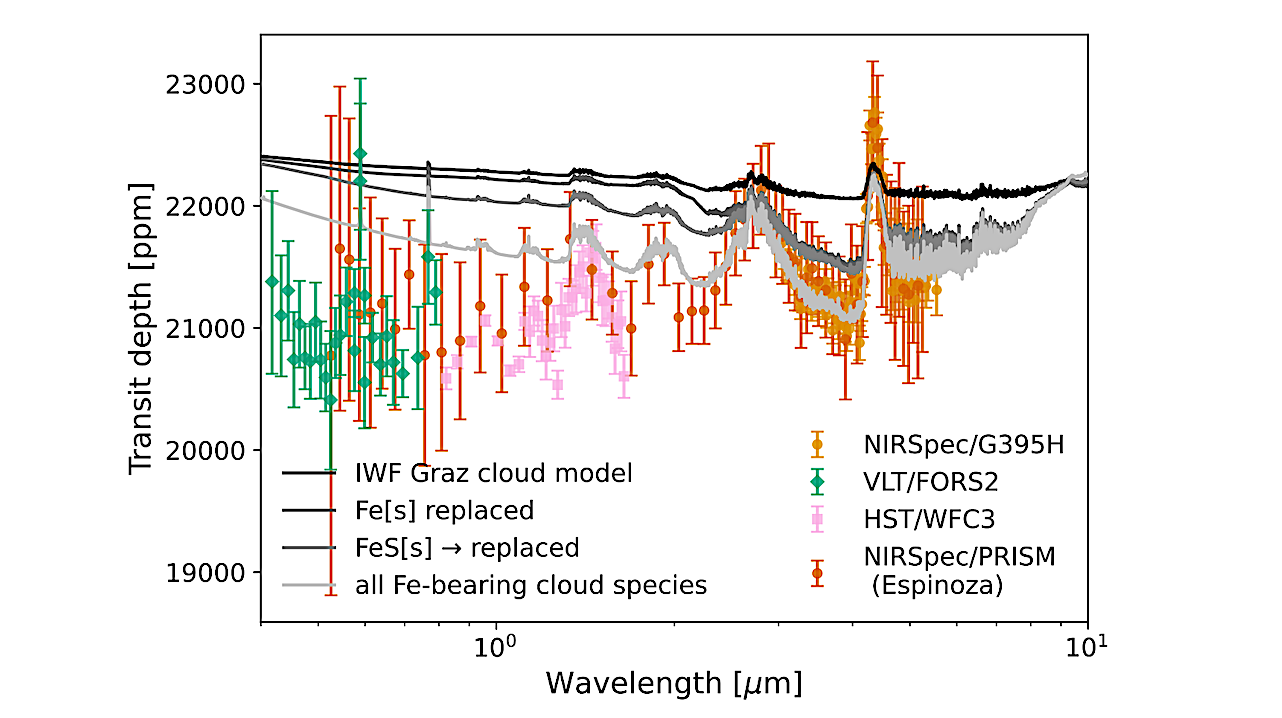

WASP-39b transmission spectra and cloud scenarios. Spectra are observed with JWST (orange), HST (magenta), and VLT (green) in comparison to models with different Fe content: full IWF Graz cloud model (black line), Fe[s] replaced (dark gray), FeS[s] replaced (middle gray), and all Fe-binding materials replaced (light gray). The Fe-free mixed-material cloud compositions provide a good fit in the near-IR but not in the optical. — astro-ph.EP
Context. Space missions such as CHEOPS, JWST, and PLATO facilitate detailed characterization of exoplanets, particularly close-in gas giants and their wide range of global temperatures and climate regimes.
Aims. The aim of this work is to provide a framework to characterize cloud and climate properties of close-in gas giants via transit depth asymmetries from the optical to the infrared (λ = 0.33 … 10 μm).
Methods. The AFGKM ExoRad 3D GCM grid provides 3D gas temperature profiles, assuming a chemical equilibrium gas-phase, for an ensemble of 50 tidally locked gaseous planets orbiting A-, F-, G-, K-, and M-type host stars. It is combined with a kinetic cloud formation model (with nucleation, surface growth and evaporation, gravitational settling, mixing, and element conservation). The end result is a set of synthetic transit spectra and evening-to-morning transit asymmetries that span all relevant climate regimes: warm (Tglobal = 800 K … 1000 K), intermediately hot (Tglobal = 1200 K … 2000 K), and ultrahot (Tglobal = 2200 K … 2600 K).
WASP-39b 3D model cross sections. Shown are the local gas temperature, Tgas K and cloud dust-to-gas mass ratio, ρdust/ρgas (right). The values are derived from the 3D GCM results and shown as cross section across the evening (left hemisphere) and morning terminator (right hemisphere). — astro-ph.EP
Results. WASP-39b observations suggest that clouds are iron-free and that cloud condensation nuclei are less abundant than predicted. The ensemble study shows that clouds increase transit limb differences due to asymmetries in cloud coverage and by enhancing horizontal differences in the gas temperatures. For planets in the intermediately hot climate regime, evening-to-morning differences of up to 150 ppm are suggested in the optical band, whereas differences of up to 100 ppm are implied in the infrared (2-8 μm).

For ultrahot Jupiters, the observed evening-to-morning transit differences are dominated by the morning cloud for a cloud-free evening limb. The differences are strongly negative in the PLATO band (0.5-1 μm, −500 ppm), moderately negative in the near-infrared (11.5 μm, −200 ppm), and moderately positive (+100 ppm) for λ> 2 μm. For a partly cloudy evening terminator, the evening-to-morning transit asymmetry is moderately positive in the whole wavelength range. Warm Jupiter planets exhibit negligible transit asymmetries. The reported transit asymmetries are conservative. Planets 30% larger than 1 RJup increase the transit asymmetry signal by a factor of two.
Conclusions. PLATO may help characterize climate regimes as well as cloud properties. The combination of precise PLATO and JWST transit asymmetry observations between 1-2 μm is optimal to characterize cloudy planetary atmospheres around K-A stars. JWST/MIRI observations are the most effective for planets around M stars with transit differences ≥+500 ppm for 8-10 μm.
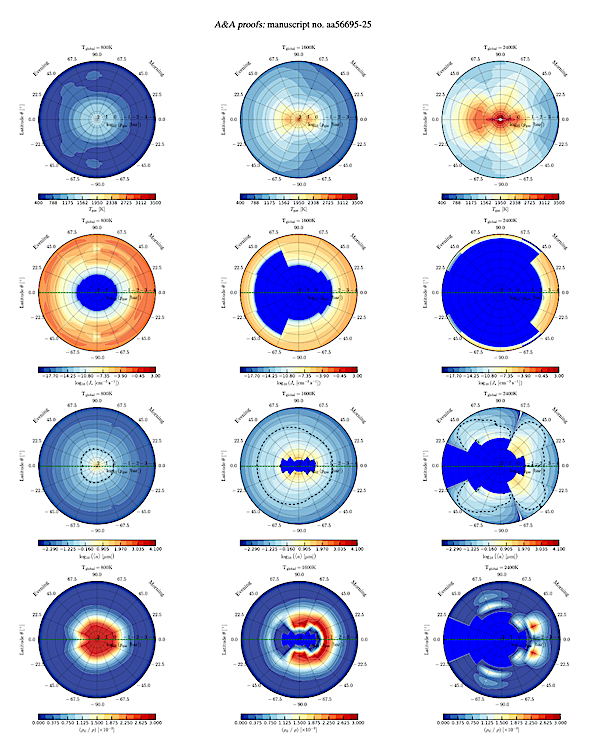
2D terminator slice plots for the three climate regimes. Shown are from top to bottom local gas temperatures, Tgas [K], total nucleation rate, [log10(J∗/cm−3 s−1 )], mean cloud particle sizes, [log10(⟨a⟩/µm)] (with contour line at ⟨a⟩ = 0.1µm ) and cloud dust-to-gas mass ratio, ρdust/ρgas, for tidally locked gas planet with global temperatures of Tglobal = 800 K, 1600 K, 2400 K (left to right). A G main sequence host star with Teff = 5660 K, 0.98 RSun, and 0.98 MSun is assumed. — astro-ph.EP
Exoplanet climate characterization with transit asymmetries A comprehensive population study from the optical to the infrared, Astronomy & Astrophysics (open access)
Astrobiology,










Related Posts

Stay Informed With the Latest & Most Important News
Previous Post
Next Post



Advertisement
-
 01Two Black Holes Observed Circling Each Other for the First Time
 -
 02From Polymerization-Enabled Folding and Assembly to Chemical Evolution: Key Processes for Emergence of Functional Polymers in the Origin of Life
 -
 03Astronomy 101: From the Sun and Moon to Wormholes and Warp Drive, Key Theories, Discoveries, and Facts about the Universe (The Adams 101 Series)
 -
 04True Anomaly hires former York Space executive as chief operating officer
 -
 05Φsat-2 begins science phase for AI Earth images
 -
 06Hurricane forecasters are losing 3 key satellites ahead of peak storm season − a meteorologist explains why it matters
 -
 07Binary star systems are complex astronomical objects − a new AI approach could pin down their properties quickly