
Now Reading: Survival Of NASA-cleanroom Microbial Isolates Under Simulated Space And Martian Conditions
-
01
Survival Of NASA-cleanroom Microbial Isolates Under Simulated Space And Martian Conditions

Survival Of NASA-cleanroom Microbial Isolates Under Simulated Space And Martian Conditions

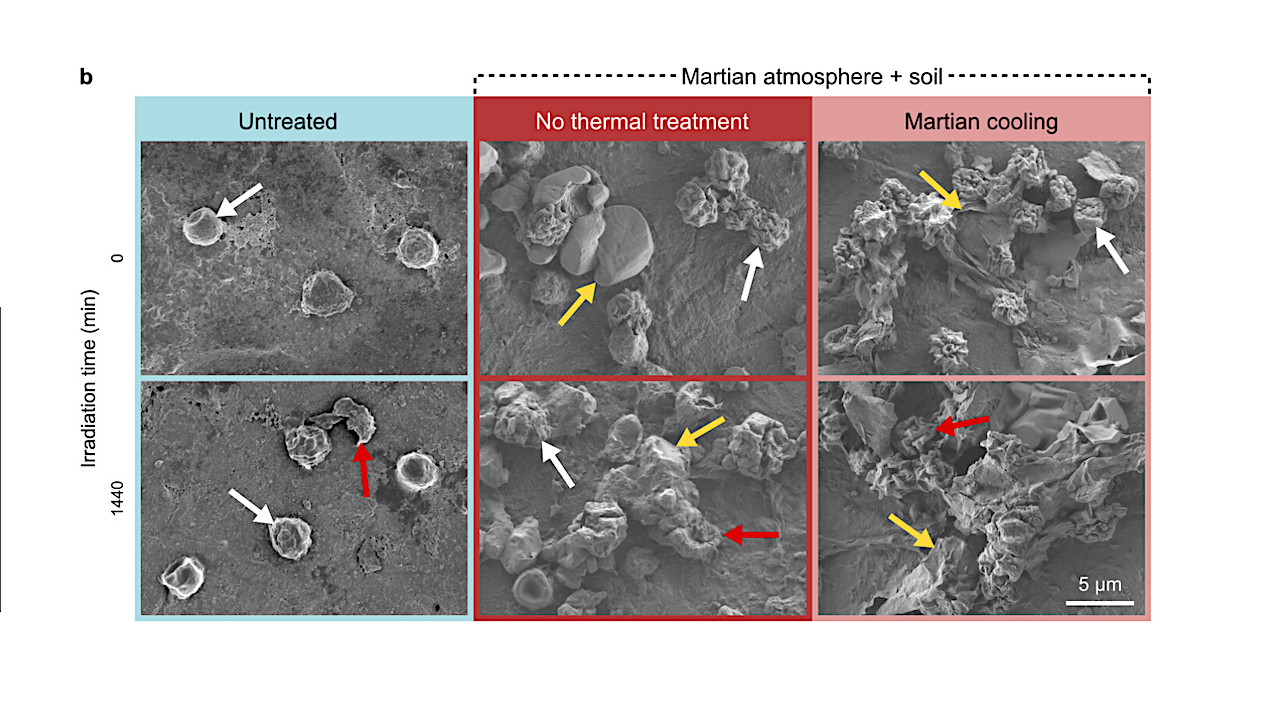
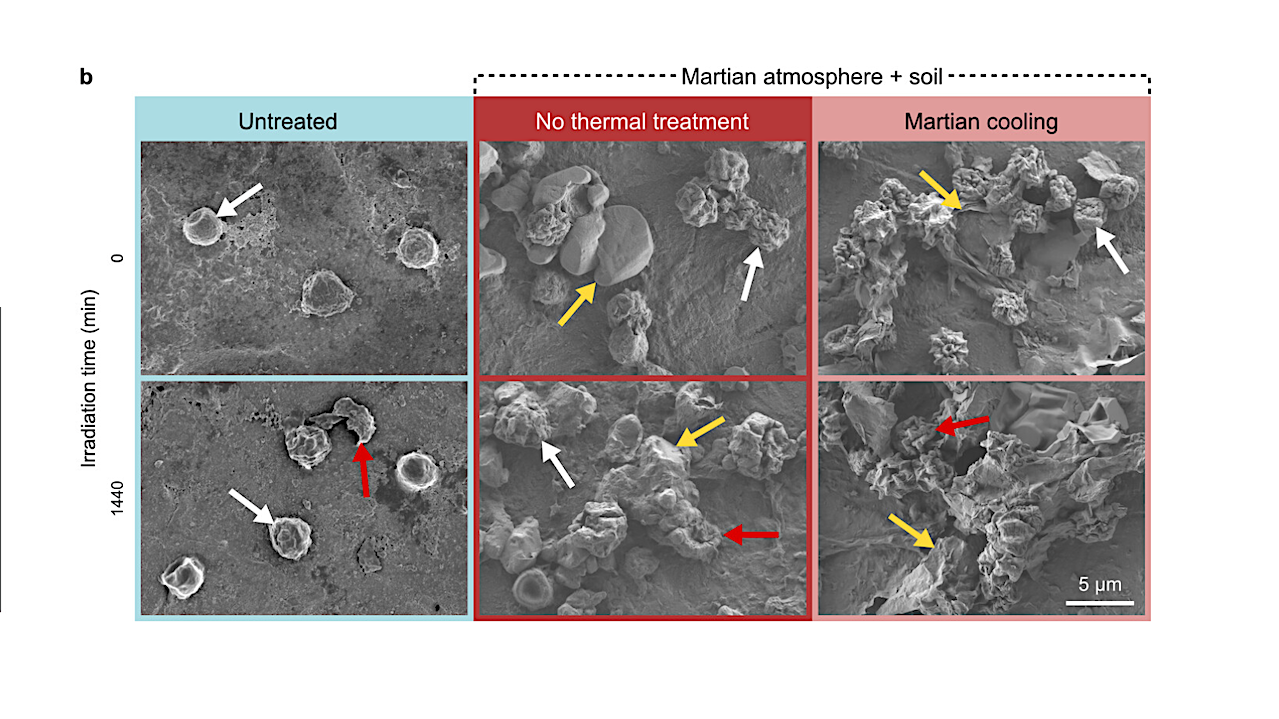
SEM images demonstrating the morphological changes of A. calidoustus conidia during exposure to SMC (irradiation, atmosphere, regolith, and cooling). White arrows indicate intact conidia, red arrows indicate lysed conidia, and yellow arrows indicate soil particles. Scale bar equals 5 µm. — Environmental Microbiology
Planetary protection hinges on understanding microbial survival following reduction procedures, the stressors of space travel, and exposure to extraterrestrial environmental conditions.
This study identified 23 fungal strains isolated from NASA spacecraft assembly cleanrooms, capable of surviving ultraviolet radiation exposure. Using experimental simulation facilities, we conducted a comprehensive assessment of microbial survivability and morphology on the most resilient spacecraft-associated microorganisms.
Aspergillus calidoustus demonstrated remarkable survival under simulated Martian conditions, withstanding up to 1,440 min of Martian solar irradiation, Mars atmospheric pressure and composition, and the presence of Martian regolith.
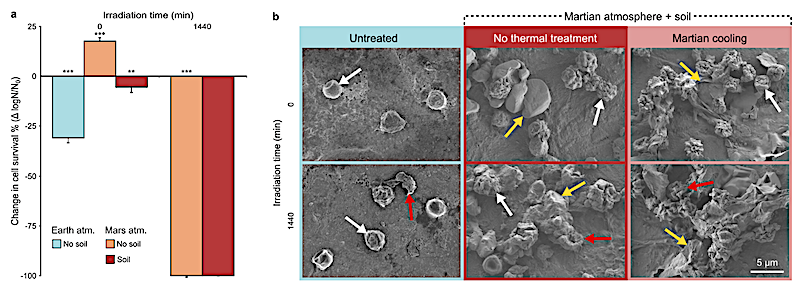
Influence of simulated Martian temperature on the survival and morphology of A. calidoustus conidia. (a) Change in mean survival induced by 1,440 min of Martian cooling in pure dried microbial cell samples (light red) or dried cells mixed with Martian regolith (dark red). Simultaneous to Martian cooling, samples were exposed to up to 1,440 min of simulated Martian solar irradiation and Martian atmosphere. This was compared against unirradiated pure-cell samples, under an Earth atmosphere (light blue). n = 3 and error bars represent standard deviation. Asterisks indicate treatments that statistically differ from their non-thermally treated equivalent, as determined by a one-way ANOVA (*, P < 0.05; **, P < 0.01; ***, P < 0.001). (b) SEM images demonstrating the morphological changes of A. calidoustus conidia during exposure to SMC (irradiation, atmosphere, regolith, and cooling). White arrows indicate intact conidia, red arrows indicate lysed conidia, and yellow arrows indicate soil particles. Scale bar equals 5 µm. — Environmental Microbiology
Lethality only occurred under combined irradiation and cooling to -60°C (the mean Mars surface temperature), emphasizing the synergistic effect of these conditions. Furthermore, A. calidoustus survived long-duration neutron radiation exposure (replicating ionizing space radiation doses) and dry-heat microbial reduction technique (typically used for spacecraft components).
This is the first study to perform an end-to-end evaluation of eukaryotic microbial survival across conditions that occur during preparation for, travel to, and robotic exploration of Mars. The experimental facilities and chronic exposure methods utilized offer a biologically meaningful model for understanding microbial risks during long-duration space missions.
The capacity for fungal conidia to survive multiple space-relevant conditions suggests their potential as forward contaminants, capable of being transported to and persisting on Mars. As current spacecraft microbial reduction protocols prioritize bacterial spores, this research highlights a critical gap in planetary protection strategies. In addition to offering novel insights into microbial survival, these findings have broader implications for biocontamination within the food, pharmaceutical, and medical sectors.
IMPORTANCE
This study reveals that conidia of the fungus Aspergillus calidoustus, which was isolated from spacecraft assembly cleanrooms, can survive simulated space-relevant stressors like ultraviolet irradiation, Martian cold atmospheric pressure, regolith exposure, ionizing radiation, and specific doses of recommended dry-heat microbial reduction method for spacecraft.
Such fungal resistance demonstrates that the species can survive certain space and Mars conditions previously thought to be sterilizing, highlighting a need to revise current spacecraft decontamination standards that focus mainly on bacterial spores.
This study also emphasizes the need for continued microbial monitoring of spacecraft during transit from Earth to other planets, not only to achieve goals of planetary protection but also to maintain healthy closed systems for human missions.
Moreover, fungal species are highlighted as biocontamination risks for food, medical, and pharmaceutical industries, which may require the need for new standards of sterilization approaches transferable to space exploration.
Astrobiology, microbiology,










Related Posts
Stay Informed With the Latest & Most Important News
Previous Post
Next Post

Advertisement
-
 01Two Black Holes Observed Circling Each Other for the First Time
 -
 02From Polymerization-Enabled Folding and Assembly to Chemical Evolution: Key Processes for Emergence of Functional Polymers in the Origin of Life
 -
 03Astronomy 101: From the Sun and Moon to Wormholes and Warp Drive, Key Theories, Discoveries, and Facts about the Universe (The Adams 101 Series)
 -
 04True Anomaly hires former York Space executive as chief operating officer
 -
 05Φsat-2 begins science phase for AI Earth images
 -
 06Hurricane forecasters are losing 3 key satellites ahead of peak storm season − a meteorologist explains why it matters
 -
 07Binary star systems are complex astronomical objects − a new AI approach could pin down their properties quickly