
Now Reading: Spectrally And Spatially Resolved (sub)millimeter HCN-to-HCO+ Flux Ratios In Nearby Ultraluminous Infrared Galaxies
-
01
Spectrally And Spatially Resolved (sub)millimeter HCN-to-HCO+ Flux Ratios In Nearby Ultraluminous Infrared Galaxies

Spectrally And Spatially Resolved (sub)millimeter HCN-to-HCO+ Flux Ratios In Nearby Ultraluminous Infrared Galaxies

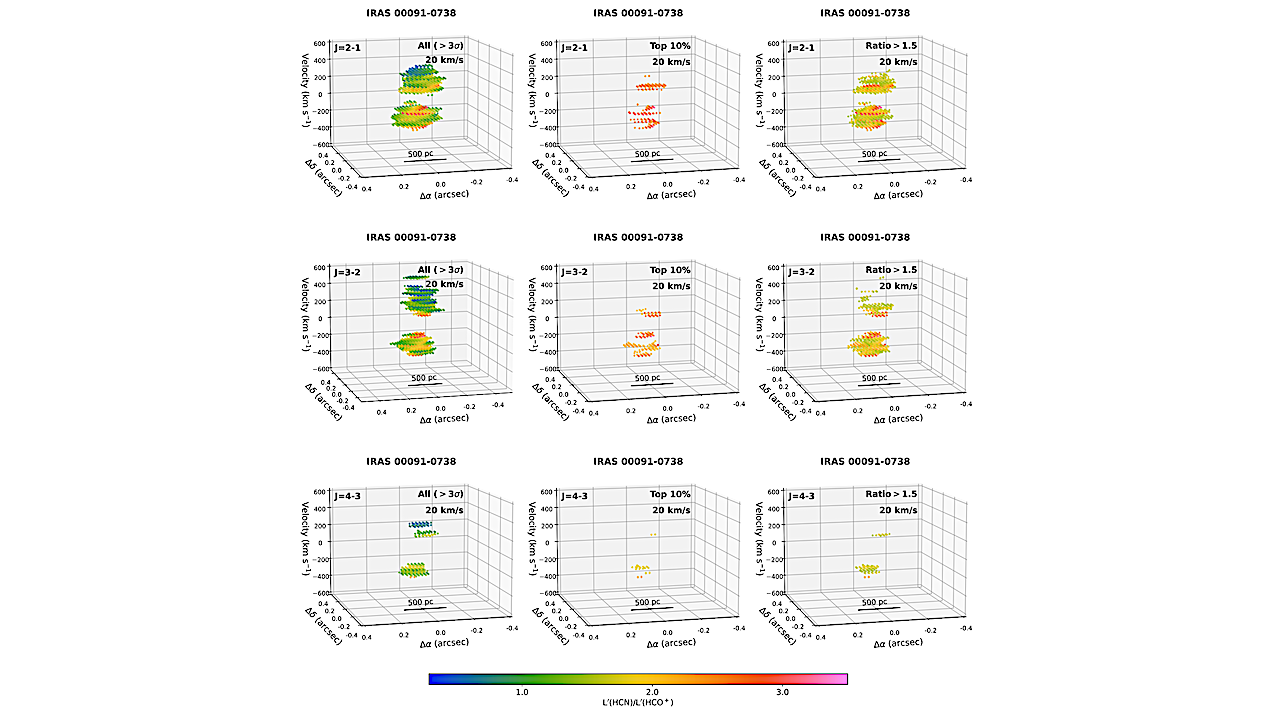
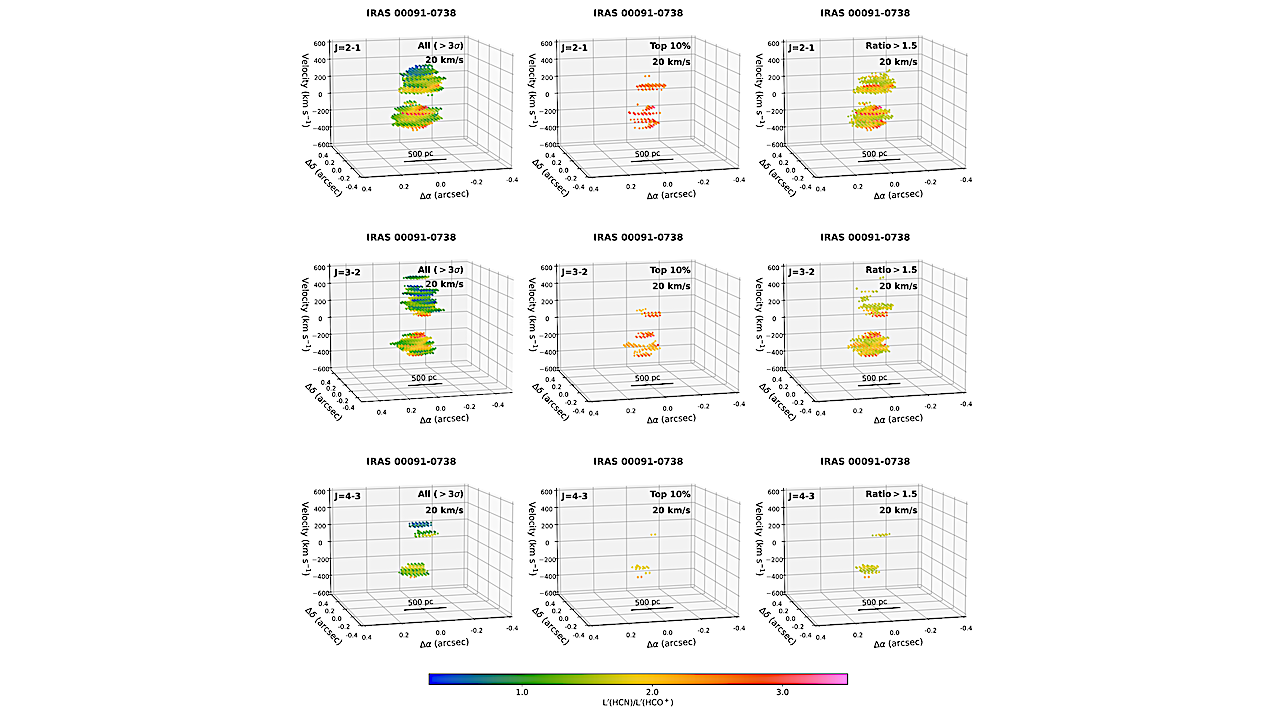
PPV plot of the (sub)millimeter HCN-to-HCO+ flux ratios at J=2–1, J=3–2, and J=4–3, with a velocity resolution of 20 km s−1 and a pixel scale of 0. ′′02 pixel−1 for IRAS 00091−0738. The HCN-to-HCO+ flux ratios are calculated in brightness temperature (K). (This is virtually identical to the ratio in flux density (Jy ∝ K × ν 2 ), because the HCN and HCO+ frequencies differ only by a factor of ∼1.006 at the same J transition.) Only data with >3σ detections in emission for both the HCN and HCO+ lines are plotted. The color bar corresponds to 0.285 (blue) to 3.5 (pink) in the same way as Nishimura et al. (2024). Left: All >3σ-detected data. Center : Data with the top 10% ratios. Right: Data with ratios >1.5. East is to the left and west is to the right along the ∆α axis. North is farther and south is nearer along the ∆δ axis. — astro-ph.GA
We present the results of our investigations of spectrally and spatially resolved (sub)millimeter HCN-to-HCO+ flux ratios at J=2-1, J=3-2, and/or J=4-3 in 18 nearby (z< 0.15) ultraluminous infrared galaxies (ULIRGs), using ALMA ≲0.2″ (≲500 pc) resolution data.
The geometry of elevated HCN-to-HCO+ flux ratios (with >3σ detections for both molecular lines) in position-position-velocity (PPV) space is visually classified into (i) spherical shell (spectrally and spatially distinct), (ii) spectrally distinct and spatially compact, and (iii) filled (spectrally filled and spatially compact).
These can naturally be explained by the elevation of the flux ratio due to (i) a spatially resolved outflow, (ii) an AGN and/or a spatially unresolved outflow with blueshifted and redshifted emission components, and (iii) an AGN and/or a spatially confined outflow with not clearly separated blueshifted and redshifted velocity components, respectively.
Signatures of elevated HCN-to-HCO+ flux ratios originated from (a) spatially resolved outflow and (b) AGN and/or spatially unresolved outflow are seen in seven and nine ULIRGs, respectively. In the former spatially resolved outflow-origin case, modest-velocity components relative to the maximum outflow velocity tend to be probed by spaxels with elevated HCN-to-HCO+ flux ratios.
The spectrally and spatially resolved HCN-to-HCO+ flux ratios can provide additional information on the physical origin of the elevated flux ratios in nearby ULIRG nuclei, compared to previously conducted spatially integrated and/or velocity-integrated analyses.
Masatoshi Imanishi (1), Yuri Nishimura (2), Shunsuke Baba (3), Kouichiro Nakanishi (1), Takuma Izumi (1) ((1) NAOJ, (2) University of Tsukuba, (3) JAXA)
Comments: 24 pages, 9 figures. ApJ accepted
Subjects: Astrophysics of Galaxies (astro-ph.GA)
Cite as: arXiv:2605.06842 [astro-ph.GA] (or arXiv:2605.06842v1 [astro-ph.GA] for this version)
https://doi.org/10.48550/arXiv.2605.06842
Focus to learn more
Submission history
From: Masatoshi Imanishi
[v1] Thu, 7 May 2026 18:46:44 UTC (13,320 KB)
https://arxiv.org/abs/2605.06842
Astrobiology, Astrochemistry,










Related Posts

Stay Informed With the Latest & Most Important News
Previous Post
Next Post



Advertisement
-
 01Two Black Holes Observed Circling Each Other for the First Time
 -
 02From Polymerization-Enabled Folding and Assembly to Chemical Evolution: Key Processes for Emergence of Functional Polymers in the Origin of Life
 -
 03Astronomy 101: From the Sun and Moon to Wormholes and Warp Drive, Key Theories, Discoveries, and Facts about the Universe (The Adams 101 Series)
 -
 04True Anomaly hires former York Space executive as chief operating officer
 -
 05Φsat-2 begins science phase for AI Earth images
 -
 06Hurricane forecasters are losing 3 key satellites ahead of peak storm season − a meteorologist explains why it matters
 -
 07Binary star systems are complex astronomical objects − a new AI approach could pin down their properties quickly