
Now Reading: Seasonal Insolation Variability On Early Venus: Implications For Energy Budget
-
01
Seasonal Insolation Variability On Early Venus: Implications For Energy Budget


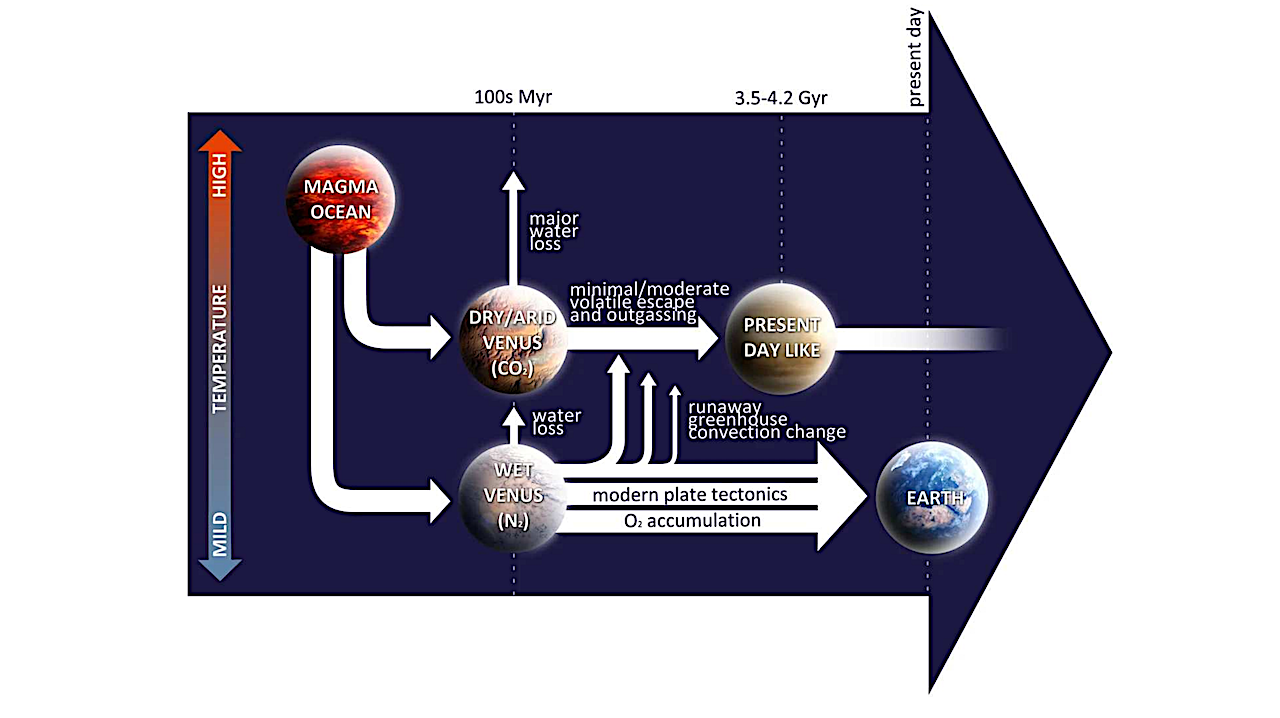
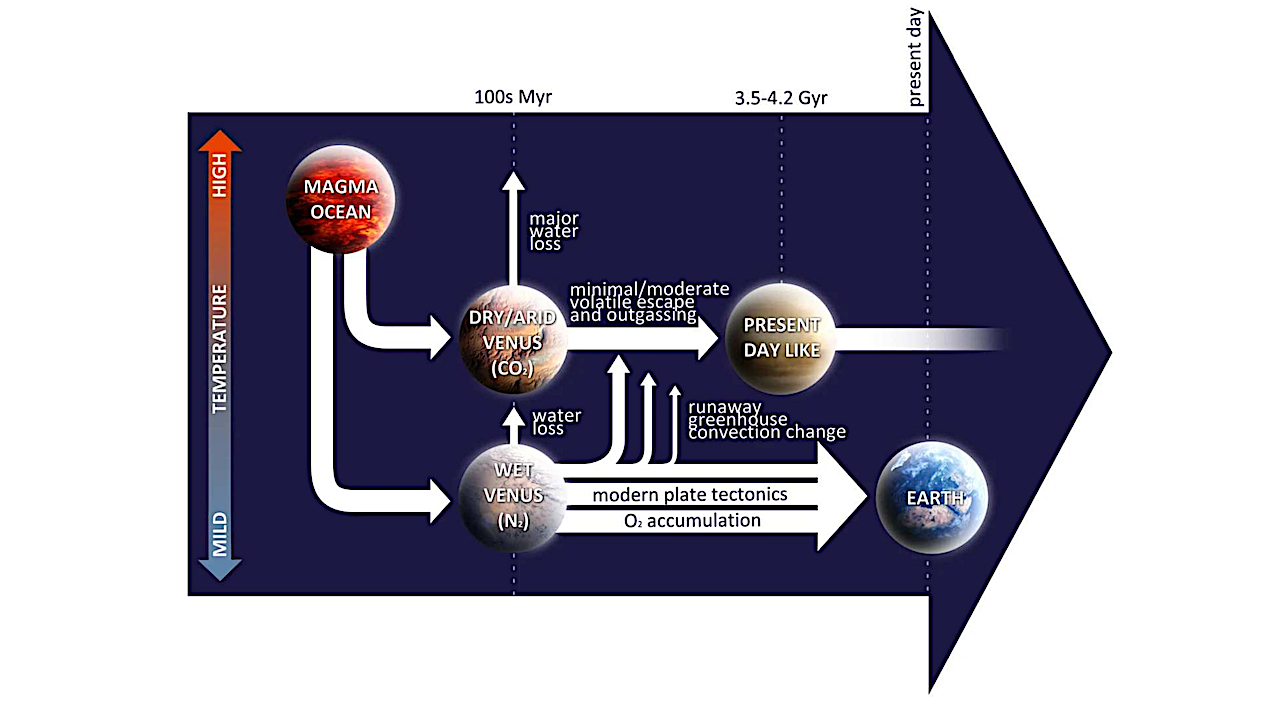
Representation of possible evolutionary pathways for Venus to its present state, starting with a magma ocean phase. The top pathway is for the case where Venus lost much of its water inventory early, while the bottom pathway considers an extended period of surface liquid water until the climate was destabilized. Figure reproduced from Gillmann et al. (2022). — astro-ph.EP
Venus and Earth are similar in bulk properties yet followed dramatically different climatic trajectories.
Reconstructing Venus’s climate evolution requires understanding how rotation, obliquity, eccentricity, and solar luminosity shaped incident energy and the atmospheric response. Here we present latitude-orbital phase maps of incident solar flux for Venus at the present epoch and at an age of 0.5 Gyr, when the Sun was fainter and Venus may have occupied a different dynamical state.
We explore slow- and fast-rotator regimes, moderate obliquity (10deg), and elevated eccentricity (e=0.15-0.30), motivated by dynamical studies of plausible limits. To translate flux maps into climate-relevant quantities, we apply an idealized atmospheric energy-balance framework with global (0-D) and latitude-dependent (1-D) formulations calibrated to modern Venus.
This framework defines a radiative relaxation timescale that links forcing variability to thermal response. The resulting diagnostics connect orbital forcing to surface energy balance and assess seasonal and orbital variability relative to Venus’s extreme greenhouse state. Our results show that early Venus could experience substantial redistribution of insolation across latitude and orbital phase, but orbit-averaged incident flux varies only modestly across the explored parameter space, leaving atmospheric opacity as the dominant control on surface temperature.
Insolation variations therefore act mainly as modulators rather than primary drivers of climate state, with their expression governed by the competition between forcing and radiative adjustment timescales. The insolation maps and response diagnostics provide boundary conditions for future 3-D climate simulations of early Venus, including regimes in which temperate surface conditions may have been sustained.
Stephen R. Kane
Comments: 17 pages, 6 figures, 1 table, accepted for publication in Astrophysics and Space Science (Astronomy Awardees Prize Collection)
Subjects: Earth and Planetary Astrophysics (astro-ph.EP)
Cite as: arXiv:2605.11089 [astro-ph.EP] (or arXiv:2605.11089v1 [astro-ph.EP] for this version)
https://doi.org/10.48550/arXiv.2605.11089
Focus to learn more
Submission history
From: Stephen Kane
[v1] Mon, 11 May 2026 18:00:47 UTC (1,046 KB)
https://arxiv.org/abs/2605.11089
Astrobiology,










Related Posts
Stay Informed With the Latest & Most Important News
Previous Post
Next Post
Advertisement
-
 01Two Black Holes Observed Circling Each Other for the First Time
 -
 02From Polymerization-Enabled Folding and Assembly to Chemical Evolution: Key Processes for Emergence of Functional Polymers in the Origin of Life
 -
 03Astronomy 101: From the Sun and Moon to Wormholes and Warp Drive, Key Theories, Discoveries, and Facts about the Universe (The Adams 101 Series)
 -
 04True Anomaly hires former York Space executive as chief operating officer
 -
 05Φsat-2 begins science phase for AI Earth images
 -
 06Hurricane forecasters are losing 3 key satellites ahead of peak storm season − a meteorologist explains why it matters
 -
 07Binary star systems are complex astronomical objects − a new AI approach could pin down their properties quickly