
Now Reading: Jielong-3 launches internet test satellite, Kinetica-1 lofts 8 remote sensing sats
-
01
Jielong-3 launches internet test satellite, Kinetica-1 lofts 8 remote sensing sats


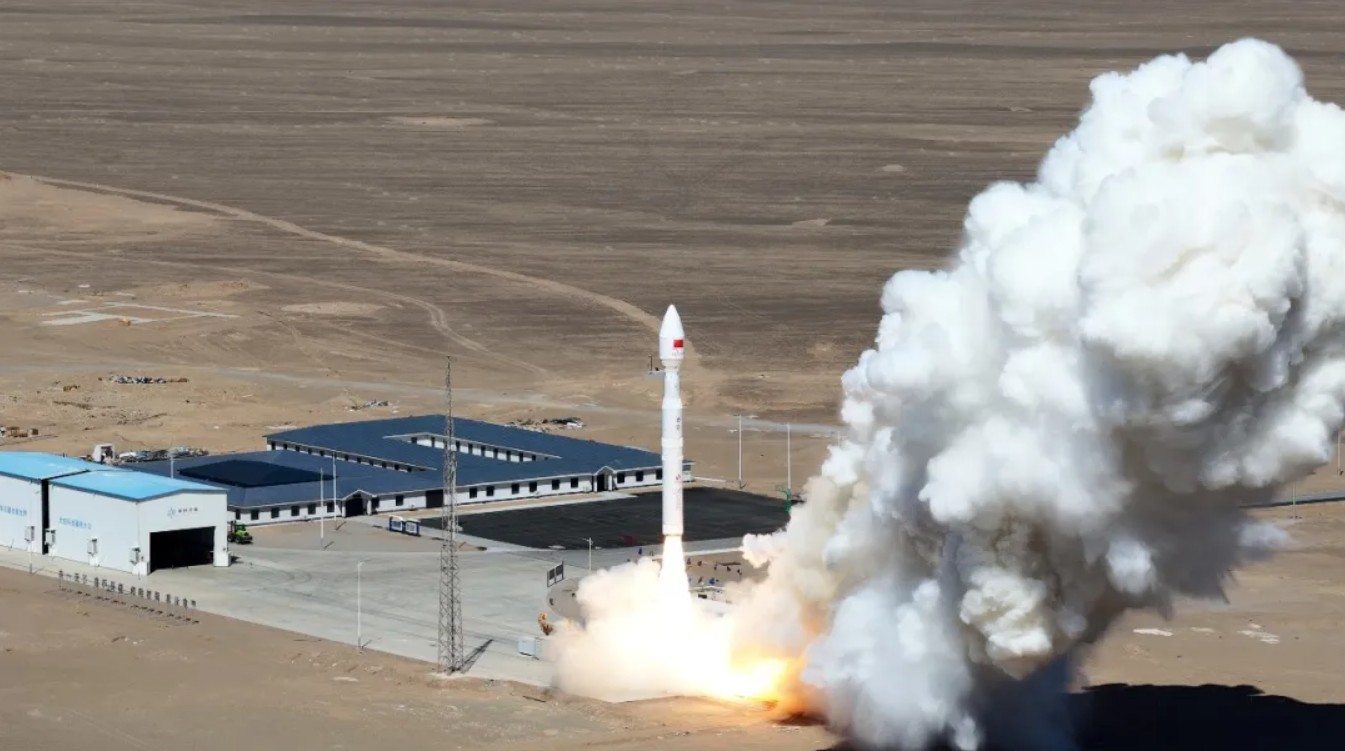

HELSINKI — A pair of solid rocket launches have added to China’s satellite internet and commercial remote sensing capabilities, sending a total of nine satellites into orbit.
The two launches, taking place off the coast of Guangdong province and Jiuquan spaceport, northwest China, include an opaque satellite internet technology test satellite, likely related to the national Guowang broadband megaconstellation, and eight satellites for the commercial Jilin-1 optical remote sensing constellation.
The Jielong-3 lifted off at 7:32 a.m. Eastern (1132 UTC) April 11 from the converted barge Dong Fang Hang Tian Gang in the South China Sea off the coast of Guangdong province. A “jellyfish” effect associated with the twilight launch was observed in the region.
The launch, indicated via navigational warnings, was later declared successful by the China Aerospace Science and Technology Corporation (CASC). The payload for the mission was described as a “weixing hulianwang jishu shiyan weixing” (satellite internet technology test satellite).
This designation has been used for a number of launches to low Earth orbits, with no images or details released regarding their purposes, payloads or capabilities. Possibly related satellites have also been launched to geostationary orbit. The missions are thought to be related to the Guowang national broadband megaconstellation project, which currently has 168 operational phase satellites in orbit, and is planned to consist of around 13,000 satellites in various shells in low Earth orbit.
The launch was the 11th for the 31-meter-long, four-stage Jielong-3 solid rocket, all of which have been sea launches and have been successful. Sea-based launches provide China with greater flexibility in launch azimuths and help alleviate congestion at inland spaceports as the country’s launch cadence continues to grow.
Kinetica-1 launch
The Jielong-3 mission was followed by another solid rocket launch, this time operated by CAS Space, a commercial spinoff from the state’s Chinese Academy of Sciences (CAS).
A Kinetica-1 solid rocket lifted off at 12:03 a.m. Eastern (0403 UTC) April 14 from the Dongfeng Commercial Aerospace Innovation Test Zone at Jiuquan Satellite Launch Center in the Gobi Desert.
The successful launch sent eight satellites into orbit for Chang Guang Satellite Technology (CGST), another CAS commercial spinoff based in China’s northeast. The payloads were part of CGST’s Jilin-1 constellation Gaofen-07 series, specifically the A02–A04, B02–04, and C02–03 satellites. These satellites, branded as part of a “Jixing” sub-series within the Jilin-1 constellation, are designed for rapid-response imaging tasks, including hotspot monitoring, stereo mapping, and space object observation, and are capable of acquiring imagery with sub-0.5 metre resolution. CGST also states the satellites feature advanced onboard processing, autonomous mission planning, and in-orbit AI algorithm updates.
Jixing Gaofen-07A03 is additionally described as a high-precision optical remote sensing platform developed by CGST in partnership with the Postal Savings Bank of China.
The Kinetica-1 has launched 92 satellites into space, with a total payload mass exceeding 12 tons, according to CAS Space. The launcher’s debut flight took place in July 2022, and suffered a failure on its sixth launch, in December 2024. The rocket has now flown 12 times.
The launch follows the successful debut of the kerosene-liquid oxygen Kinetica-2 March 30, also launched from Dongfeng Commercial Aerospace Innovation Test Zone.
The launches were China’s 22nd and 23rd orbital launch attempts of 2026, including three failures, most recently of the first Tianlong-3 rocket. The country is reported to be aiming to launch around 140 times this year, which would require an average of more than 10 launches a month. China’s launch activity typically slows around the Chinese New Year holiday, and accelerates in the second half of the year.
Upcoming launch activity includes planned Long March 2D and Long March 3B launches from Jiuquan and Xichang, southwest China, respectively, while the reusable Long March 10B rocket could make its debut flight before the end of the month, having recently undergone tests at Hainan commercial spaceport.










Related Posts
Stay Informed With the Latest & Most Important News
Previous Post
Next Post
Advertisement
-
 01Two Black Holes Observed Circling Each Other for the First Time
 -
 02From Polymerization-Enabled Folding and Assembly to Chemical Evolution: Key Processes for Emergence of Functional Polymers in the Origin of Life
 -
 03Astronomy 101: From the Sun and Moon to Wormholes and Warp Drive, Key Theories, Discoveries, and Facts about the Universe (The Adams 101 Series)
 -
 04True Anomaly hires former York Space executive as chief operating officer
 -
 05Φsat-2 begins science phase for AI Earth images
 -
 06Hurricane forecasters are losing 3 key satellites ahead of peak storm season − a meteorologist explains why it matters
 -
 07Binary star systems are complex astronomical objects − a new AI approach could pin down their properties quickly