
Now Reading: L3Harris investing upfront in bid for Golden Dome work
-
01
L3Harris investing upfront in bid for Golden Dome work


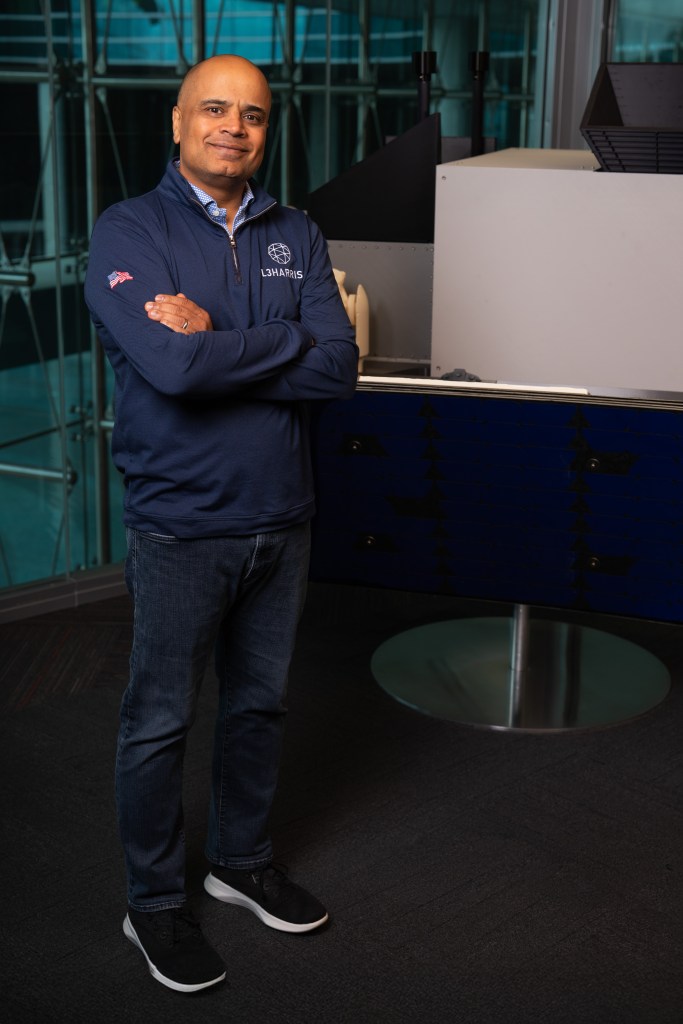
Sam Mehta, the newly appointed head of L3Harris Technologies’ space busines, is looking to recast how a traditional defense contractor competes in a market increasingly shaped by commercial speed and capital.
Mehta, who took over as president of the company’s Space & Mission Systems unit in March, said the company is directing resources toward missile-defense architectures like the Pentagon’s Golden Dome missile defense program, expected to rely heavily on space-based sensing.
The strategy breaks from a long-standing industry model: waiting for government contracts before committing capital. Instead, L3Harris says it is building capacity and securing supply chains in anticipation of demand.
“We’ve invested hundreds of millions of dollars in inventory, getting long lead parts and components on order,” he said in an interview.
He noted the company has spent about $250 million to expand production facilities across Florida, Indiana and Massachusetts, adding roughly 150,000 square feet of manufacturing space.
These moves are happening against a backdrop of criticism from venture-backed startups and policymakers who argue that defense primes are slow-moving and reluctant to take risks.
“I know the criticisms out there … I think it’s a valid criticism,” he said. “There are newer companies that want to come in and obviously break into the marketplace.”

Companies such as SpaceX and Anduril Industries have reset expectations around development timelines and capital deployment, pressing incumbents to adapt.
Mehta argued L3Harris is doing so not only through physical expansion but also through investments in digital engineering and workflow tools. “Everyone likes to see these large buildings,” he said, but the company is also investing in design and production infrastructure for a new generation of engineers.
The company enters the missile-tracking market with an established position. L3Harris has contracts to build low-Earth orbit tracking satellites for the Space Development Agency and is one of the prime contractors in the Missile Defense Agency’s Hypersonic and Ballistic Tracking Space Sensor program, aimed at persistent tracking of maneuvering missiles.
Still, Mehta is seeking to broaden the company’s role. A central focus is infrared sensing, a key component of missile warning systems. Rather than tying those payloads to specific satellite programs, L3Harris is positioning itself as a merchant supplier.
“We don’t have the luxury … to be able to hold them close and say we’re not going to support other folks,” he said. “We need to be able to work with everybody.”
The shift reflects a more open posture toward both established primes and newer entrants, as the Pentagon moves toward multi-vendor architectures.
Mehta is also looking to extend L3Harris’ ground-base tactical communications business into space-enabled networks. The company is a major supplier of tactical radios and battlefield networking systems, equipment that provides the “last mile” connectivity linking troops, vehicles and command centers.
It is now exploring how commercial satellite constellations could augment those systems. L3Harris announced a partnership in 2025 with Amazon’s planned low-Earth orbit network to evaluate options such as hosted payloads and secure communications links.
Mehta described scenarios where tactical radios could connect through terminals to commercial LEO constellations, extending encrypted communications beyond line of sight.










Related Posts
Stay Informed With the Latest & Most Important News


Advertisement
-
 01Two Black Holes Observed Circling Each Other for the First Time
 -
 02From Polymerization-Enabled Folding and Assembly to Chemical Evolution: Key Processes for Emergence of Functional Polymers in the Origin of Life
 -
 03Astronomy 101: From the Sun and Moon to Wormholes and Warp Drive, Key Theories, Discoveries, and Facts about the Universe (The Adams 101 Series)
 -
 04True Anomaly hires former York Space executive as chief operating officer
 -
 05Φsat-2 begins science phase for AI Earth images
 -
 06Hurricane forecasters are losing 3 key satellites ahead of peak storm season − a meteorologist explains why it matters
 -
 07Binary star systems are complex astronomical objects − a new AI approach could pin down their properties quickly