
Now Reading: Moon’s lunar soil reveals organic clues to Earth’s origins of life
-
01
Moon’s lunar soil reveals organic clues to Earth’s origins of life


Recent research has unveiled that the Moon might hold essential clues regarding the origins of life on Earth, thanks to the organic materials found within its lunar soil. Analysis of samples retrieved by China’s Chang’e missions has uncovered a variety of organic compounds, offering unique insights into the chemical dynamics of the early Solar System, a history largely lost from our home planet.
This groundbreaking discovery stems from the material collected during the Chang’e-5 mission in 2020 and the Chang’e-6 mission in 2024, both of which returned samples from the Moon’s surface. Advanced analytical methods were employed to detect nitrogen-rich organic matter in various forms, including tiny particles, thin coatings, and inclusions within minerals. Most of these organic features measure just a few micrometers or smaller in size. The analysis revealed that these compounds primarily consist of carbon, nitrogen, and oxygen, existing mainly in an amorphous state rather than being crystalline. Notably, some samples exhibited amide group structures, indicating a notable complexity in their chemical makeup and suggesting that the lunar organic compounds have undergone some degree of transformation.
While these findings do not imply the presence of life, they do point to the existence of simple carbon-based molecules, often considered the building blocks of biological processes. The importance of their presence on the Moon lies in the relatively unchanged record they provide of the mechanisms that reshaped and distributed organic material in the early Solar System.
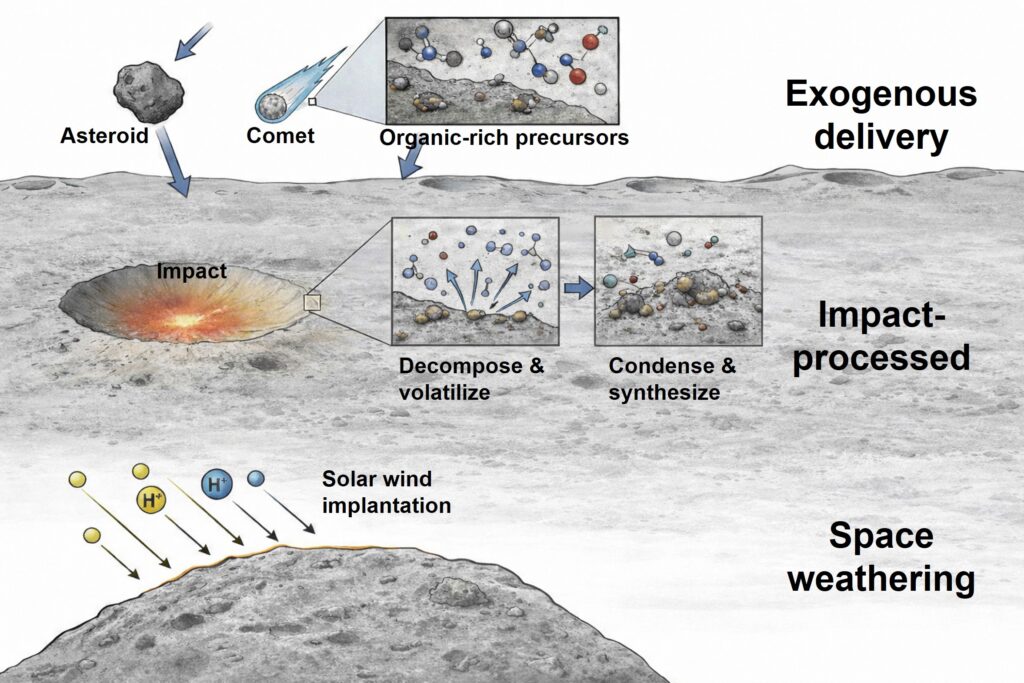
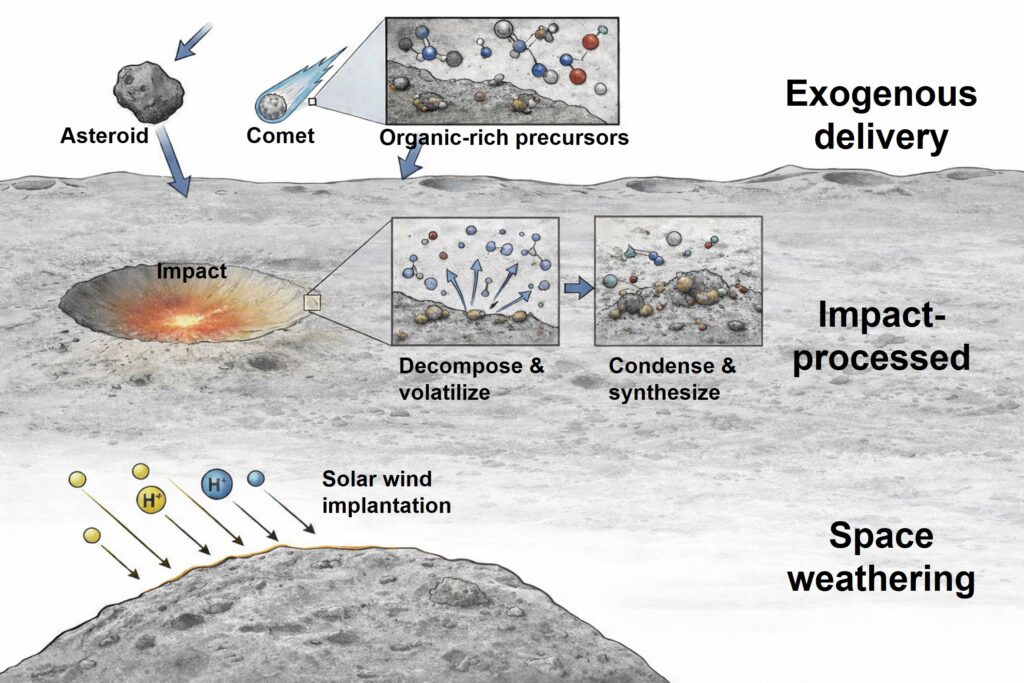
The research team proposes that this organic material likely originated from asteroids and comets that collided with the Moon over billions of years. Given the Moon’s heavily cratered surface, these impacts have consistently delivered organic carbon to its regolith. In contrast to Earth, where geological activity continuously recycles and obliterates ancient records, the Moon’s surface has largely remained stable, albeit with signs of some alteration.
Isotopic analysis further supports the idea of dynamic processing occurring on the Moon. Researchers discovered that the ratios of hydrogen, carbon, and nitrogen isotopes in the lunar samples are lighter than those typically found in carbon-rich meteorites, suggesting that the organic material experienced modifications after its arrival. This alteration likely occurred through cycles of impact-induced heating, which caused some material to break down and vaporize, only to re-condense on surface minerals and form new compounds containing nitrogen and oxygen.
Additionally, researchers found evidence of “solar wind implantation,” marking the first identification of this phenomenon in lunar organic matter. This process involves charged particles from the Sun embedding themselves into the upper layers of lunar grains. The variations in isotopes and elemental ratios near the surfaces of these grains suggest that solar wind interactions had a significant impact, supporting the idea that these materials are not contaminated by Earth.
By acting as a “time capsule,” the Moon preserves a record of the evolution of organic matter under the conditions of space. Analyzing these samples in detail could help scientists recreate how life’s building blocks were distributed throughout the Solar System and transformed prior to their journey to planets like Earth.
This study underscores the rising significance of sample-return missions, as laboratory analysis of pristine materials offers invaluable insights into their chemical structures, far surpassing what remote observations or on-site experiments can achieve. With more lunar samples expected from future missions, the Moon is set to play a vital role in enhancing our understanding of the chemical processes that may have led to life on Earth. The research was led by scientists from the Institute of Geology and Geophysics of the Chinese Academy of Sciences, alongside collaborators from institutions such as the University of New Mexico and Changsha University of Science and Technology. Their findings were published in Science Advances on April 8.










Related Posts

Stay Informed With the Latest & Most Important News
Previous Post
Next Post

Advertisement
-
 01Two Black Holes Observed Circling Each Other for the First Time
 -
 02From Polymerization-Enabled Folding and Assembly to Chemical Evolution: Key Processes for Emergence of Functional Polymers in the Origin of Life
 -
 03Astronomy 101: From the Sun and Moon to Wormholes and Warp Drive, Key Theories, Discoveries, and Facts about the Universe (The Adams 101 Series)
 -
 04True Anomaly hires former York Space executive as chief operating officer
 -
 05Φsat-2 begins science phase for AI Earth images
 -
 06Hurricane forecasters are losing 3 key satellites ahead of peak storm season − a meteorologist explains why it matters
 -
 07Binary star systems are complex astronomical objects − a new AI approach could pin down their properties quickly